Two Assisted Routes for Difficult Materials: Cryogenic Cooling vs Laser Assist
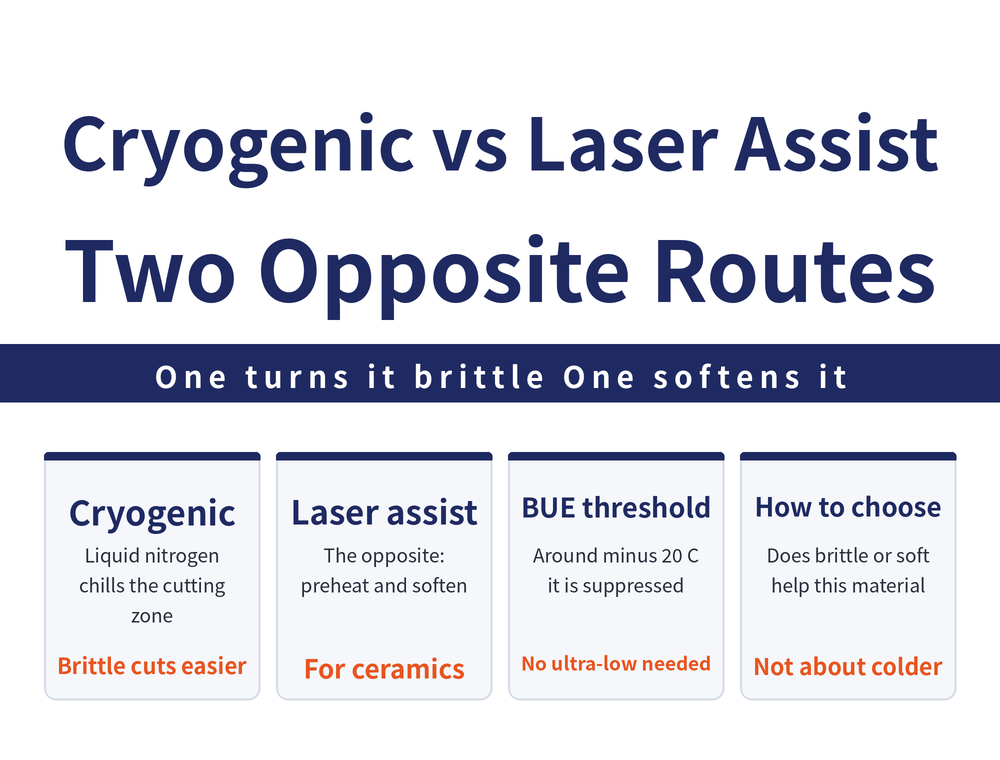
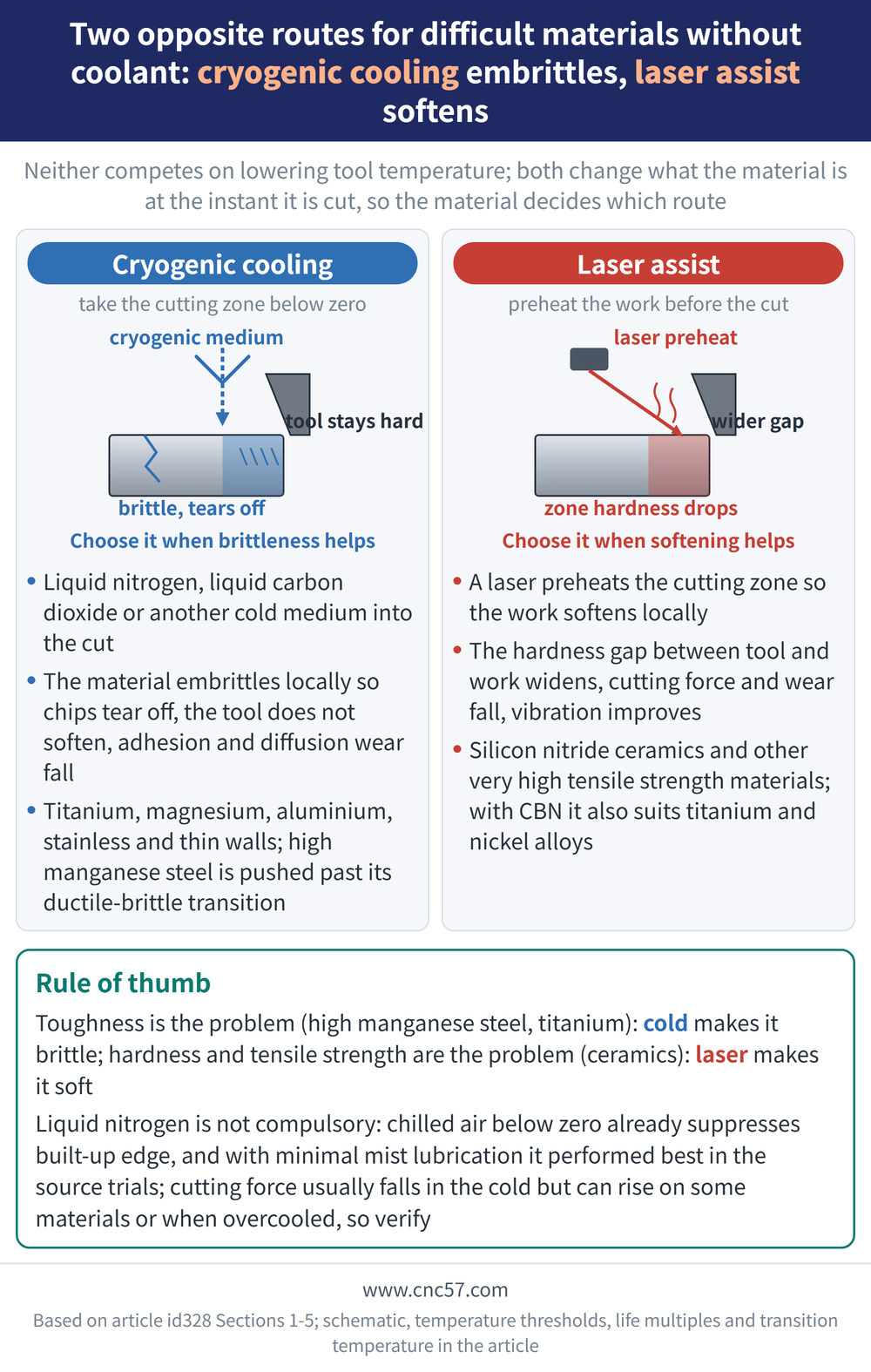
When difficult materials have to be cut without coolant, there are two routes pointing in opposite directions: chill the cutting zone below zero so the material turns brittle and the tool stays hard, or preheat the workpiece with a laser so it softens before the cut. Neither is cooling in the conventional sense — both actively change how the material behaves at the instant of cutting.
1. Two routes that point opposite ways
When difficult materials are cut dry, relying on the tool material alone to survive the heat has a limit. Hard turning is one route — using tool heat resistance to replace grinding at room temperature, see the hard turning guide. When the material itself is the problem, two further "active intervention" methods exist:
| Method | What it does | Why it works |
|---|---|---|
| Cryogenic cooling | Chills the cutting zone below zero | Material turns locally brittle and tears more easily; tool does not soften |
| Laser assist | Preheats the workpiece ahead of the cut | Hardness in the cutting zone falls, widening the tool-to-work hardness gap |
Note what they share: neither competes on "lowering tool temperature" — both change how the material behaves at the moment it is removed. That also decides the choice: does brittleness help you, or does softening?
2. Cryogenic cooling: brittle material, hard tool
Cryogenic cooling delivers liquid nitrogen (around -186°C), liquid carbon dioxide (around -76°C) or another low-temperature medium into the cutting zone. It does two things at once: it makes the workpiece locally brittle so chips tear away with less cutting load, and it prevents the tool itself from softening, reducing friction, adhesion and diffusion wear. It suits titanium, magnesium, aluminium, molybdenum and stainless steel, along with thin-walled parts.
Magnitudes reported by the source (all single-source measurements, dependent on process conditions): cutting temperature in steel can fall by three to four hundred degrees, in titanium alloy by two to three hundred; tool life in heat-resistant steel can more than double, and in stainless steel rise three to five times. Passive and feed forces show reductions in the twenty to thirty percent range — but there is a counter-case: with certain materials, or when the temperature goes too low, material hardness rises instead and cutting force can increase. It is not a universal rule.
The most useful number for surface quality is a threshold: at a workpiece temperature around -20°C the built-up edge is largely suppressed, and below -20°C it disappears. For identifying built-up edge against other wear modes, see the tool wear analysis guide.
3. Five ways cryogenic cooling is classified
| By | Categories | Trade-off |
|---|---|---|
| Temperature | Near-ambient 2–6°C / low 0 to -30°C / ultra-low below -50°C | Lower costs more |
| Continuity | Continuous / intermittent | Continuous works better |
| Target | Cool the tool / cool the workpiece | Depends where the bottleneck is |
| Form | Internal / external | Internal gives uniform temperature, works better |
| Refrigeration | Mechanical / chemical / electronic | Depends on shop supply |
A more practical tier on cost is chilled air machining: holding the gas below -20°C is enough, with no liquid nitrogen involved. In one source trial machining high-silicon aluminium pistons, -30°C chilled air combined with minimal vegetable-oil mist gave the lowest tool wear — lowering cutting zone temperature and cutting friction at the same time beat either measure alone. For the positioning of minimal quantity lubrication, see how to choose cutting fluid.
4. High manganese steel: cold turns "difficult" into "cuttable"
High manganese steel is a classic difficult-to-cut material: turned with ordinary carbide at room temperature, cutting speed stays in a very low band and tool life is short. Its decisive property is a ductile-brittle transition temperature around -40°C: source measurements take impact toughness at 20°C as the baseline, falling to roughly half at -40°C and to under a tenth at -100°C.
So cryogenic cooling does more than lower temperature here — it pushes the material past its ductile-brittle transition, turning a material that would deform plastically and stick to the edge into one that tears in a brittle manner. The source comparison also shows cutting force varying more smoothly and stably with speed at low temperature, against clear fluctuation at room temperature: less shock on the edge, longer tool life.
5. Laser assist: the opposite solution
Laser assist runs the reverse logic: a laser preheats the cutting zone, raising local workpiece temperature and lowering hardness there, widening the hardness gap between tool and workpiece and thereby reducing cutting force and tool wear.
The classic target is silicon nitride ceramic and similar materials of extremely high tensile strength, where any tool cutting directly will fail quickly. The source reports that laser assist softens the material locally, bringing tensile strength down to roughly half its original magnitude, so cutting resistance drops substantially, tool wear falls sharply and vibration in dry cutting improves markedly; and because surface defects are reduced, laser-assisted turned specimens actually show higher fracture strength than ground specimens. CBN and other superhard materials suit the tool side, and the method also applies to titanium and nickel-based alloys. See the ceramic cutting tool guide and the CBN and PCBN guide.
One equipment note is worth making: with compact high-power semiconductor-based lasers, the laser and its auxiliaries can be built into a single lathe, removing the need for separate large equipment. For the machining characteristics of titanium and superalloys, see the S-class titanium and superalloy guide.
6. Frequently Asked Questions (FAQ)
Q: Cryogenic cooling or laser assist — which should I choose?
It depends on the material. Cold makes material brittle and easier to tear, suiting high manganese steel and titanium where toughness is the difficulty; laser softens the material, suiting ceramics where hardness and tensile strength are too high.
Q: Is liquid nitrogen essential?
No. Chilled air below -20°C is enough to suppress built-up edge at far lower cost than liquid nitrogen, and combining it with minimal oil mist performed best in the source trials.
Q: Does cryogenic cooling always reduce cutting force?
Not always. It usually does, but with certain materials or when the temperature goes too low, material hardness rises and cutting force can increase instead. Verify under your actual process conditions.
Q: How cold does it need to be to eliminate built-up edge?
Source measurements show built-up edge largely suppressed at a workpiece temperature around -20°C and gone below that. The threshold is higher than most expect, so ultra-low temperatures are not required.
This article is part of Dry Machining: The Complete Guide - Losing the Coolant, and How Five Processes and Three Techniques Cope; that guide shows how the whole topic fits together.