Ceramic Cutting Tool Guide: Choosing Between Alumina, SiAlON and Whisker-Reinforced
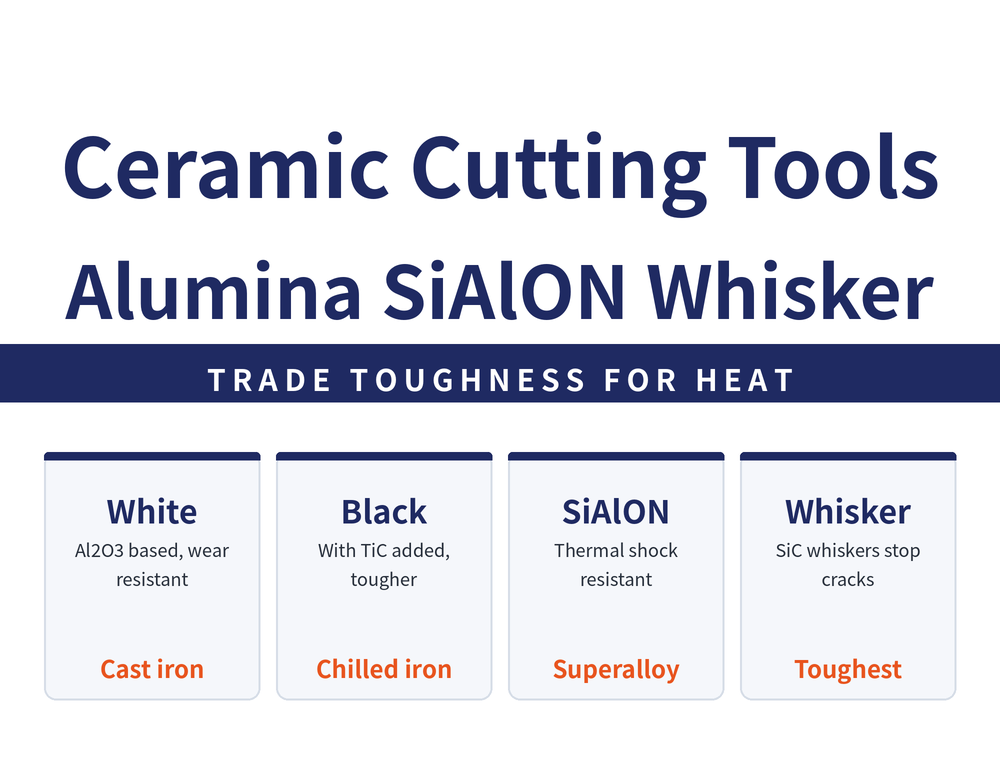
Ceramic cutting tools trade toughness for heat resistance, which is what makes high-speed dry cutting possible. Their home ground is high-speed cast iron machining and roughing of nickel-based superalloys. The three families divide the work clearly: alumina for wear resistance, silicon nitride/SiAlON for thermal shock resistance, whisker-reinforced for toughness. This guide covers how to choose between them and when not to use ceramic at all.
1. What Ceramic Tools Really Are: Toughness Traded for Heat Resistance
A ceramic insert is sintered from ceramic powder, giving hardness and hot hardness clearly above carbide (tungsten carbide sintered with cobalt, the most versatile tool material). The price is low toughness and poor impact resistance. That fixes its operating window: high speed, continuous cutting, and mostly dry.
Thermal shock: cracking caused by rapid temperature swings in the insert. A ceramic edge runs very hot at high speed, so intermittent coolant flooding quenches it over and over until it cracks and chips. That, not a lack of need for cooling, is why ceramic is normally run dry.
For the full landscape of tool materials, see Cutting Tool Materials Complete Guide; for picking a material by tool type, see Tool Material Selection by Tool Type.
2. The Alumina Family: White and Black Ceramic
Ceramic inserts are not one material but three technical routes, and knowing the family is more useful than memorising grade codes. Alumina is the most basic route, living on chemical stability and wear resistance.
| Family | Main composition | Characteristics | Typical use |
|---|---|---|---|
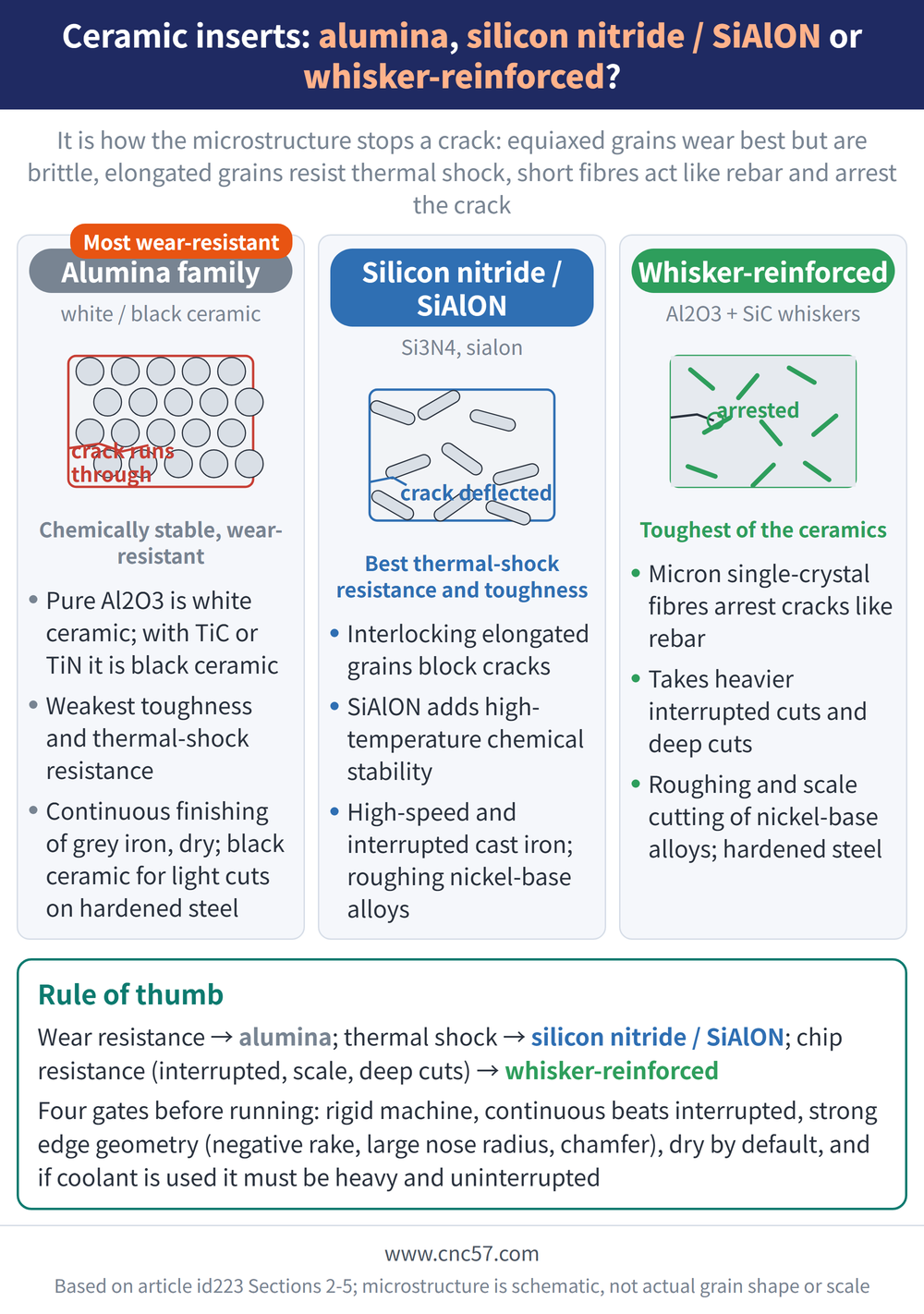
| Pure alumina (white ceramic) | Al2O3 (aluminium oxide, the basic ceramic insert matrix) | Chemically stable, wear and oxidation resistant; weakest in toughness and thermal shock | Continuous finish turning of grey cast iron, dry |
| Mixed alumina (black ceramic) | Al2O3 plus hard phases such as titanium carbide or titanium nitride | Tougher than white ceramic with better heat conduction, still wear resistant | Light continuous cuts in chilled cast iron and hardened steel |
For matching tool material to the workpiece, see Material and Coating Selection by Workpiece; for the ISO grouping logic, see Cutting Tool Material PMKNSH Classification.
3. Silicon Nitride/SiAlON and Whisker-Reinforced
The other two routes use composition or fibre reinforcement to raise toughness and thermal shock resistance; they are the reason ceramic can touch interrupted cuts and nickel-based alloys at all.
| Family | Main composition | Characteristics | Typical use |
|---|---|---|---|
| Silicon nitride / SiAlON | Si3N4 (silicon nitride); SiAlON (silicon-aluminium-oxynitride ceramic, a silicon nitride base with aluminium and oxygen in solution) | Best thermal shock resistance and toughness among ceramics; SiAlON adds high-temperature chemical stability | High-speed and interrupted cast iron work (Si3N4); nickel-based superalloy roughing (SiAlON) |
| Whisker-reinforced | Al2O3 matrix with silicon carbide whiskers (micron-scale single-crystal short fibres that arrest cracks like rebar) | Toughest of the ceramics; takes heavier interrupted cuts and larger depths of cut | Superalloy roughing, scaled surfaces, hardened steel |
Both tables above are general family-level selection comparisons, not measurements taken by this site; actual grade properties and acceptance conditions follow the manufacturer catalogue or the relevant standard.
In one line: pick alumina for wear resistance, silicon nitride/SiAlON for thermal shock resistance, whisker-reinforced against chipping.
4. Home Ground: High-Speed Cast Iron and Superalloy Roughing
Ceramic is not a general-purpose material; it clearly beats carbide in two kinds of work, both of them places where carbide cannot survive the temperature.
| Application | Suggested family | Why ceramic wins |
|---|---|---|
| High-speed turning and face milling of grey and ductile cast iron | Alumina (continuous finishing), silicon nitride (high speed and interrupted) | Cast iron gives short chips and steady cutting forces, so ceramic can run far above carbide speeds without losing hardness |
| Roughing and scale removal on nickel-based superalloys | SiAlON, whisker-reinforced | These alloys conduct heat poorly and concentrate it at the edge, softening carbide quickly; ceramic holds up on hot hardness and buys throughput with speed |
| Light continuous cuts in hardened steel | Mixed alumina, whisker-reinforced | Cheaper than CBN (cubic boron nitride, the superhard material second only to diamond), and adequate where accuracy demands are not extreme |
Ceramic can run several times carbide speed in cast iron and superalloys, but the actual figures vary widely, so never apply a generic number: decide from the tool catalogue and a trial cut. For the calculation method, see Turning Machining Formula Handbook. For workpiece-side strategy, see Cast Iron Machining Guide (ISO K) and Titanium and Superalloy Machining Guide (ISO S).
5. Prerequisites: Clear These Four Gates First
Ceramic usually fails not because the wrong family was chosen but because the machine and the cut were not right.
| Prerequisite | Requirement |
|---|---|
| 1. Machine rigidity and power | High speed plus high cutting forces demands a rigid spindle and clamping with short overhang; vibration chips the edge directly |
| 2. Continuous beats interrupted | Continuous cutting is safest; if interrupted cutting is unavoidable, switch to silicon nitride or whisker-reinforced and cut the load per edge |
| 3. Strong edge geometry | Negative rake, a larger nose radius and an edge chamfer keep a brittle material loaded mainly in compression |
| 4. Coolant policy | Dry by default; if coolant is required it must be copious and continuous, never on and off |
6. Boundaries: Ceramic, CBN or Carbide
The boundary against the other superhard materials, one line each:
| Material | Relative strength | Main territory |
|---|---|---|
| Carbide | Best toughness and versatility; handles interrupted cuts and coolant | The great majority of general steel work and low-to-medium speeds |
| Ceramic | Strong hot hardness at a lower unit cost than CBN | High-speed cast iron, superalloy roughing |
| CBN | Highest hardness and no reaction with iron; most stable on size and roughness | Finish turning of hardened steel (replacing grinding) and cast iron finishing |
This is a general comparison of tool-material roles, not measurements taken by this site; heat resistance and hardness figures are typical values, with the manufacturer catalogue or the relevant standard taking precedence.
Whether hardened steel goes to ceramic or CBN comes down to hardness and accuracy requirements — see Hard Turning Guide: Replacing Grinding at HRC45–65 and Hardness and Tool Selection Guide (HB/HRC/HV). For reading carbide grade codes, see Carbide Grade Decode Guide.
Last updated: 2026-08-08
7. Frequently Asked Questions (FAQ)
Q: Why are ceramic tools usually run without coolant?
Ceramic keeps its hardness hot and does not rely on cooling to hold an edge, but it resists thermal shock poorly, so intermittent flooding quenches the edge repeatedly until it cracks. Dry cutting is therefore the default; if coolant is needed it must be copious and uninterrupted.
Q: How do I quickly choose between alumina, SiAlON and whisker-reinforced?
Choose alumina for wear resistance in continuous cast iron cuts, SiAlON for nickel-based superalloy roughing, and whisker-reinforced whenever chipping is the risk — interrupted cuts, scaled surfaces or large depths of cut.
Q: Can ceramic tools handle interrupted cutting?
Yes, with conditions: use silicon nitride or whisker-reinforced grades, strengthen the edge with negative rake and a larger nose radius, and reduce the load per edge. For heavily interrupted work, go back to carbide.
Q: Should I pick ceramic or CBN?
Ceramic is more economical for high-speed cast iron and superalloy roughing; CBN is the choice for finish turning hardened steel where dimensional stability and low roughness matter. The decision rests on workpiece hardness and accuracy requirements, not on price alone.
This article is part of Tool Materials and Coatings: The Complete Guide - Separate Substrate From Coating, Then Work Back From the Workpiece; that guide shows how the whole topic fits together.