CBN and PCBN Tool Guide: Machining Hardened Steel and Cast Iron
CBN (cubic boron nitride) is second only to diamond in hardness and, unlike diamond, has no chemical affinity for iron — which makes it the dedicated tool material for ferrous difficult-to-cut work: hard turning of hardened steel and high-speed machining of grey cast iron. This guide covers how CBN and PCD divide the work, how to choose between low-content and high-content PCBN, and the four keys to using it.
1. What CBN Is: Second Only to Diamond, but Not Afraid of Iron
CBN (cubic boron nitride) is a synthetic superhard material, second only to diamond in hardness and heat resistance. What really established it in the market is not the hardness but the chemical stability.
Diamond has a chemical affinity for iron at high temperature and wears away rapidly; CBN does not. The split is therefore clear: ferrous materials (steel and cast iron) use CBN, while aluminium, copper, composites and other non-ferrous materials use PCD (polycrystalline diamond, a superhard tool material sintered from fine diamond grains).
PCBN (polycrystalline CBN): the insert form made by sintering CBN powder with a binder phase under high temperature and pressure and bonding it onto a carbide substrate. Almost every "CBN insert" sold in practice is physically PCBN.
For where each tool material sits on the hardness-toughness scale, see Cutting Tool Materials Complete Guide; for picking a material by tool type, see Tool Material Selection by Tool Type.
2. Low-Content vs High-Content CBN: Two Very Different Jobs
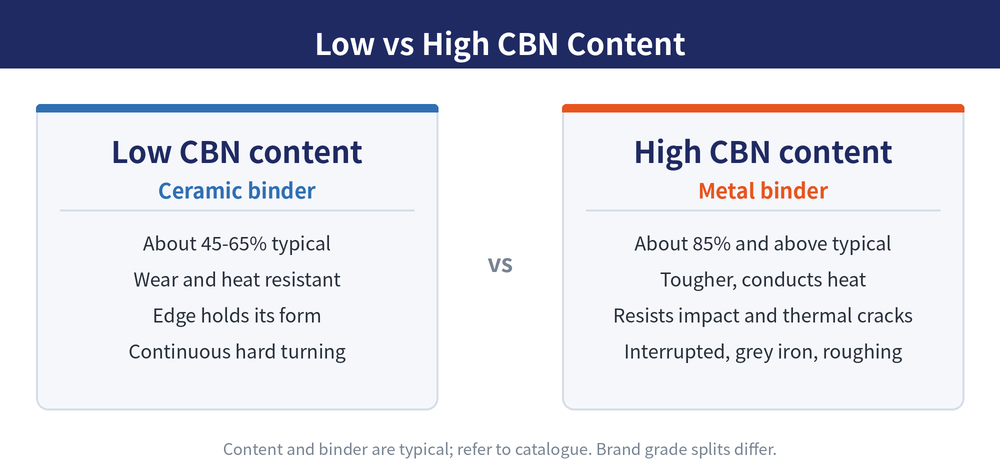
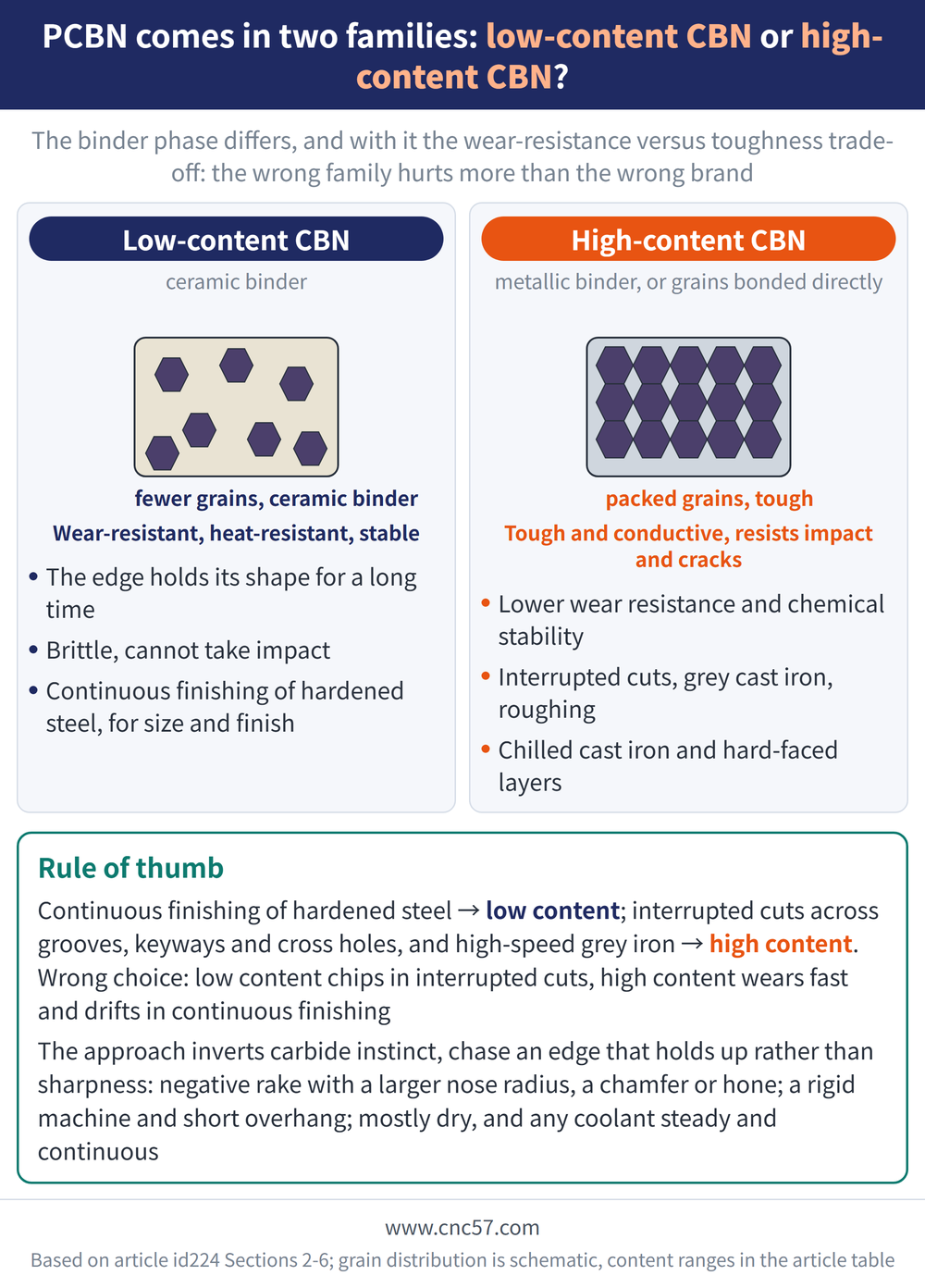
PCBN splits into two families by CBN volume content, differing in binder phase and therefore in the wear-resistance versus toughness trade-off. Picking the wrong family hurts more than picking the wrong brand.
| Criterion | Low-content CBN | High-content CBN |
|---|---|---|
| CBN volume content (typical range) | About 45–65% | About 85% and above |
| Binder phase | Ceramic binder | Metallic binder, or CBN grains bonded directly to each other |
| Main strength | Wear-resistant, heat-resistant and chemically stable; the edge holds its shape for a long time | Good toughness and thermal conductivity; resists impact and thermal cracking |
| Main weakness | More brittle, cannot take impact | Lower wear resistance and thermochemical stability |
| Typical use | Continuous finish turning of hardened steel, for size and surface quality | Interrupted cuts, grey cast iron and roughing |
| Cost of choosing wrong | Chips the edge in interrupted cutting | Wears faster in continuous finishing, size tends to drift |
Contents and binder types above are typical values; follow the catalogue or the relevant standard — not measurements taken by this site. Grade names and cut-off points differ by brand, so check the manufacturer's catalogue before purchasing.
3. Where CBN Wins: Hard Turning of Hardened Steel and High-Speed Cast Iron
CBN is not a universal tool material; it dominates only on ferrous difficult-to-cut work. To read where a workpiece sits on the hardness scale, start with the Hardness Conversion Chart.
| Workpiece material and cutting condition | Why CBN | Suggested PCBN type |
|---|---|---|
| Hardened steel, continuous finishing (bearing steel, die steel, carburised gear cases; typically HRC45–65) | Too hard for carbide inserts to cut reliably; CBN keeps its hardness hot enough to replace grinding | Low-content CBN |
| Hardened steel, interrupted cutting (grooves, keyways, cross holes) | Same hardened material, but the edge takes an impact every revolution, so toughness comes first | High-content CBN |
| Grey cast iron, high-speed machining (turning and milling) | The graphite structure cuts easily, and CBN resists wear and heat well enough for long continuous high-speed runs, clearly outlasting carbide | High-content CBN |
| Chilled cast iron, hardfacing overlays (weld overlay, thermal spray) | The surface layer is extremely hard with uneven stock; ordinary tool materials cannot hold up | High-content CBN |
For chip control and tool matching on the cast-iron side, see Cast Iron Machining Guide (ISO K); for the overall hardened-steel strategy, see Hardened Steel Machining Guide (ISO H).
4. Other Ferrous Parts and Where CBN Is Not Recommended
Away from that main ground the call changes: one case depends on how interrupted the cut is, the rest are cheaper to run with another tool material.
| Workpiece material and cutting condition | Why CBN | Suggested PCBN type |
|---|---|---|
| Sintered powder-metallurgy ferrous parts | Pores and hard spots make the structure highly abrasive; CBN wear resistance keeps size stable | Choose between the two families by how interrupted the cut is |
| Soft steel (not hardened) | Not recommended: built-up edge and abnormal wear are likely, and the cost does not pay back | Use carbide or cermet instead |
| Aluminium, copper, graphite, composites | Not recommended: non-ferrous work has no iron-affinity problem to design around | Use PCD instead |
| Titanium alloys, nickel-based superalloys | Generally not recommended: chemical affinity causes rapid wear | Use carbide or ceramic tools instead |
The two tables above give typical values for general selection direction; follow the catalogue or the relevant standard — not measurements taken by this site.
5. Give the Edge Support: Negative Rake, Larger Nose Radius, Chamfer
CBN is hard but brittle, so the approach inverts carbide instinct: do not chase sharpness, chase an edge that holds up. Start with the geometry of the insert itself.
| Key | Detail |
|---|---|
| 1. Negative rake plus a larger nose radius | Both thicken the support behind the edge so it carries the high forces of hard material; a larger nose radius raises radial force, so rigidity must back it up |
| 2. Edge chamfer or hone | Replacing the sharp edge with a supported land (T-land) or a rounded hone is the standard way to stop CBN from chipping |
6. Machine and Coolant: Rigidity, Short Overhang, Dry Cutting
Geometry alone is not enough: without a matching machine and coolant strategy, vibration and thermal shock will still chip the edge.
| Key | Detail |
|---|---|
| 3. Rigid machine, short overhang | Machine, bar and clamping all need to be rigid with overhang as short as possible; vibration is CBN's worst enemy and causes chipping rather than gradual wear |
| 4. Mostly dry cutting | CBN is heat-resistant, so dry is fine; if coolant is used it must be steady and continuous, as intermittent flooding causes thermal shock cracking |
This article covers the tool material side only; for when replacing grinding pays off, the five hard-turning keys and white-layer control, see Hard Turning Guide: Replacing Grinding at HRC45–65. Do not apply generic cutting speed and feed values; decide them from the catalogue and a trial cut, with the calculation method in Turning Machining Formula Handbook. For tool material and coating matching, see Material and Coating Selection by Workpiece, and for hardness mapping, see Hardness and Tool Selection Guide (HB/HRC/HV).
Last updated: 2026-08-08
7. Frequently Asked Questions (FAQ)
Q: What is the difference between CBN and PCD, and how do I choose?
Both are superhard tool materials; the difference is chemical affinity for iron, since diamond reacts with iron at high temperature and wears away rapidly while CBN does not. Use CBN for ferrous materials (steel and cast iron) and PCD for non-ferrous work such as aluminium, copper, graphite and composites.
Q: Are CBN and PCBN the same thing?
CBN is the material itself, while PCBN is the insert form sintered from CBN powder plus a binder phase onto a carbide substrate. In practice almost every insert sold as a "CBN insert" is PCBN.
Q: How do I choose between low-content and high-content CBN?
Choose low-content CBN (ceramic binder, wear-resistant) for continuous finish turning of hardened steel where size and surface quality matter; choose high-content CBN (metallic binder, tougher) for interrupted cuts, high-speed grey cast iron and roughing. Grade contents follow the manufacturer's catalogue.
Q: Should CBN inserts run with coolant or dry?
Dry is fine in most cases because CBN is heat-resistant in itself. If coolant is required, keep the flow steady and continuous — on-off flooding causes thermal shock and edge cracking.
For the full reading guide on this topic, see Insert Selection: A Complete Reading Guide.
This article is part of Tool Materials and Coatings: The Complete Guide - Separate Substrate From Coating, Then Work Back From the Workpiece; that guide shows how the whole topic fits together.