
Grinding Drills for Different Materials: Five Material-Specific Points and Four Special-Hole Variants
The same twist drill burns up in titanium, tears the edge of thin sheet and wanders on a curved surface. The drill is not broken — the point geometry was never changed. This guide sets out five material-specific points and four special-hole variants, and when to leave the 118° standard behind.
1. When to leave 118° behind
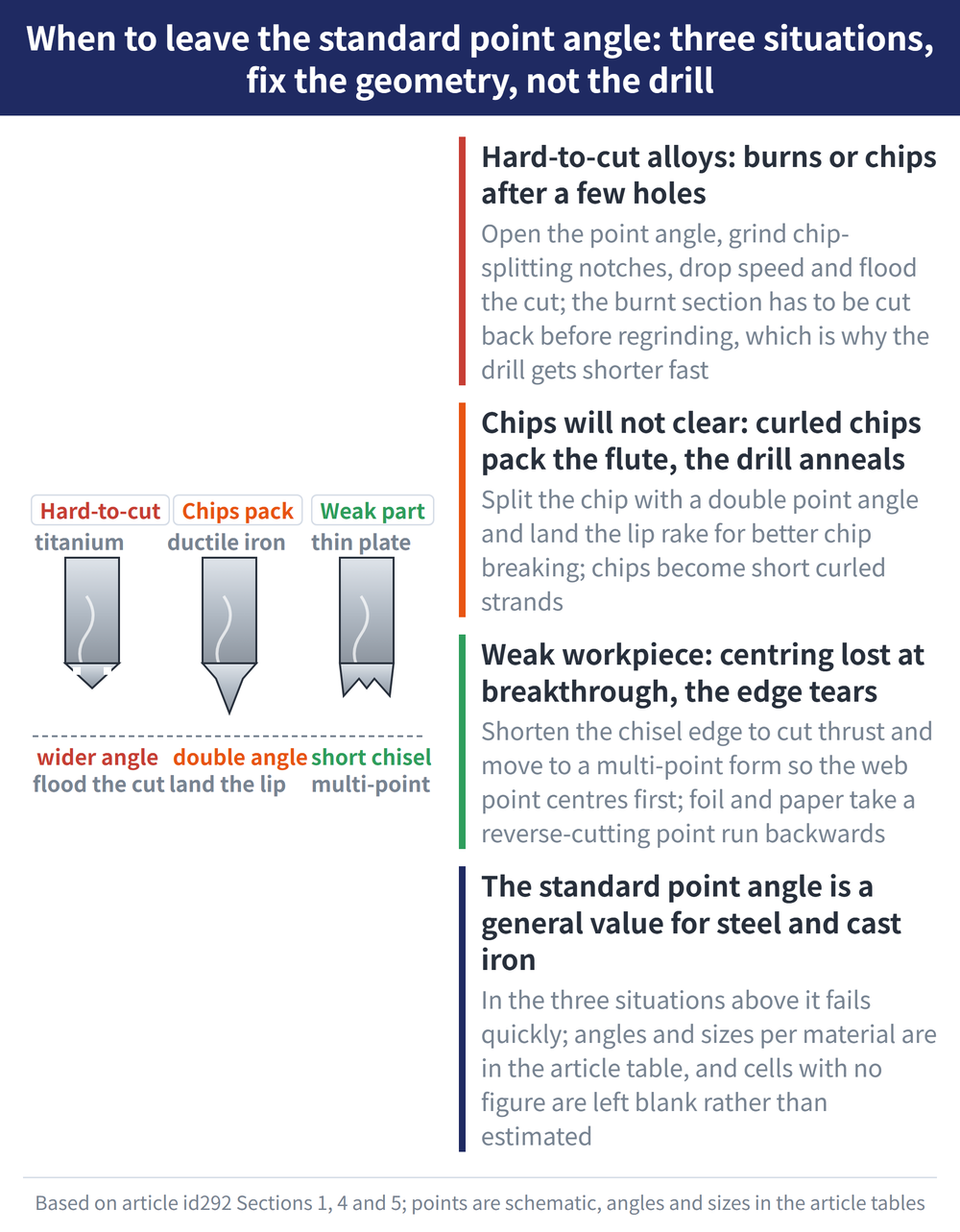
The 118° point angle is a general-purpose value designed for steel and cast iron. In the three situations below, grinding to the standard fails quickly — and the fix is the point geometry, not a more expensive drill. For the baseline regrinding motion, see Regrinding HSS Twist Drills.
| Situation | How it fails | Direction of the fix |
|---|---|---|
| Hard-to-cut alloys (titanium, heat-resistant cast steel) | Burns or chips after a few holes | Open the point angle, grind chip-splitting notches, drop speed and flood the cut |
| Chips will not clear (deep holes, ductile iron) | Large curled chips pack the flute; the drill overheats and anneals | Split the chip with a double point angle; land the lip rake down to 0° for better chip breaking |
| Weak workpiece (thin plate, soft thin stock) | Centring is lost at breakthrough; the edge tears and the part deforms | Shorten the chisel edge to cut thrust, or move to a multi-point or reverse-cutting form |
2. Five material-specific points in one table
The table lists the adjustments item by item. Cells where no figure is given are left blank rather than estimated.
| Material / use | Point angle | Other key work | Reported benefit |
|---|---|---|---|
| Titanium plate | No given figure | Grind the lips by the rotating method; keep the drill no hotter than the hand can bear, tap water is enough | 4~8× the output, Ra3.2μm |
| Core drilling castings | Closed (no figure), with the lip lengthened | Grind a second point angle (its length 1.2~1.5× the core-drilling chip thickness); short drill, small clearance; inclination 5°~10°; stone the flank to prevent built-up edge | Better roundness and straightness when opening a cored hole |
| Ductile iron, deep holes | 2φ=140° second point angle 2φ₁=90° | Outer lip about half the inner lip length; 1mm land on the lip rake with 0° land rake; chisel edge 0.5~1mm; clearance 8° | Chips become short curled strands, corner strength and heat flow both improve |
| Aluminium alloy, deep holes (φ4~φ12mm, over 50mm deep) | Opened up (no figure) | Larger clearance (no figure); a narrow land on the flank side of the lip; 75° corner at the periphery to cut thrust; rake ground into the chisel edge | Chips leave as twisted strands; no cutting fluid needed |
| CrMnN heat-resistant cast steel | 2φ=150°~160° | Chip-splitting notch in the outer lip; web offset 0.3~0.5mm from centre; a radiused transition 3~5mm high, 0.5~1mm wide and 0.3~0.5mm deep where margin meets flute face | See the case below |
3. Two hard-to-cut cases
Titanium plate. A standard twist drill in 5~10mm titanium plate manages only 1~3 holes before it burns, and the burnt section has to be cut back by at least 5~10mm before it can be reground — this is the classic reason a drill gets shorter fast. The documented practice floods the cut (No.20 machine oil blended with an equal part of kerosene, or an emulsion) and works at low speed with hand feed.
CrMnN heat-resistant cast steel (the example runs Cr 18%~20%, Mn 11%~13%, N 0.24%) is tough, hot-strong and work-hardens heavily, and a plain HSS twist drill simply will not cut it: at 130° with chip-splitting notches it still managed only 1~2 holes of φ22mm in 15mm plate. With the geometry above, the material solution treated first, low speed and light feed, and the rule that the drill must never spin without cutting and must be flooded continuously, one regrind lasted 15 holes.
The speeds and feeds in both cases are single-case conditions, deliberately not reproduced here so they are not mistaken for general recommendations. Work out your own from machine, drill grade and hole depth — see Drilling Parameters Guide; for reading chip form, see Drill Chip Formation Guide.
4. Large holes in thin plate: two common forms both fail
Thin plate is weak and ductile. The moment the web breaks through, the chisel edge loses its centring, the part chatters, thrust collapses and springback bends the material. On a large hole the arc lip and gash cut over a wider area, chatter gets worse and the web point chips — neither a plain twist drill nor the thin-plate multi-point form is suitable.
One recorded case is φ50 holes in 6mm steel plate: with a plain twist drill the upper part of the hole opened out, the wall showed tearing marks, the mouth threw burrs and the hole came out un-round or even polygonal.
The fix is a multi-point large-hole drill: grind a double inner point angle to strengthen the web point, rework both corner angles to extend the life of the two outer points, and shorten the chisel edge to 1~1.1mm to cut thrust. For φ50mm: outer point angle 110°, inner point angle 90°, double inner point angle 110°, corner angle 40°, chisel edge angle 60°, point height 1mm, arc radius R3~4mm, and arc depth greater than plate thickness plus 2mm; keep the guiding section short and cool with emulsion. All three points are then keen — the web point centres, the two outer points quickly shear the middle disc free, close to trepanning. The hole comes out round and burr-free, and the recorded rate is 2~2.5× the output.
5. Soft thin stock runs in reverse; spherical holes need a different contact
Reverse cutting for soft thin stock. On copper foil, paper and electrical insulation under 0.1mm, an ordinary drill tears the work apart the moment the lips touch, and there is a real entanglement hazard. The answer is a reverse-cutting point, which also suits thin foam, soft rubber, packaging materials and heavy board. Rotation direction is the key: very thin stock must be run with the drill turning backwards, everything else runs forward, and the feed is given slowly by hand. No grinding angles are given.
Spherical holes. A standard twist drill meets a curved surface at a single point, so the hole centre drifts off the sphere centre. The fix is to grind away the point and put angles on the rake and flank so the lip falls into two segments: contact becomes an arc instead of a point, and the conical tip improves centring and guidance. The recorded parameters (some cells are incomplete; only the two confirmable rows are reproduced):
| Drill diameter D | Segment size d | Clearance a | Rake γ |
|---|---|---|---|
| ≤8mm | 1.0mm | 1° | 0° |
| 10~12mm | 1.8~3.5mm | 2° | 1° |
When grinding, neither rake nor clearance may be excessive, and both must taper down from the periphery toward the centre; keep the feed modest, especially on small diameters.
6. The shop-made flat drill for the lathe
Mounted in the lathe turret, it drills like a drill and bores like a single-point bar, which suits small batches made and ground in-house. It is not for volume drilling or holes needing high centring accuracy. The build route: wire-cut a solid HSS blank to 10×10×200mm and surface-grind it down to 9.5mm square; on a tool grinder put a 10°~12° secondary clearance on both thickness faces over no more than 100mm, including about 0.2mm back taper; grind the straight outer lip, the gash and the inner lip freehand (figures only, with no angle values); finally hone the flank and the corner with a fine aluminium oxide stone.
For the full accuracy route of drilling, core drilling, reaming and boring instead of a shop-made tool, see Improving Hole Accuracy; for an overview of point forms and regrind types, see Drill Point Geometry Guide.
7. Frequently Asked Questions (FAQ)
Q: Drills keep burning in titanium — should I switch to carbide?
Change the point geometry and the coolant supply first, then talk about grade. The documented practice floods the cut (machine oil with an equal part of kerosene, or an emulsion) and works at low speed with hand feed. Note that the burnt section has to be cut back at least 5~10mm before regrinding.
Q: Deep holes in ductile iron keep packing with chips — what changes?
Ductile iron throws large curled chips, unlike the small broken chips of grey iron. The grind spreads the 140° and 90° double point angle to split the chip and puts a 1mm land on the lip rake so the land rake becomes 0° for better chip breaking; the chips then come off as short curled strands.
Q: Does drilling aluminium always need cutting fluid?
Not with the deep-hole aluminium point: aluminium conducts heat well and the chips carry some away, so temperature stays low. The condition is that the geometry matches — open point angle and clearance, a 75° corner, a narrow land, and rake ground into the chisel edge.
Q: Can I use a multi-point form for large holes in thin plate?
No. In this case neither a plain twist drill nor the thin-plate multi-point form works well. It calls for a separate multi-point large-hole drill with a double inner point angle to strengthen the web point and the chisel edge shortened to 1~1.1mm.
This article is part of Tool Regrinding: The Complete Guide — Decide Whether to Grind, Then Look Up How, With What, and How to Check; that guide shows how the whole topic fits together.
This article is part of Drill Bits: The Complete Guide - Start From Depth-to-Diameter, Then Pick the Drill and Set the Conditions; that guide shows how the whole topic fits together.
Published: 2026-08-17|Last updated: 2026-08-17