Machine, Tooling and Time Standards: Selection, Cutting Data Order, Time Allowance
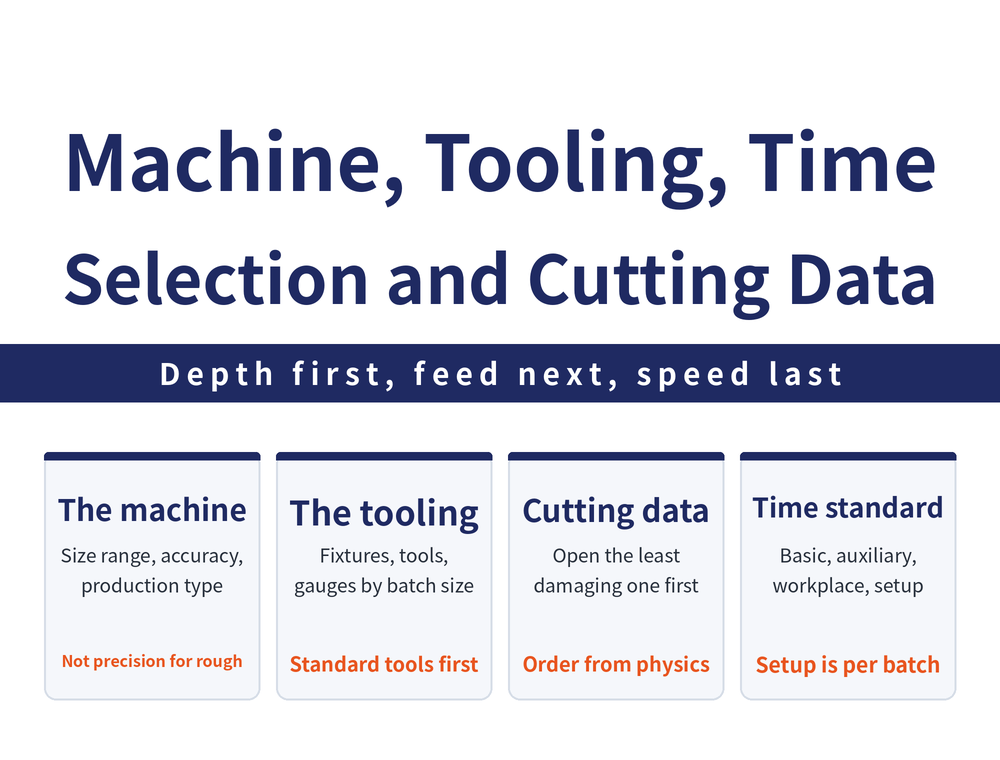
Once the sequence is set, three things remain: which machine, what fixture, tooling and gauges, and what cutting data. Cutting data has a definite order — depth of cut, then feed, then speed — and reversing it costs tool life quickly. This article also covers the five components of a time standard.
1. Choosing the machine: three things must match
| Criterion | Must match |
|---|---|
| Machining size range | The dimensions the part requires |
| Working accuracy | The accuracy that operation requires |
| Production type | The batch size |
"Match" in the second row runs both ways: insufficient accuracy cannot produce the part, but running roughing on a precision machine is equally wrong — the heavy cutting forces and heat consume the machine's accuracy. That is the practical meaning of "letting precision machines hold their accuracy longer" in the discussion of machining stages; see sequencing machining operations.
2. Fixtures, tools and gauges: batch size decides
| Item | Small batch | High volume |
|---|---|---|
| Fixture | General-purpose and modular fixtures | Dedicated fixtures designed for the operation |
| Cutting tool | Standard tools as a rule | Combination and special tools where warranted |
| Gauge | General-purpose gauges and instruments | Limit gauges, instruments and special gauges |
Tool selection rests on four further inputs: the size of the surface, the workpiece material, the accuracy and roughness required, and the machining method already chosen. "Standard tools as a rule" carries a cost meaning — lead time and inventory risk on special tooling belong in the total cost, not just unit price.
3. 🔴 Cutting data order: depth, then feed, then speed
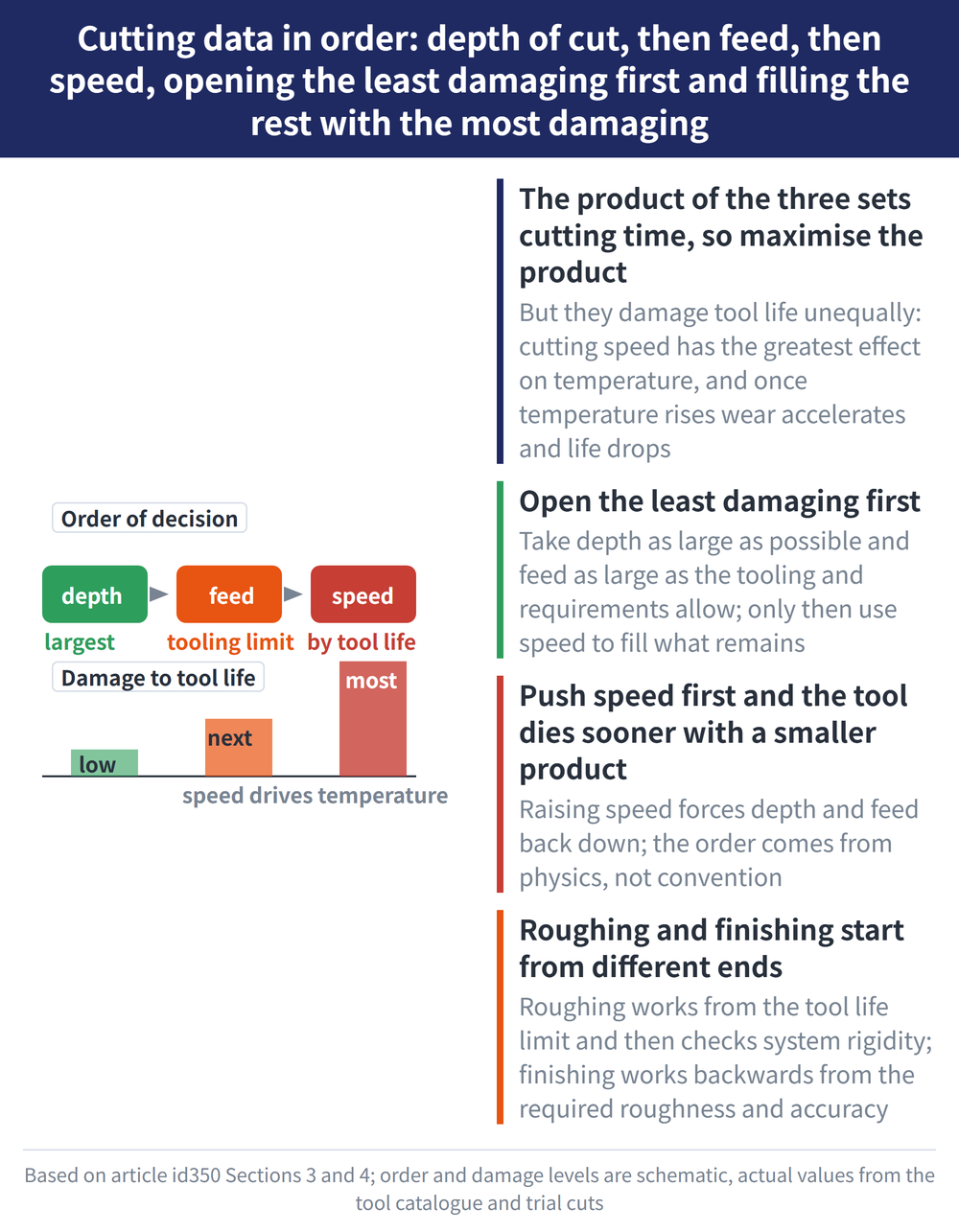
With tool material and geometry settled, three values remain: depth of cut ap, feed f and cutting speed v. They have a definite order of decision, and the order comes from physics rather than convention:
| Order | Parameter | Basis | Effect on tool life |
|---|---|---|---|
| 1 | Depth of cut ap | Take as large as possible | Smallest |
| 2 | Feed f | Take the maximum the tooling and requirements allow | Next |
| 3 | Cutting speed v | Set by what tool life permits | Largest |
The reasoning: the product of the three determines cutting time, so shortest time means largest product; but they damage tool life unequally — cutting speed has the greatest effect on cutting temperature, and once temperature rises, wear accelerates and life drops noticeably. The correct approach is therefore to open up the least damaging first and use the most damaging last to fill what remains. Push speed up first and you must pull depth and feed back down: a smaller product and a shorter-lived tool.
4. Roughing and finishing look at different things
The starting point differs by stage: roughing works from the tool life limit first, then checks whether the rigidity of the whole system allows it and adjusts; finishing works backwards from the required surface roughness and accuracy. For parameter conversion see the machining formulas cheat sheet, and for milling conditions see the end mill cutting conditions guide.
5. Five components of a time standard
| Component | Content |
|---|---|
| Basic time | Time spent directly changing the size, shape, position, surface condition or material properties of the workpiece |
| Auxiliary time | The supporting actions the process requires |
| Workplace attendance time | Tool changes, lubrication, chip clearing, tidying — taken as a percentage of operating time |
| Rest and personal time | Recovery and personal needs within the shift — also a percentage of operating time |
| Setup and teardown time | Preparation and closing work for producing one batch |
Basic plus auxiliary time equals operating time, the part spent directly making the part. Note that setup and teardown time occurs per batch, not per piece — the smaller the batch, the more of it each piece carries. This is the cost basis behind concentrating operations for small batches.
Time standards are not only for quoting: they are the main basis for production planning and cost accounting, and when designing a new plant they are used to derive equipment counts, shop layout and headcount.
Compiled from a metal cutting technical handbook as general process principles; actual cutting values should come from the tool catalogue and trial cuts. No values are given here.
6. Frequently Asked Questions (FAQ)
Q: Why depth of cut first and speed last?
Because the three damage tool life unequally and cutting speed has the greatest effect on temperature. Opening the least damaging first and using speed last maximises their product — and so minimises time — while keeping tool life.
Q: Can a precision machine be used for roughing?
Not advisable. Heavy cutting forces and heat consume machine accuracy. Matching working accuracy to the operation is a two-way requirement, not just a lower limit.
Q: Why is time per piece so high on small batches?
Because setup and teardown time occurs per batch rather than per piece. The smaller the batch, the more each piece carries — which is also why small batches favour concentrated operations.
Q: Do roughing and finishing pick parameters the same way?
No. Roughing starts from the tool life limit and then checks system rigidity; finishing works backwards from the required surface roughness and accuracy.
This article is part of Manufacturing Process: The Complete Guide - Set the Datum First, Then Sequence, Allowance and Dry Cutting; that guide shows how the whole topic fits together.