Is Tool Regrinding and Recoating Worth It? When to Resharpen and When to Replace
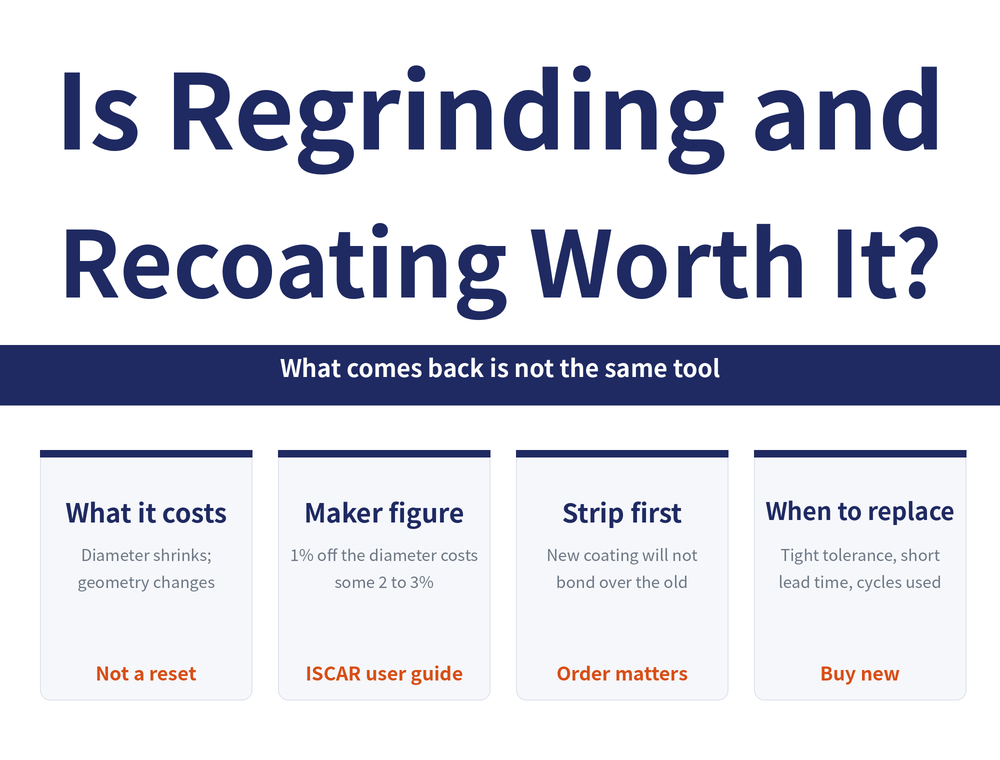
Regrinding brings a dull tool back, but not the same tool: the diameter shrinks, the wedge angle and flute depth change, and the coating on every reground face is gone. The ISCAR user guide gives a rule you can apply directly: for a solid carbide end mill, every 1% reduction in diameter costs 2% to 3% of tool performance on average. This article covers what regrinding costs you, why a reground tool normally has to be recoated, why the old coating must be stripped first, and when replacement is simply the better call.
1. What Does Regrinding Take Away? Three Things to Recognise
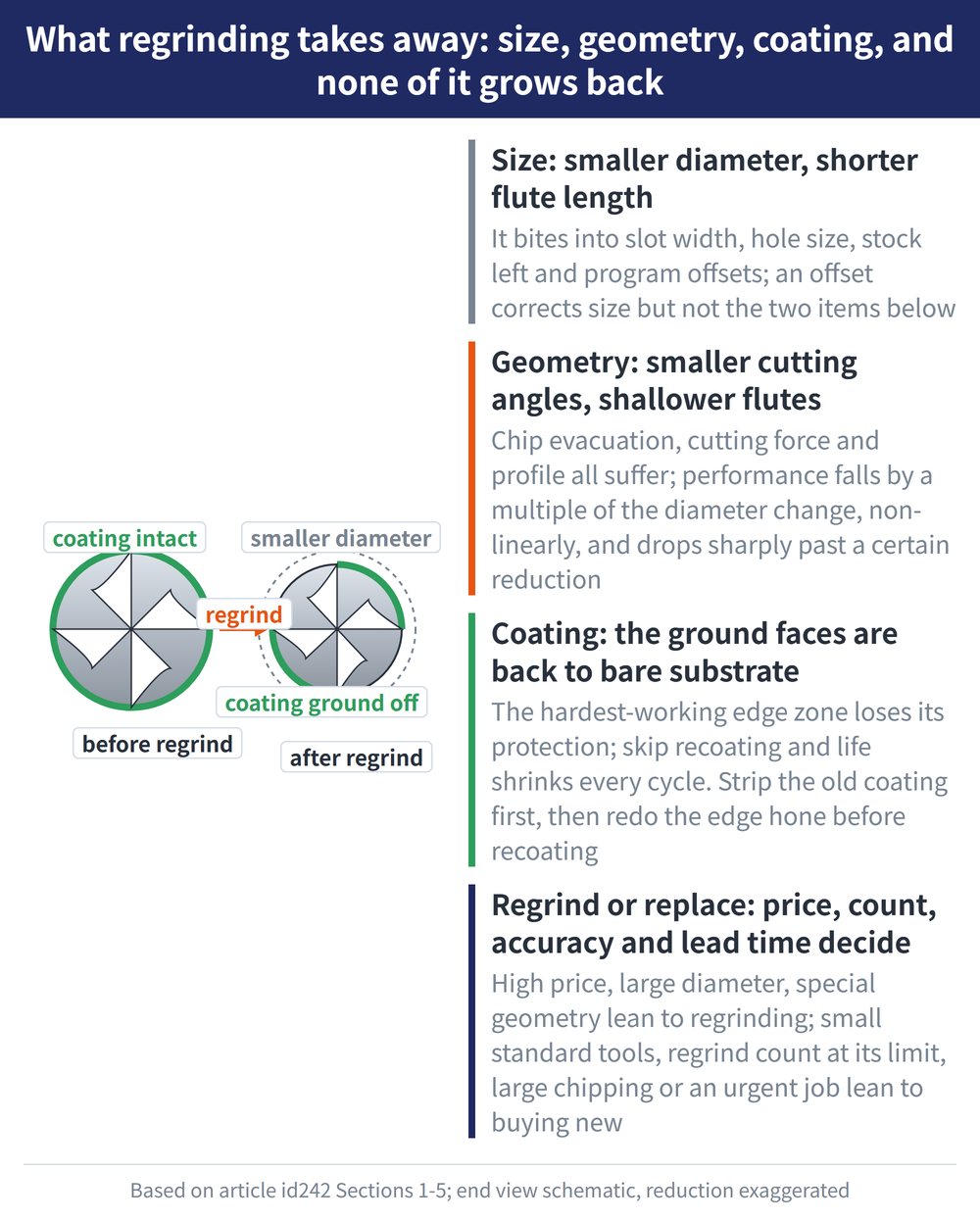
Regrinding (also called resharpening) removes the dull cutting edge together with part of the tool body, so a sharp edge can be formed again. What is ground off never comes back, so regrinding always carries a loss, and that loss falls into three categories, of which geometry is the one most often missed.
| What is lost | Actual change | What it hits |
|---|---|---|
| Size | Smaller diameter, shorter flute or overall length | Slot width, hole size, stock left, offset values |
| Geometry | Smaller wedge angle, shallower flute, altered corner radius and chamfer | Chip evacuation, cutting force, profile shape |
| Coating | Reground faces return to bare substrate | Wear resistance, anti-adhesion, tool life |
2. Lose 1% of Diameter, Lose How Much Performance?
For solid carbide end mills, every 1% reduction in diameter costs an average of 2% to 3% in tool performance; beyond a certain amount of reduction, performance drops sharply. (Source: ISCAR user guide)
Two points matter here. First, the decay is two to three times the diameter change, a steeper price than intuition suggests. Second, the relationship is not linear: the guide states that performance falls sharply past a certain reduction, so what really deserves attention is the knee of the decay curve rather than how much diameter is left.
The same source notes that the main cause of the decline is not the missing coating but the fact that regrinding works the flank and clearance faces, which makes the wedge angle smaller and the flute shallower, so the tool cuts harder and evacuates chips less well. Whether the substrate tolerates that reduction depends on grain size and cobalt content, covered in Carbide Grade Decode Guide; how end mill material relates to regrinding is covered in Carbide vs HSS End Mills.
3. Why Does a Reground Tool Normally Need Recoating?
A coating separates workpiece material from the tool body and reduces the four wear mechanisms of adhesion, abrasion, diffusion and oxidation. Regrinding takes that coating off along with the reground faces, removing the protection exactly where the load is highest; skip the recoat and tool life gets shorter with every cycle.
Which coating to reapply depends on the workpiece material and the process, covered in Tool Coating Types Guide; the difference between the PVD (Physical Vapour Deposition, in which a target is vaporised in vacuum and condenses as a film) and CVD process routes is covered in PVD vs CVD Coating Guide. Reconditioning lines usually redo the edge rounding before recoating, because that rounding governs both edge strength and coating adhesion, covered in Edge Preparation and Coating Adhesion.
4. Before Recoating, the Old Coating Has to Come Off
Regrinding only touches the area near the edge; the old coating remains on every other surface. Plating a new film straight on top means growing it over a degraded layer, and adhesion will suffer. Decoating, the pre-treatment that strips residual coating, is therefore a required step in recoating, not a paid extra.
| Item | What to confirm before ordering |
|---|---|
| Process order | Equipment makers advise decoating before regrinding; decoating afterwards can damage the finished geometry and gives poorer adhesion |
| Chemistry choice | Wet chemical decoating is selected by substrate (carbide or steel) and by the old coating system |
| Substrate protection | Avoid attacking the cobalt binder in carbide, and avoid etching notches into the edge |
| Not every tool can go again | Some non-stick coatings cannot be reapplied, and diamond coated tools are hard to regrind and rarely economic |
5. Regrind, or Just Buy New?
Cost is the first filter: regrind quotes commonly land around half the price of a new tool, with the ratio varying by tool type and batch size. The more expensive and the larger the tool, the better the case for regrinding; on small standard items the regrind fee often approaches the new price, and replacement is simply cleaner.
| Decision point | Favours regrinding | Favours buying new |
|---|---|---|
| Tool price | High unit price, large diameter, special design | Small standard items whose regrind fee nears the new price |
| Regrinds so far | Still within the maker's cycle and reduction limits | Limit reached, or diameter and length reduced too far |
| Accuracy demand | Size change absorbed by cutter compensation | Profile defined by tool form under tight tolerance |
| Tool condition | Normal wear with only slight chipping | Heavy chipping, burn discolouration, damaged shank |
| Delivery pressure | Spare tools on hand to cover the regrind loop | Urgent production with no spare of the same spec |
Two more variables get overlooked. One is the number of regrinds: industry practice commonly puts most rotary tools at roughly three to six, fewer for tight-tolerance types, with the real limit still set by the tool maker's regrinding specification. The other is lead time: regrinding is an outside service measured in weeks, and without spares that means a stopped line.
6. Frequently Asked Questions (FAQ)
Q: The diameter shrinks after regrinding, so is cutter compensation enough?
Compensation corrects size only; it cannot restore the smaller wedge angle or the shallower flute. Per the ISCAR user guide, each 1% of lost diameter costs 2% to 3% of performance, so cutting conditions should be kept conservative too.
Q: How many times can one tool actually be reground?
Industry practice commonly cites roughly three to six times for most rotary tools, fewer for tight-tolerance types. The real limit should follow the tool maker's regrinding specification, judged together with diameter reduction and tool condition.
Q: Does a reground tool always have to be recoated?
If the original cutting conditions relied on the coating, recoat after regrinding; otherwise the edge zone is effectively bare substrate and life gets shorter with every cycle.
Q: Why must the coating be stripped before recoating?
Residual old coating leaves the new film poorly adhered. Decoating is usually a wet chemical process, and the key is matching the chemistry to substrate and coating while protecting the cobalt binder in carbide.
For the full reading guide on this topic, see Tool Life and Wear: A Complete Reading Guide.
This article is part of Tool Regrinding: The Complete Guide — Decide Whether to Grind, Then Look Up How, With What, and How to Check; that guide shows how the whole topic fits together.
This article is part of Tool Materials and Coatings: The Complete Guide - Separate Substrate From Coating, Then Work Back From the Workpiece; that guide shows how the whole topic fits together.
Published: 2026-08-08 | Last updated: 2026-08-08