Tool Life and Wear: A Complete Reading Guide
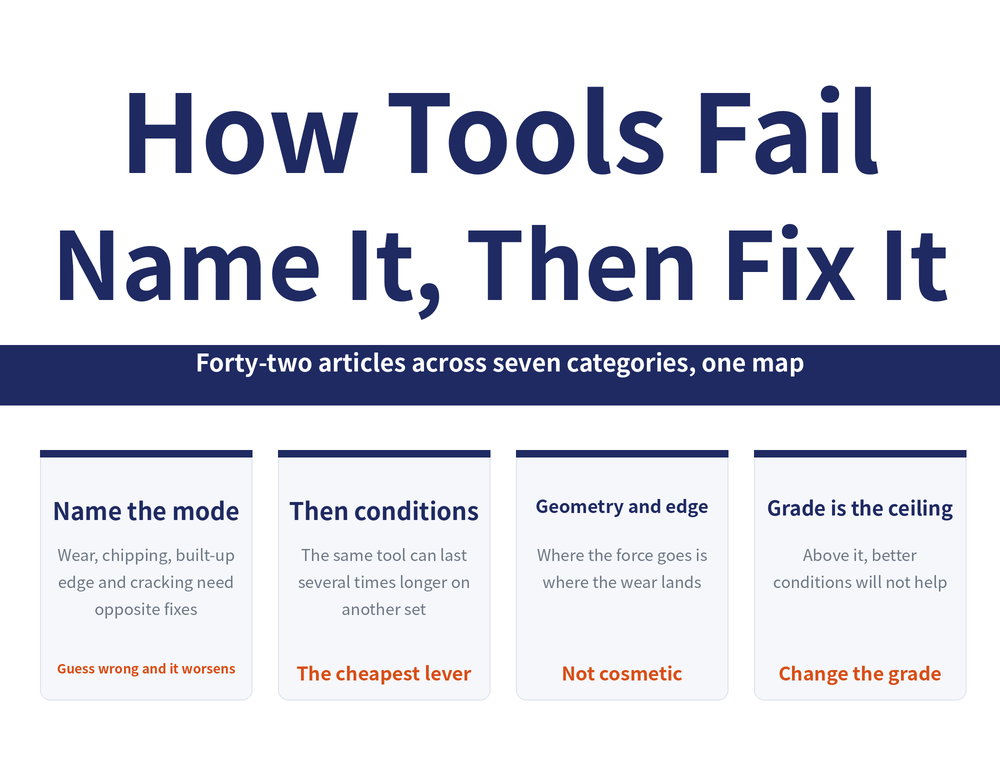
Tool life is the largest cross-category topic on this site: 42 articles across seven categories. This page is a reading guide. It does not repeat what those articles say; it answers one question: how did this tool fail, and which article should you open first.
1. Name the Failure First: Wear, Chipping, Built-Up Edge or Thermal Cracking
Different failure modes call for opposite corrections. Misread the mode and every parameter change makes it worse.
| Article | When to open it |
|---|---|
| Tool Wear Analysis | The main entry point: chipping, built-up edge and thermal cracking in one place |
| End Mill Wear Analysis | Where to start on the milling side |
| Drill Wear Analysis | Telling the We, Wf, Wo and Wm patterns apart on a drill |
| Milling Entry, Exit and Engagement | Chipping is often not the tool, it is where you enter and leave the cut |
2. Cutting Conditions: Where Tool Life Goes First
The same tool can last several times longer on a different set of conditions. This is the cheapest place to adjust.
| Article | When to open it |
|---|---|
| Turning Cutting Conditions Guide | Speed, feed and life; read this one first on the turning side |
| Cutting Conditions vs Surface Finish | How flute count and side milling affect accuracy and life together |
| Factors Affecting Drill Tool Life | For drills it comes down to heat, feed and coolant |
| CNC Thread Cutting Depth Guide | Get the depth split wrong and the tool dulls before the thread is finished |
| Climb Milling vs Conventional Milling | Cutting direction is itself a tool life variable |
| Thread Infeed Methods Explained | Radial infeed loads three faces of the edge; flank infeed does not |
3. Geometry and Edge Prep: The Same Tool, Very Different Life
Geometry and edge prep decide where the cutting force goes, and therefore which face wears.
| Article | When to open it |
|---|---|
| Turning Tool Rake and Clearance Angles | Rake and clearance set both cutting force and life |
| Turning Tool Lead Angle | Lead angle changes chip thickness, and with it where the wear lands |
| Turning Tool Edge Preparation | Chamfer and hone are not cosmetic; they are life design |
| Turning Tool Nose Radius Selection Guide | The nose radius is where finish and life trade off |
| Edge Preparation and Coating Adhesion | A poorly prepared edge will not hold the coating, and the life goes with it |
4. Substrate and Coating: The Ceiling on This Tool
Substrate and coating set the ceiling. Above that ceiling, better conditions will not help.
| Article | When to open it |
|---|---|
| Tool Coating Types Guide | From TiN to AlCrN: know the options first |
| PVD Insert Coating Chart | The cross-reference to use when switching insert grades |
| PCD and Diamond Coating Guide | The top end when you need life in aluminium and composites |
| Carbide Tap Guide | Move a tap to carbide and both life and conditions reset |
| Carbide vs HSS End Mills | Material choice is a tool life decision to begin with |
5. Outside the Tool: Workpiece and Clamping
More often than expected the tool is fine and the workpiece or the holder is the problem.
| Article | When to open it |
|---|---|
| How Easy Is a Material to Cut? Machinability | Tool life is the first of the four axes of machinability |
| Metal Elements in Machining | Carbon, chromium and nickel content change how fast the tool wears |
| Cast Iron Machining Guide | Abrasive wear in cast iron follows its own rules |
| Collet Damage and Deformation | The tool is fine; the holder failed first |
6. By Tool Type: It Already Failed, Now What
If it has already failed, enter by tool type, match the symptom, then work back through the sections above.
| Article | When to open it |
|---|---|
| End Mill Troubleshooting Guide | First stop for end mill trouble |
| End Mill Failure Troubleshooting | Failure modes and countermeasures for solid end mills |
| Face Milling Troubleshooting Guide | Symptom, cause and fix for face milling |
| End Mill Types and Machining Selection Guide | Pick the wrong tool type and no parameter saves it |
| Drilling Troubleshooting Guide | Breakage, hole size and burrs |
| Drill Flute Length vs Rigidity | Too long a flute and rigidity is what eats the life |
| Thread Machining Solutions | Breakage, wear and oversize in one table |
| Thread Troubleshooting Guide | The single-point turning side |
| Internal Thread Oversize Causes | If the thread gauges oversize, check feed and runout |
| Internal Thread Machining Guide | Broken tools in internal threading usually trace to the pass split |
7. Volume and Deep Holes: Long Tools and Indexable Edges
Long tools and indexable edges do not follow solid-tool intuition when you count life.
| Article | When to open it |
|---|---|
| Indexable Drill Guide | Changing an insert is not changing a tool; count the life separately |
| Small Diameter Deep Hole Drill Guide | In small deep holes, chip evacuation decides the life |
| Turning Tool Selection Process | In the six-step sequence, life is the last thing you set |
| Tap Torque Guide | Without a torque estimate a tap breaks, it does not gradually dull |
8. After It Dulls: Regrind, Send Out or Replace
Dull does not mean scrap. The three routes cost differently; work it out before deciding.
| Article | When to open it |
|---|---|
| When to Regrind an End Mill | Decide whether to regrind before deciding how |
| Regrind In-House vs Outsource vs Replace | How the three routes actually cost out |
| Is Regrinding and Recoating Worth It | What comes back is not the same tool: diameter and coating both changed |
| Tungsten Price Surge and Tooling Cost | Cost and tool life are two sides of the same number |
8. Frequently Asked Questions (FAQ)
Q: Do wear and chipping share the same fix?
No, and the corrections often point in opposite directions. Normal wear usually calls for more speed or a more wear-resistant grade; chipping calls for less impact, a different edge prep or a different entry. Section 1 exists to separate the two.
Q: Why do some articles say wear and others say abrasion?
They describe the same thing with different wording, and both appear on this site. Try both terms, or just enter through this guide.
Q: Is there a standard number for tool life?
No universal number. Life depends on cutting conditions, geometry, substrate and coating, workpiece and machine rigidity together, so this site gives typical ranges and direction rather than a single value.
Q: I only want to know whether to regrind.
Jump to section 8. Those three articles answer whether to regrind, whether to do it in-house, and whether the result is still worth using.
Published: 2026-08-11 | Last updated: 2026-08-11