
What Else You Can Grind Into a Turning Tool: Land, Double Land, Chipbreaker, Ball Nose and End Cutting Edge
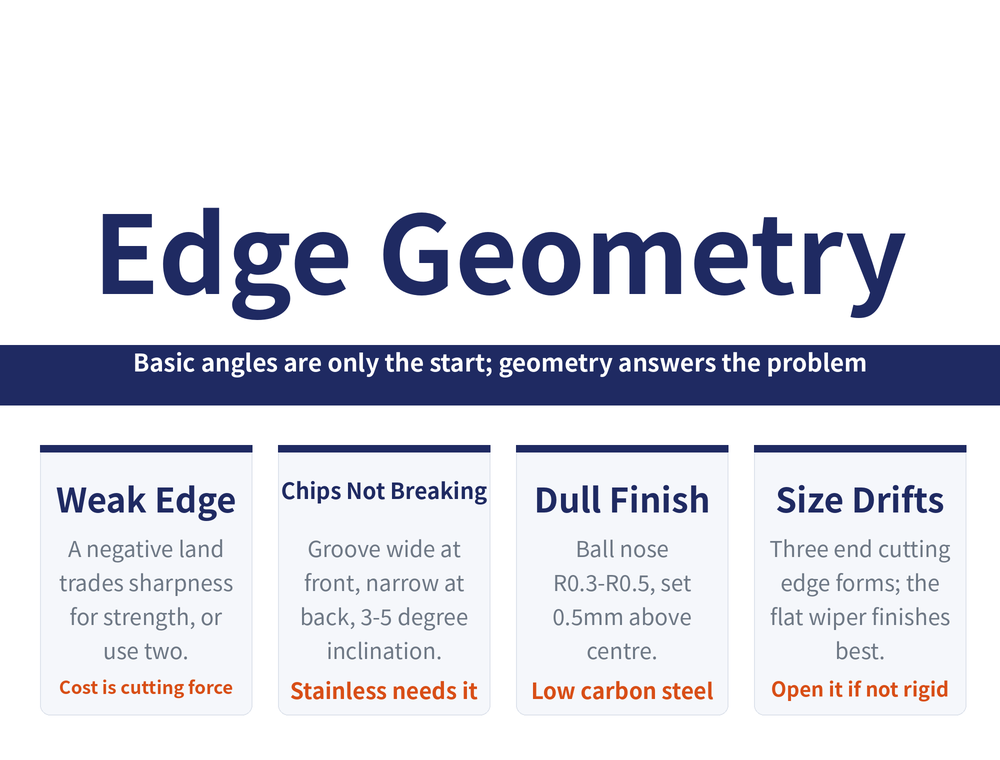
Once the basic angles are ground, five more geometries can be put on a turning tool: a negative land, a double land, a chipbreaker, a ball nose, and three end cutting edge forms. This guide covers which problem each one solves, what values to take, and the one pass people always miss.
1. Once the basic angles are done, what else is there
Rake, clearance and entering angle only get you to a pass mark. The five geometries below each answer one specific problem; the basic sequence is in How to Regrind a Turning Tool.
| Geometry | Solves | Cost |
|---|---|---|
| Negative land | Weak edge, poor heat flow, sudden failure | More deformation and cutting force |
| Double land | A single land is either too wide or too weak | Slightly duller edge, not for finishing |
| Chipbreaker | Stringy chips on tough materials | Wrong groove form packs the chips |
| Ball nose | Torn, dull surface on low carbon steel | The nose must sit above centre |
| End cutting edge form | Surface finish, size control, nose strength | The wrong form rubs the finished face |
2. Negative land: strength bought with sharpness
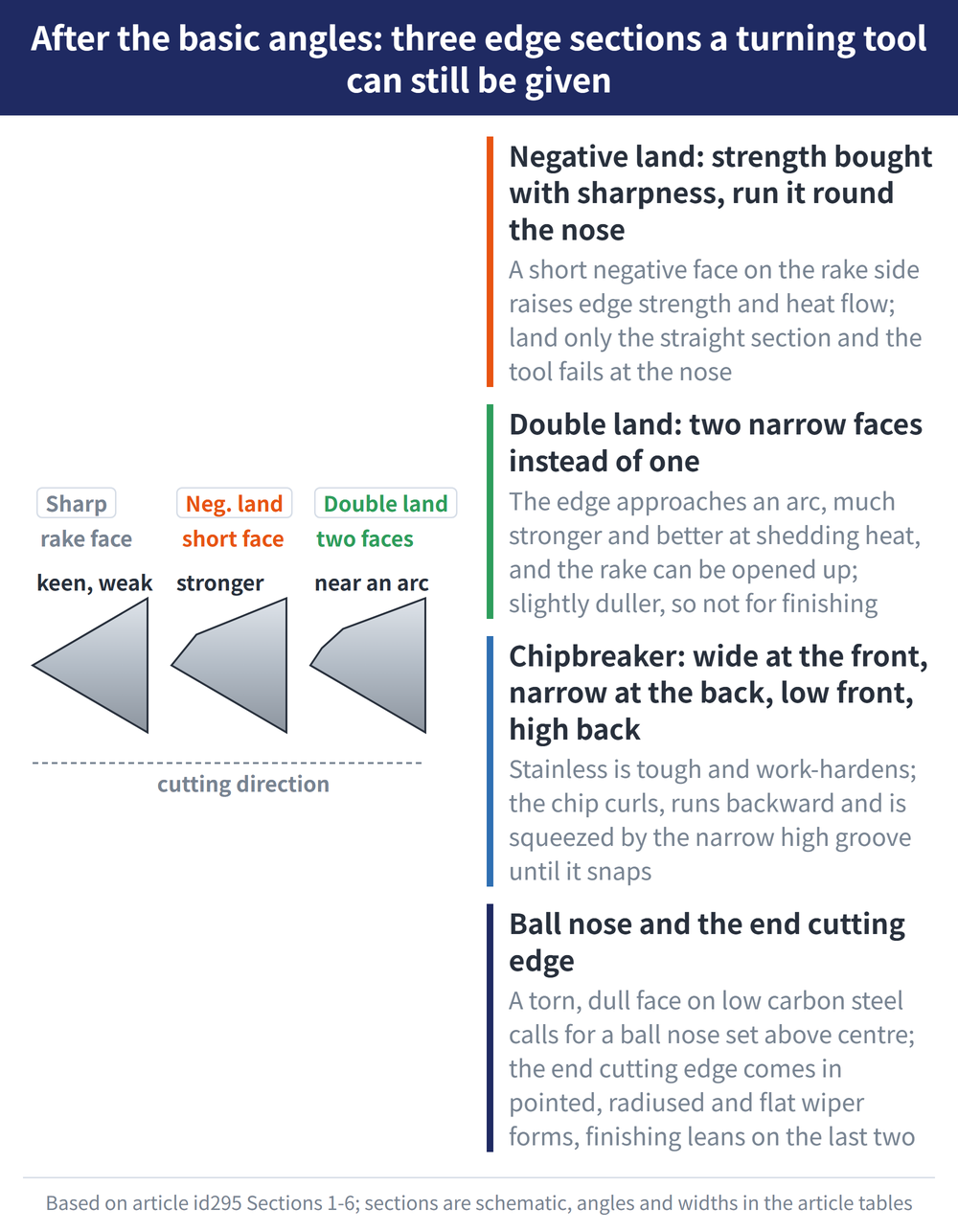
A short negative face is ground on the rake side of a carbide edge to raise edge strength and heat flow and stop sudden failures. The wider the land and the steeper its angle, the stronger the edge — and the higher the cutting force. Chosen well, tool life goes up several times over. How a land differs from a hone is covered in Turning Tool Edge Preparation Guide.
The method, and the pass everyone misses: use a thin F180~F220 silicon carbide stone by hand — clamp the tool, turn the post 90° so the main edge faces you, hold the stone at 10°~15° to the edge, press lightly with one finger and stroke along that angle 3~5 times. The land must run right around the transition edge and the nose radius. Land only the straight section and the tool starts failing at the nose.
3. Double land: two narrow faces instead of one
Grind a single land too wide and the tool turns into a negative rake tool with a dull edge; too narrow and it does nothing. A double land uses two narrower faces, each 0.1~0.2 mm, so the edge approaches an arc: much stronger, much better at shedding heat, and the rake can be opened up. It works on both ductile and brittle materials and can multiply tool life; the edge is slightly duller, so it is not a finishing geometry.
| Use | First face γo1 | Second face γo2 |
|---|---|---|
| Roughing (both negative) | −5° | −15° |
| Semi-finishing (positive/negative) | 0°~5° | −10°~5° |
Method: an F180 or finer silicon carbide stone, or freehand on a fine-grit diamond wheel. The order is fixed: γo1 first, then γo2 and its width.
4. Stainless chipbreaker: let the chip break itself
Stainless is tough and work-hardens quickly, so chip breaking is the hard part of turning it. Beyond cutting conditions, it comes down to groove form: grind a small-radius groove that is wide at the front and narrow at the back (10°~12°), low at the front and high at the back (inclination about 3°~5°). The chip curls, runs backward fast, is squeezed by the narrow high groove and snaps against the major flank.
The main edge and nose radius also need a negative land — with one, life runs over four times that of the same tool without. A short 0° clearance wiper flat where the nose radius meets the end cutting edge, working with a steady rest, gives three-point location so the cut stays stable even if the centre works loose. Matching groove form to material is covered in Turning Chip Control Guide and M-Group Stainless Steel Machining Guide.
A cheap way to lap the groove: after rough grinding, clamp the tool on a horizontal lathe, turn a cast iron lap, coat it with silicon carbide powder mixed to a paste and run the spindle in reverse. It produces an accurate, low-roughness groove for very little money, and works just as well on threading tools and parting blades.
5. Ball nose: when low carbon steel will not come up bright
Low carbon steel that has not been forged or heat treated to improve machinability usually turns grey and dull with visible tearing. A ball nose holds the finished face at Ra3.2~Ra1.6 μm.
Grind a 0.2~0.3 mm chamfer along the whole corner where the major and end flanks meet, then stone the nose into a R0.3~R0.5 mm spherical face. Set it in the holder with the nose 0.5 mm above workpiece centre and cut. Cutting resistance is lower than a tool with a negative land and negative rake, which helps when the machine is not rigid or the part has a large length-to-diameter ratio. Note that the contact width of the sphere must exceed the feed per revolution or the burnishing action breaks down; the radius-to-finish relationship is in Turning Tool Nose Radius Guide.
6. End cutting edge angle and its three forms
The end cutting edge keeps the tool off the finished face and sets the nose angle and its strength. End clearance is usually ground equal to the main clearance: 5°~7° on carbide for roughing, 6°~8° on HSS, and 8°~12° for finishing.
| Tool and conditions | Suggested angle |
|---|---|
| OD tool, rigid setup, continuous cut | 5°~10° |
| OD tool, poor rigidity (or rigid but interrupted) | 10°~15° |
| OD tool, poor rigidity, interrupted cut | 20°~35° |
| Bent-head turning tool | 30°~45° |
| Boring and facing tool | 20°~35° |
| Parting and grooving blade | 1°~2° |
| Form | Spec and use |
|---|---|
| Pointed | A 60° nose suits plunging in or slender parts; the double-point form suits semi-finishing and finishing, cutting in layers |
| Radiused | Nose radius 0.3~1.5 mm, for high-speed low-feed finishing |
| Flat | A 1.5~3 mm wiper flat, longer than the feed per revolution, reaching Ra0.8~0.2 μm |
Wiper inserts work on the same principle — see Wiper Inserts in Turning.
7. Frequently Asked Questions (FAQ)
Q: I ground a negative land and the nose still chips — why?
Usually because only the straight section was landed. The land has to continue around the transition edge and the nose radius; leave the nose out and it is as good as not landed, and failure starts there.
Q: Can a double land be used for finishing?
Generally no. Two faces leave the edge slightly dull — strong, but not keen. For finishing, reach for a radiused or flat wiper end cutting edge instead.
Q: Why does a ball nose have to sit above centre?
The sphere works by burnishing the finished face, and only a slightly raised nose puts it in the right contact position. The contact width must also exceed the feed per revolution or the burnishing is not continuous.
Q: Is a smaller end cutting edge angle always better?
No. A small angle lowers surface roughness, but on a soft setup or an interrupted cut it has to open to 10°~35°, otherwise the end cutting edge rubs the finished face and the tool vibrates.
This article is part of Tool Regrinding: The Complete Guide — Decide Whether to Grind, Then Look Up How, With What, and How to Check; that guide shows how the whole topic fits together.
Published: 2026-08-17|Last updated: 2026-08-17