Carbide Insert Coating Chart | ISO Grade Cross Reference Guide
A carbide insert coating chart is a key reference for CNC tool selection: by matching ISO classes (P, M, K, N, S) to brand grades you can quickly find equivalent inserts. Coating-and-material combinations directly affect wear resistance, heat resistance and stability. This guide covers carbide coating cross-references and application logic to help pick the best insert. For the ISO workpiece groups, see ISO Workpiece Material Classification.
What Is an Insert Coating Chart?
It supports cross-brand substitution, matching cutting conditions and extending tool life, based on three aspects.
| Purpose | Basis |
|---|---|
| Cross-brand substitution | ISO material class (P / M / K / N / S) |
| Matching cutting conditions | Tool material (carbide) |
| Extending tool life | Coating type (PVD / CVD) |
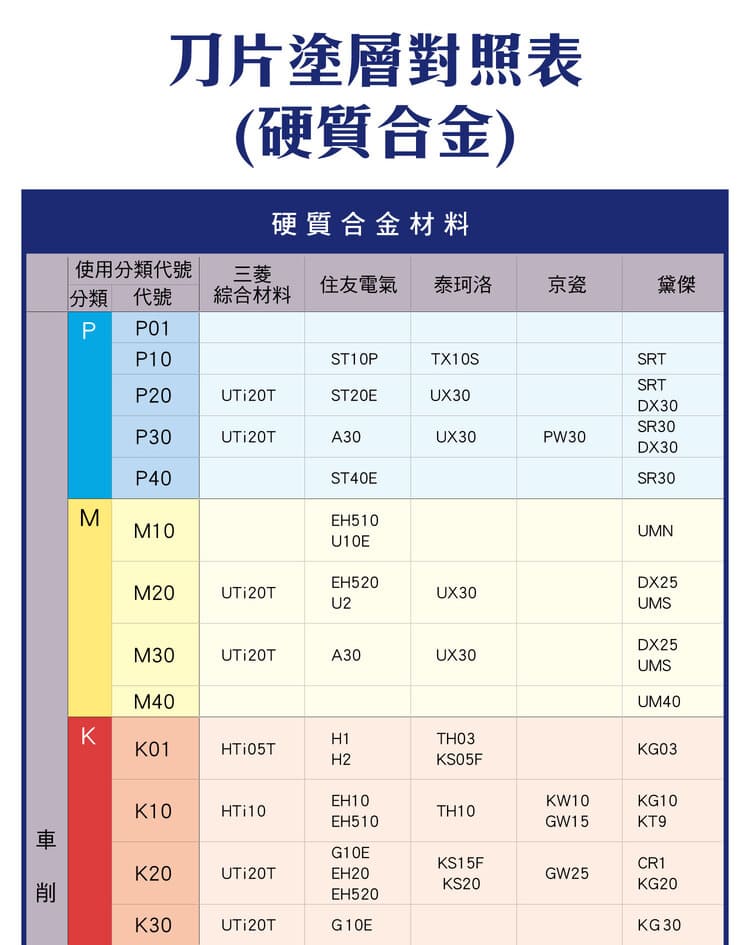
ISO Classes, Applications and Common Grades
By ISO group: material, traits and example insert grades for same-group substitution.
| ISO group | Material | Trait | Common grades (example) |
|---|---|---|---|
| P | Carbon / alloy steel | Stable cutting | UTi20T, ST20E, UX30, PW30, DX30, SR30 |
| M | Stainless steel | Gummy | EH520, UX30, DX25, UMS |
| K | Grey / ductile cast iron | High wear | HTi05T, KS15F, GW25, KG20 |
| N | Aluminum, copper | Low hardness, ductile | HTi10, KW10, CR1 |
| S | Titanium, superalloys | High-temp strength | RT9005, MT9015, SW10, FZ15 |
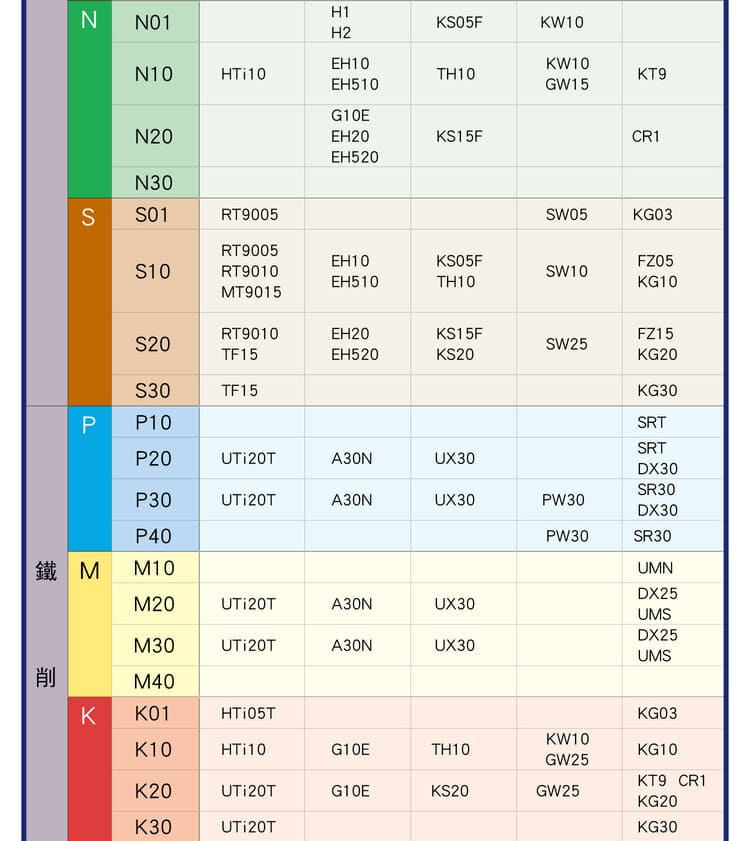
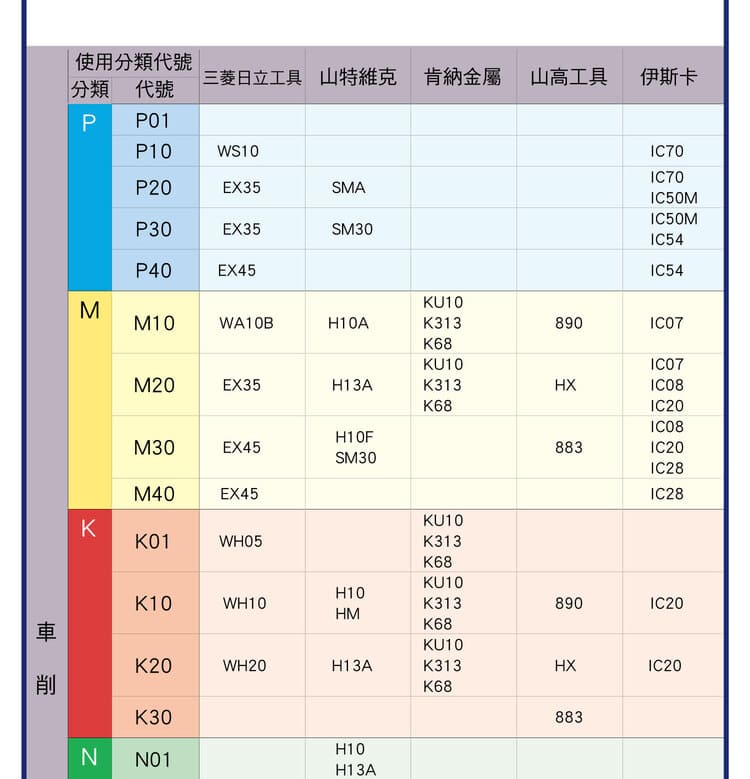
Brands Covered
The chart consolidates major tool brands; the same ISO class points to equivalent substitutes.
| Brand | Origin |
|---|---|
| Mitsubishi | Japan |
| Sumitomo | Japan |
| Kyocera | Japan |
| Sandvik | Sweden |
| Kennametal | USA |
| ISCAR | Israel |
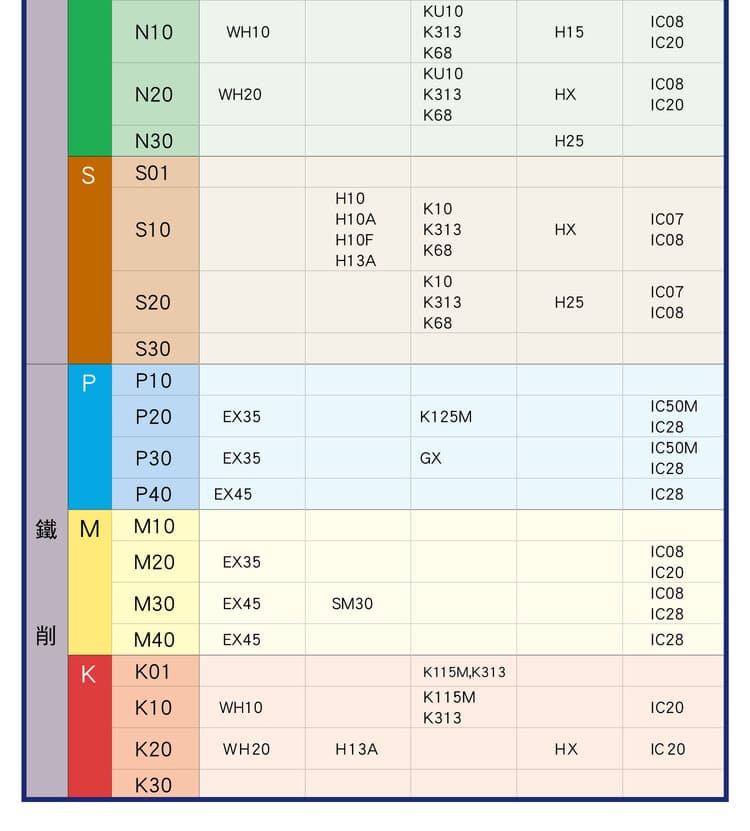
Turning vs. Milling Inserts
| Type | Mainstream coating | Emphasis |
|---|---|---|
| Turning insert | Mostly CVD | Wear resistance & stability |
| Milling insert | Mostly PVD | Impact resistance |
CVD vs. PVD Coating
| Coating | Thickness | Trait | Best for |
|---|---|---|---|
| CVD | Thick | High wear resistance | Roughing |
| PVD | Thin | High toughness | Finishing |
For full per-brand grade lists by coating, see CVD Insert Coating Chart and PVD Insert Coating Chart.
Practical Insert Selection
| Scenario | Recommendation |
|---|---|
| High-speed | PVD coating, better thermal-crack resistance |
| Heavy cutting | CVD coating, better wear resistance |
| Finishing | Cermet or PVD |
| High-hardness materials | CBN or dedicated coating |
Three-step selection: Step 1 classify material (steel→P, stainless→M, cast iron→K); Step 2 assess conditions (roughing→high wear, finishing→high toughness); Step 3 choose coating (high temp→CVD, precision→PVD). Set actual parameters by machine and material hardness—see End Mill Cutting Conditions Guide.
※ Grades are common examples compiled from the source for same-ISO-group substitution reference only; verify exact equivalents and applicability against each brand's catalog.
FAQ
How do I use an insert coating chart?
Determine the ISO group from the workpiece (steel P, stainless M, cast iron K, non-ferrous N, heat-resistant S), then match brand grades within that group to find equivalent substitutes. Confirm against the maker's catalog.
How do I choose between CVD and PVD?
CVD is thick and wear-resistant for turning, heavy and continuous cutting; PVD is thin, tough and chip-resistant for milling, finishing and interrupted cutting. Choose CVD for high-temp continuous cutting, PVD for precision and impact.
Are turning and milling insert coatings the same?
Usually different. Turning mostly uses CVD (wear and stability); milling mostly uses PVD (impact resistance), since milling is interrupted cutting with higher impact.
Which insert for high-hardness materials?
For hardened steel and other high-hardness materials, use CBN or dedicated coated inserts; ordinary steel uses carbide, and high-speed work uses coated inserts.
For the full reading guide on this topic, see Insert Selection: A Complete Reading Guide.
This article is part of Tool Materials and Coatings: The Complete Guide - Separate Substrate From Coating, Then Work Back From the Workpiece; that guide shows how the whole topic fits together.