ISO Workpiece Material Classification (P/M/K/N/S/H)
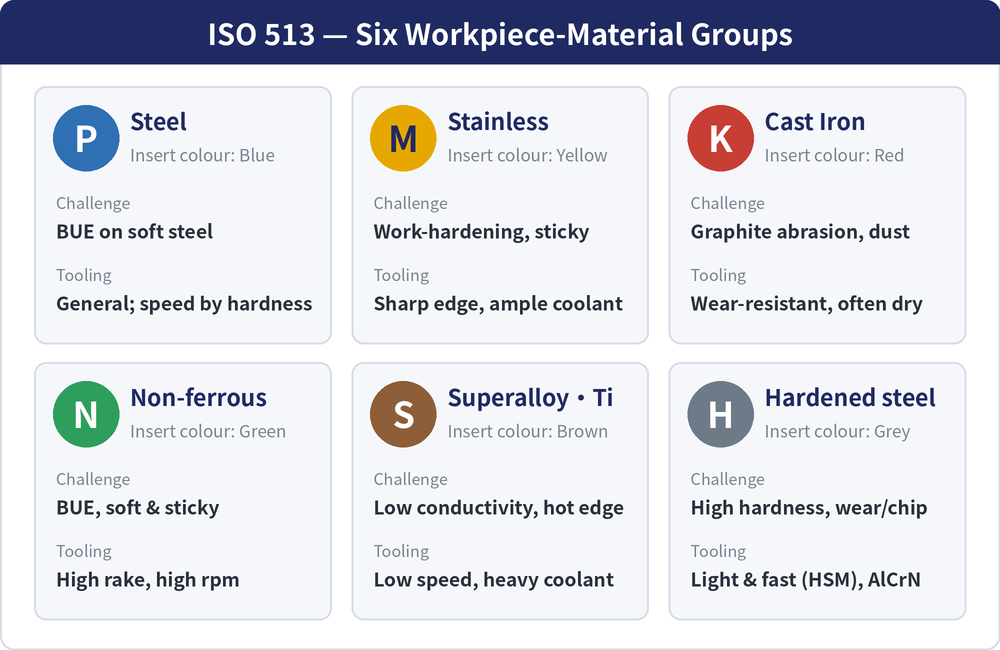
The workpiece material is the root factor that determines tool grade, coating and cutting parameters. Hardness, thermal conductivity, work-hardening tendency and stickiness vary enormously between materials, directly affecting tool life, efficiency and surface quality. The international standard ISO 513 divides workpiece materials into six groups — P, M, K, N, S, H — each with a colour code, providing a common basis for tool selection and parameter setting. This article overviews the six groups and their machining challenges, and builds the "material family × hardness state" two-axis mindset.
Why classify by workpiece material
The same tool can behave completely differently on different materials. Classifying by workpiece material gives tool selection and parameters a system to follow:
| Item | Description |
|---|---|
| Tool grade and coating | wear resistance (for high hardness) versus heat- and adhesion-resistance call for different choices. |
| Cutting speed and feed | conductivity and hardness set the usable vc range. |
| Cutting strategy | work-hardening materials dislike dwelling, brittle materials chip at edges, sticky materials form built-up edge (BUE). |
ISO 513 — the six groups at a glance
| Group | Colour | Representative materials | Main machining challenge | Tool & parameter direction |
|---|---|---|---|---|
| P Steel | Blue | S45C, SCM440, SKD11/SKD61 (annealed) | BUE on soft steel; wide strength range | General-purpose tools; adjust speed by hardness |
| M Stainless | Yellow | 304, 316, 440, 17-4PH (630) | Work-hardening, sticky, low conductivity | Sharp edge, ample coolant, avoid dwelling/rubbing |
| K Cast iron | Red | FC200/250, FCD | Graphite abrasion, dust, brittle edge chipping | Wear-resistant tools, often dry cutting, dust control |
| N Non-ferrous | Green | Aluminium 6061/7075, brass, beryllium copper | BUE, soft & sticky; Si-containing die-cast abrasion; BeCu dust toxicity | High rake sharp edge, high rpm, polished edge; protect against BeCu dust |
| S Superalloy · Ti | Brown | Ti-6Al-4V, Inconel 718 (Ni-based), Stellite (Co-based) | Low conductivity, work-hardening, hot tool tip, high-temp strength | Low cutting speed, heavy coolant, high rigidity, climb milling, no dwelling |
| H Hardened steel | Grey | HRC45–65 hardened steel, hardened SKD11 | High hardness, tool wear/chipping, high cutting force | HSM light-and-fast, AlCrN/nano coatings, high rigidity |
Machinability and tool-selection direction
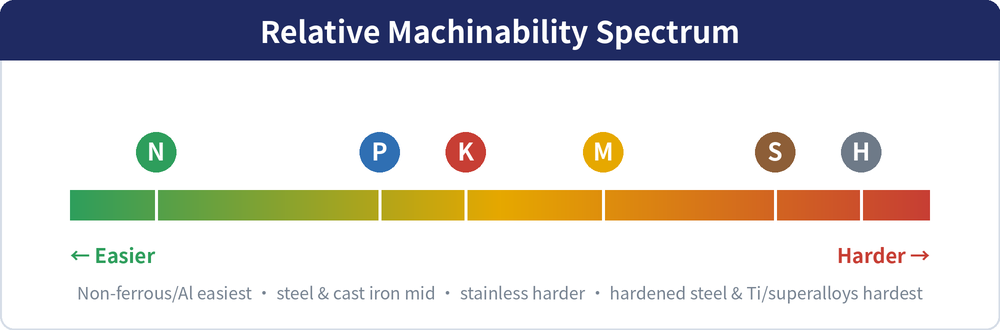
The general trend in relative machining difficulty is: non-ferrous/aluminium easiest, steel and cast iron in the middle, stainless harder, hardened steel and titanium/superalloys hardest. The harder it is, the lower the cutting speed and the more wear-resistant the grade and coating need to be.
For actual cutting-speed and feed values, see "End Mill Cutting-Conditions Calculation Guide"; for tool grades and coatings, see "Cutting Tool Material Classification."
Material family × hardness state: the two-axis concept
Beyond grouping, the more decisive factor is the hardness state. After heat treatment the same material changes hardness dramatically, and the strategy changes completely — e.g. annealed SKD11 is group P and easy to cut; hardened to HRC58 it becomes group H and needs wear-resistant tools and light-and-fast cutting. So when choosing tools, consider both "material family" and "current hardness state."
Also note: pre-hardened steel at HRC35 and a material "tempered to HRC35" have similar hardness but still differ in microstructure, residual stress and cutting behaviour.
The six groups in brief
| Item | Description |
|---|---|
| P Steel | covers carbon steel, quenched-and-tempered alloy steel and annealed mould steel — the most common machining target; soft steel needs BUE control, and the high-hardness state moves to group H. |
| M Stainless | austenitic (304/316) work-hardens badly, is sticky and low-conductivity; precipitation-hardening (17-4PH) is high-strength. The keys are a sharp edge, ample coolant, and never dwelling/rubbing. |
| K Cast iron | grey iron chips well but has clear graphite abrasion and dust; ductile iron is tougher. |
| N Non-ferrous | aluminium alloys for high-speed cutting with BUE control; die-cast aluminium with silicon causes abrasion; beryllium copper is strong but its dust is toxic and must be controlled. |
| S Superalloy · Ti | titanium alloys and Ni-/Co-based superalloys have low conductivity, work-harden and run hot at the tip — needing low speed, heavy coolant and high rigidity. |
| H Hardened steel | driven mainly by hardness state (pre-hardened/hardened/high-hardness), using high-speed light-and-fast cutting, dedicated hard-material coatings and rigid clamping. |
How to choose tools and parameters by material
- First determine the workpiece's group and current hardness state.
- Choose tool grade (carbide/HSS) and coating by group and hardness.
- Look up the material's cutting-speed and feed ranges and plug them into the calculation.
- Adjust depth of cut and strategy by operation type (roughing/finishing, slot/side/contour).
FAQ
What do ISO 513's P/M/K/N/S/H stand for?
P = steel (blue), M = stainless (yellow), K = cast iron (red), N = non-ferrous (green), S = superalloys & titanium (brown), H = hardened steel (grey) — the internationally common workpiece classification and insert colour code.
For the same material, is tool choice the same annealed and hardened?
No. For example annealed SKD11 is group P and easy to cut; hardened to HRC58 it is group H and needs a wear-resistant grade, hard-material coating and a light-and-fast strategy. Hardness state matters as much as material family.
Which group is the hardest to machine?
Generally group S (titanium, Ni-/Co-based superalloys) and group H (hardened steel) are hardest, because low conductivity, work-hardening or high hardness wear tools quickly; non-ferrous (N) is relatively easy. Actual results still depend on grade and hardness.
Once I know the material group, how do I set cutting parameters?
First look up the material's cutting-speed and feed-per-tooth ranges, then plug them into the speed and feed formulas; see "End Mill Cutting-Conditions Calculation Guide." This overview gives direction and does not replace actual parameter calculation and trial cuts.
This article is part of Workpiece Materials: The Complete Guide - Name the Metal First, Then Match the Tool; that guide shows how the whole topic fits together.