In-house Regrinding vs. Outsourced Grinding vs. Buying New — Which Is Cheapest?
When a carbide end mill goes dull, a shop usually has three roads: buy a new tool, send it out for grinding, or regrind it in-house. On the surface all three "work," but once you lay out the cost and time, the gap is bigger than you'd think. This article uses one typical shop's usage to make the math clear.
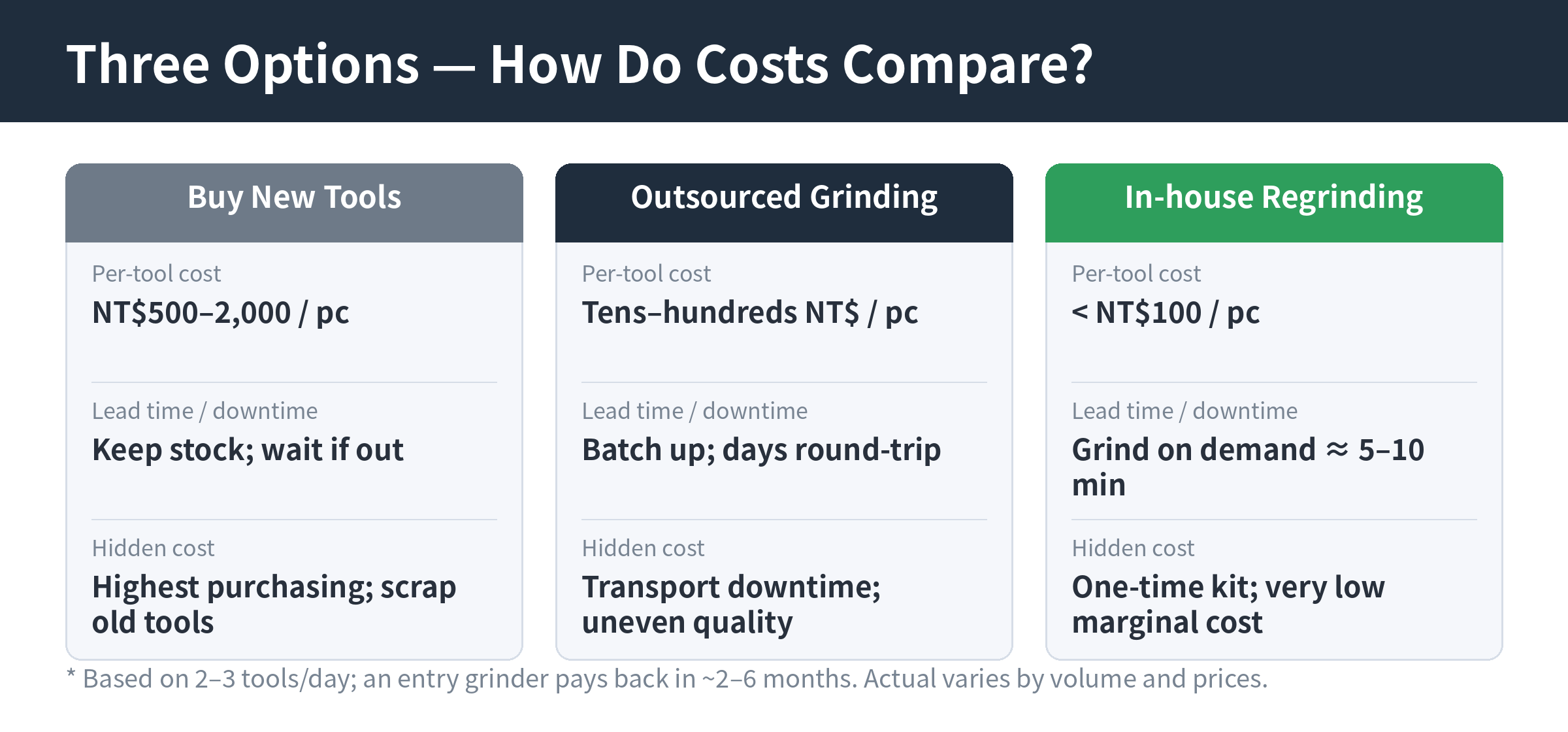
Three options, each with its own cost structure
| Option | Per-tool cost | Lead time / downtime | Hidden cost |
|---|---|---|---|
| Buy new | About NT$500–2,000 / tool | Need stock on hand; wait if out of stock | Highest purchasing cost; old tool scrapped |
| Outsourced grinding | About tens to a hundred-plus NT$ / tool (varies by diameter and vendor) | Need to batch up and ship back and forth; often tens of days | Shipping round-trips, downtime waiting, inconsistent quality |
| In-house regrinding | Consumables under NT$100 / tool | Grind and run immediately, about 5–10 min / tool | One-time equipment investment; very low marginal cost thereafter |
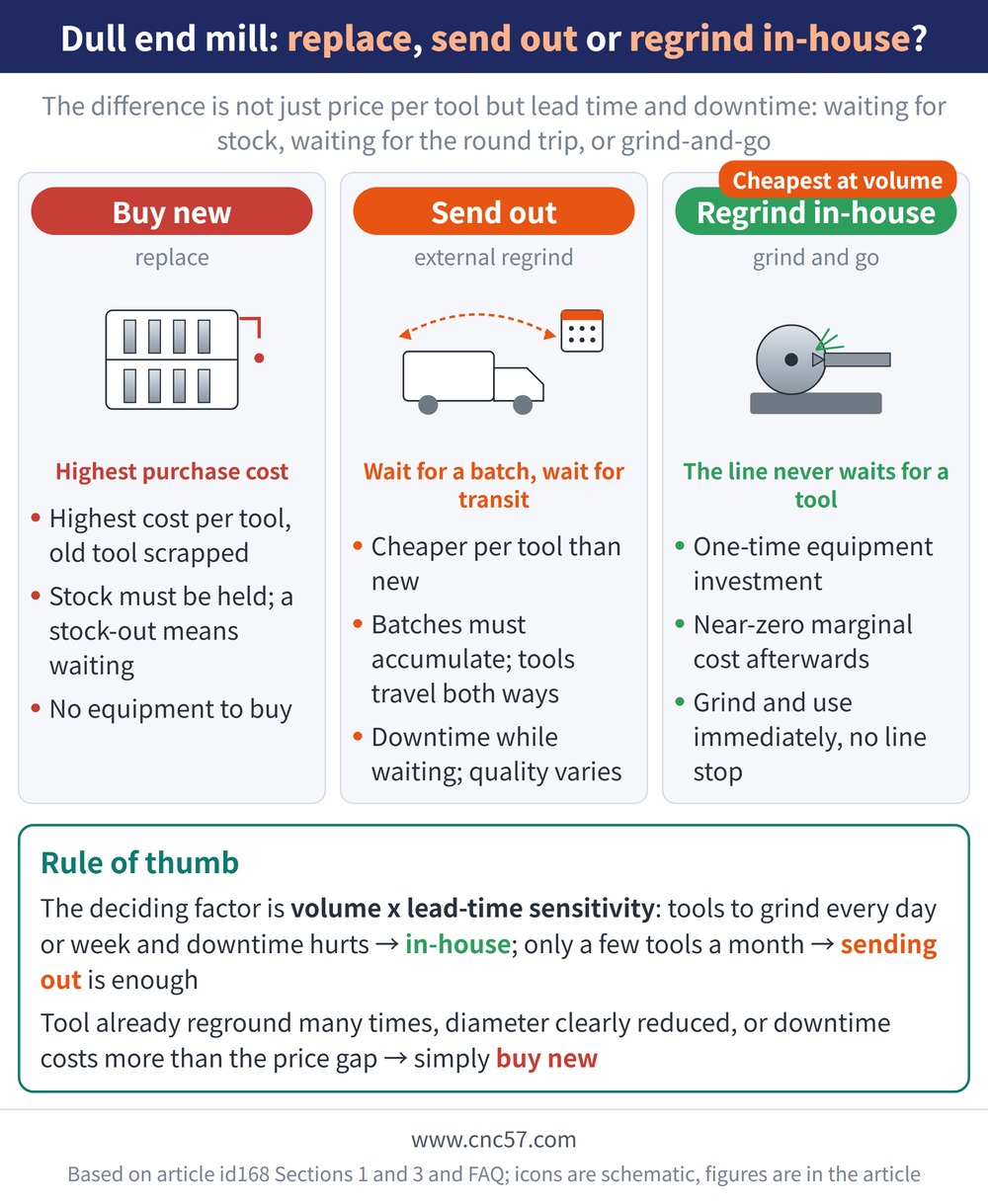
The key difference isn't just "how much per tool," but lead time and downtime. Buying new requires holding stock; outsourced grinding requires waiting for batches and logistics — these hidden costs are often overlooked. In-house regrinding is grind-and-run, so the line doesn't have to stop and wait for tools.
A calculation using a typical usage
Assume a shop needs to regrind 2–3 carbide end mills per day:
| Item | Description |
|---|---|
| If all are replaced new | at about NT$500–2,000 each, with 2–3 tools a day over ~22 working days, new-tool purchasing alone is a significant monthly outlay. |
| If reground in-house | at about NT$100 per regrind — and each tool can be reground many times — monthly consumables run only a few thousand NT$ at the same volume. |
| Switching from "buy new" to "regrind" saves several hundred to over a thousand NT$ per tool; against a one-time entry-level machine at NT$37,000, most shops recover the cost in about 2–6 months, with nearly pure savings after that (the higher the volume and the pricier the tool, the faster the payback). | |
Outsourced grinding is cheaper than buying new, but once you add lead-time waiting and batch requirements, its flexibility and long-term cost still lag in-house regrinding for shops that "use tools every day."
When should you consider buying a machine to regrind yourself?
| Item |
|---|
| You regularly have end mills to regrind every day/week, with steady volume. |
| You care a lot about lead time and can't accept tens of days of downtime from outsourcing. |
| You run many tool types (carbide, HSS, parting tools) and want one machine to handle them all. |
Conversely, if usage is sporadic and you grind only a few tools a month, outsourced grinding may be enough. The deciding factor is "volume × lead-time sensitivity" — the higher the volume and the more downtime hurts, the more worthwhile in-house regrinding becomes. (Not sure whether a tool should be reground? See "When to Regrind an End Mill? 5 Signs and the Correct Process.")
* The figures above are reasonable estimates; actual results vary with tool spec, unit price, usage, number of regrinds, and outsourcing rates.
FAQ
How long until in-house regrinding pays back?
It depends on usage. Estimating 2–3 tools per day, switching from buying new to regrinding saves several hundred to over a thousand NT$ per tool, so most shops recover an entry-level machine (NT$37,000) in about 2–6 months, mostly net savings after that; the higher the volume and tool unit price, the faster the payback.
What's the difference between outsourced grinding and in-house regrinding?
Outsourcing is cheaper per tool but requires batching and round-trip shipping, often tens of days, with inconsistent quality. In-house is grind-and-run, about 5–10 minutes per tool, so the line doesn't stop to wait. For high-volume, downtime-sensitive shops, in-house is cheaper long term.
Is buying a grinder worth it if usage is low?
If you grind only a few tools a month, outsourcing may be enough. Buying a machine pays off clearly when you regularly have tools to grind every day/week and you care about lead time.
When is simply buying a new tool the most economical?
When a tool has already been reground several times with noticeable diameter or length loss, or when precision demands and downtime costs outweigh the price gap, buying new often beats regrinding; low-cost, high-consumption standard tools are also usually replaced rather than reground.
For the full reading guide on this topic, see Tool Life and Wear: A Complete Reading Guide.
This article is part of Tool Regrinding: The Complete Guide — Decide Whether to Grind, Then Look Up How, With What, and How to Check; that guide shows how the whole topic fits together.
This article is part of End Mills: The Complete Guide - Know the Cutter, Choose It, Set the Conditions; Toolpaths Are Another Line; that guide shows how the whole topic fits together.
Further reading
| Item |
|---|
| When to Regrind an End Mill? 5 Signs and the Correct Process |
| End Mill Wear Analysis | A Complete Guide to Normal and Abnormal Wear |
Want to assess the right model for you? Take a look at the End Mill Grinder (Made in Taiwan · 1-year warranty · 2 on-site training sessions) — fits Φ3–20mm, with a "milling + parting" combo model also available. Send an online inquiry and we'll help estimate your usage and payback period.