
Work Hardening Explained: Causes, Prone Materials and Fixes
When you cut stainless steel or a superalloy, the surface gets harder the more you cut and the edge dulls almost at once — this guide helps you decide how to break that cycle. Which materials are most prone to it, the six countermeasures you can actually apply on the floor, and which one to reach for first are all covered.
1. What work hardening is: plastic deformation hardens the surface
Work hardening (also called strain hardening) is the effect where plastic deformation distorts the surface lattice and piles up dislocations, raising the hardness and strength of the surface layer.
The high strain in the cutting zone makes the machined surface harder than the base material, so the next pass is cutting a harder layer. This is an inevitable physical effect of ductile metals, not a fault of the tool or the parameters.
2. How the vicious cycle forms: rubbing, not cutting
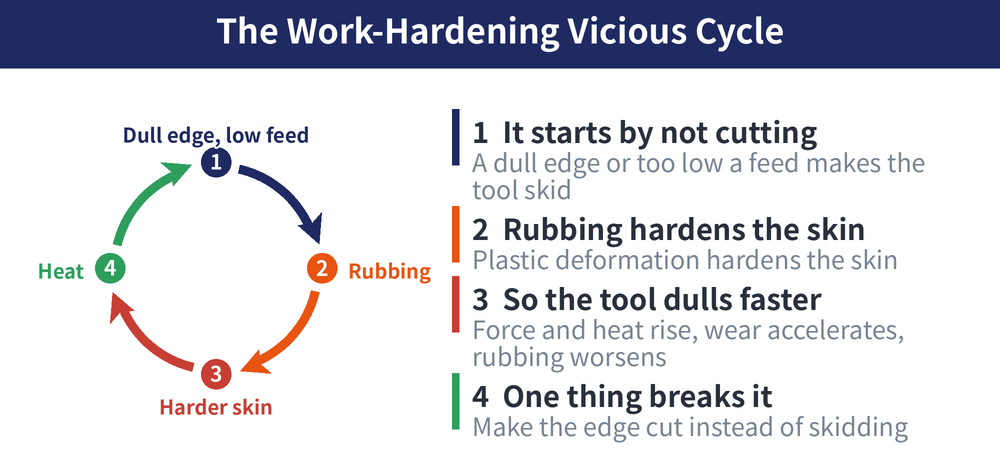
Work hardening itself is not the problem; the vicious cycle it feeds is. When the edge is dull, the rake angle too small, or the feed too low, the tool only rubs and scrapes the surface instead of cutting into it.
Rubbing hardens the surface layer, the material gets harder to cut, cutting force and heat rise, the tool dulls faster, and the rubbing worsens — round and round.
In one line: rubbing rather than cutting is the root of runaway work hardening. Get the edge to truly "bite into" the material instead of skating on the surface, and the cycle is broken.
3. Which materials are especially prone to work hardening
The tendency to work harden is tied to lattice structure, thermal conductivity and ductility; the following classes deserve the most caution.
| Material | Why it hardens easily | Note |
|---|---|---|
| Austenitic stainless (e.g. 304/316) | Face-centred cubic structure, low thermal conductivity, high ductility | Marked work hardening, the most common material to trip up on |
| Nickel-based superalloy (e.g. Inconel family) | High strength at temperature, poor conductivity, heat concentrates at the edge | Severe hardening, the hardest-to-cut S group in the ISO classification |
| High-manganese steel (Hadfield) | Designed to rely on work hardening for wear resistance | Extremely hard to cut, usually needs a special strategy or grinding (see sections 5 and 6 for how to cut it) |
| Some titanium alloys and duplex stainless | High strength, poor conductivity, medium to high work hardening | Harder to cut than plain carbon steel; needs a sharp edge and enough depth |
Material tendencies are a general summary; 304/316/Inconel/Hadfield are common standard grades. Actual work-hardening degree varies with grade, batch and heat treatment — defer to the standard or catalogue. For stainless see the M-group stainless steel machining guide; for titanium and superalloys see the S-group titanium and superalloy machining guide.
4. Six countermeasures: make the tool actually cut
The core of every fix is one thing — let the edge cut rather than rub. The six moves below break the vicious cycle.
| Countermeasure | Why it works |
|---|---|
| ① Sharp edge + positive rake | Makes the tool bite in rather than rub, cutting surface plastic deformation |
| ② Enough depth of cut | Cuts below the layer hardened by the previous pass, not just skimming the hard skin |
| ③ Feed not too low | Too low a feed per tooth skids and rubs on the hardened layer, making it worse |
| ④ Avoid dwelling and air-scraping | A tool stopped on the part, or scraping without cutting, only builds a hardened layer |
| ⑤ Ample cooling and rigid clamping | Lowers edge heat and deflection, keeping the cut stable |
| ⑥ Change dull tools promptly | A dull tool is the rubbing source; pushing on only speeds the cycle up |
Number ③ is the most counter-intuitive: slowing down when hardening appears is a common mistake, since too low a feed just skids on the hardened layer. For setting cutting parameters see the end mill cutting conditions guide.
Specific depth of cut, feed per tooth (fz) and cutting speed (vc) are typical values — defer to the tool catalogue and standard; this site does not invent figures. For tool material and coating pairing see material and coating selection by workpiece; for hardness and tool choice see hardness and tool selection; for how heat treatment affects machinability see heat treatment and machinability.
5. Why high-manganese steel is hard to cut, and how to set turning parameters
High-manganese steel is heated and then quenched in water to give a single austenitic structure; under impact or plastic deformation its surface turns into fine-grained martensite. Hardness can climb from about 170–220 HBS to about 500–550 HBS, the hardened layer can reach 0.3 mm or more, and the hardening is more severe than in austenitic stainless. That is where its wear resistance comes from, and cutting is exactly what applies the force.
So the parameter rules run against the usual instinct for difficult materials ("cut shallow, keep the feed low"): what you are fighting is not the hardness but the layer the previous pass left behind.
| Parameter | What to do on high-manganese steel | Why |
|---|---|---|
| Depth of cut | Medium | Too deep and the cutting force is excessive; too shallow and the edge works inside the layer hardened by the previous pass and wears faster |
| Feed | High | The hardened layer is deep; a low feed just keeps scraping inside it |
| Cutting speed | Low with carbide tools | Cutting force is high and temperature runs high, so the tool wears fast |
| Carbide turning | Roughing | Semi-finishing | Finishing |
|---|---|---|---|
| Depth of cut ap (mm) | 3–6 | 1–2 | 0.5–1 |
| Feed f (mm/rev) | 0.3–1.5 | 0.2–0.8 | 0.2–0.8 |
Carbide cutting speed is about 20–50 m/min: the low end for roughing, the high end for semi-finishing and finishing. All of these are reference values; take actual values from the tool catalogue, and for the speed conversion see the end mill cutting conditions guide.
6. Drilling and milling high-manganese steel
Drilling is the hardest: drilling is a semi-enclosed cut, chips are hard to clear and the drill is not very rigid. Brazed carbide drills and indexable drills for shallow holes are the more practical choices. When regrinding, shorten the chisel edge and reduce its negative rake to lower the thrust, and enlarge the point angle to help chip flow (for regrinding technique see the Carbide Drill Regrinding Guide). Coolant must be ample and never interrupted, and submerging the part in cutting fluid is best where possible; the hole can shrink from spring-back, so choose a drill slightly larger than the hole.
Milling: for roughing, a carbide end mill with a wave-shaped edge helps: it cuts only near the wave crests, breaking wide, thin chips into short, thick pieces; the thicker chip means less of the edge skidding on the hardened layer. The price is a rougher surface, so it is for roughing only.
Beyond cutting parameters: avoid knocking the workpiece surface during handling and storage, since every knock hardens it before machining even starts; a high-temperature temper before cutting lowers the hardening tendency, but the original heat treatment must be redone afterwards to restore wear resistance; and roughing can switch to hot machining. For the opposite route, making it brittle with cold, see section 4 of Two Assisted Routes for Difficult Materials.
Last updated: 2026-10-26
7. Frequently Asked Questions (FAQ)
Q: Why does stainless steel get harder the more I cut it?
Austenitic stainless (such as 304/316) has low conductivity and high ductility, so plastic deformation hardens the machined surface and the next pass cuts a harder layer. A dull edge or too-low feed makes the hardening worse.
Q: Does too low a feed actually make it worse?
Yes. When the feed per tooth is too low the edge cannot bite the hardened layer and just skids and rubs, creating more hardening and speeding up wear. Faced with hardening, give enough depth and feed rather than simply slowing down.
Q: How do I recover once a hardened layer has formed?
Use a fresh sharp edge and a larger depth of cut to take the whole hardened skin off in one pass; do not keep scraping it with a dull tool at shallow depth. Anneal to soften first if necessary.
Q: Can work hardening be avoided completely?
No. It is an inevitable effect of deforming ductile metal and cannot be eliminated, only controlled. A sharp edge, positive rake, and enough depth and feed keep it within an acceptable range and out of the vicious cycle.
This article is part of Workpiece Materials: The Complete Guide - Name the Metal First, Then Match the Tool; that guide shows how the whole topic fits together.









