
Grinding Parting Blades: Twelve Edge Forms and the Materials They Suit
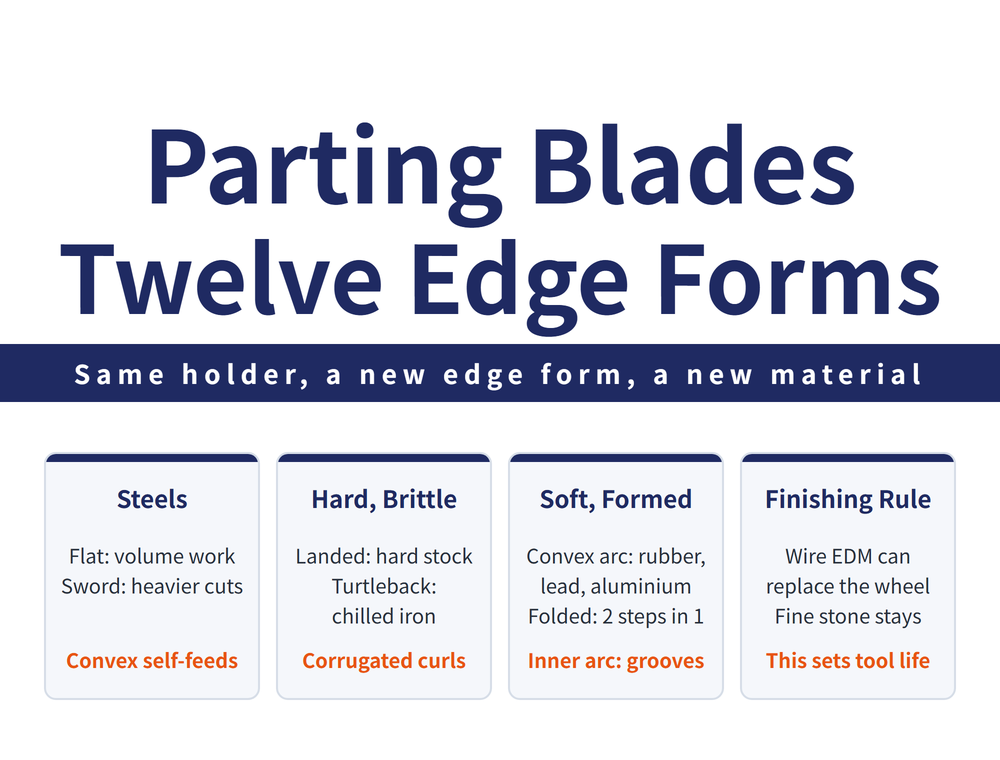
The parting blade chips first and gets reground most. Keep the holder and change only the edge form and the same blade covers a different material. This guide maps twelve parting edge forms to their workpieces, details the three that carry real numbers, and says which hand pass survives even after wire EDM replaces grinding.
1. Why a machinist is judged on the parting blade first
A shop-floor saying goes: a workshop that cannot grind a parting blade is a third-rate workshop. The first test of a turner is whether they can grind a good parting blade quickly — the blade is thin, has poor rigidity and little room for chips, so it is the easiest tool of all to chip. Parting itself is covered in How to Part Off, and indexable selection in How to Select Parting and Grooving Tools.
2. Twelve edge forms: start from the material
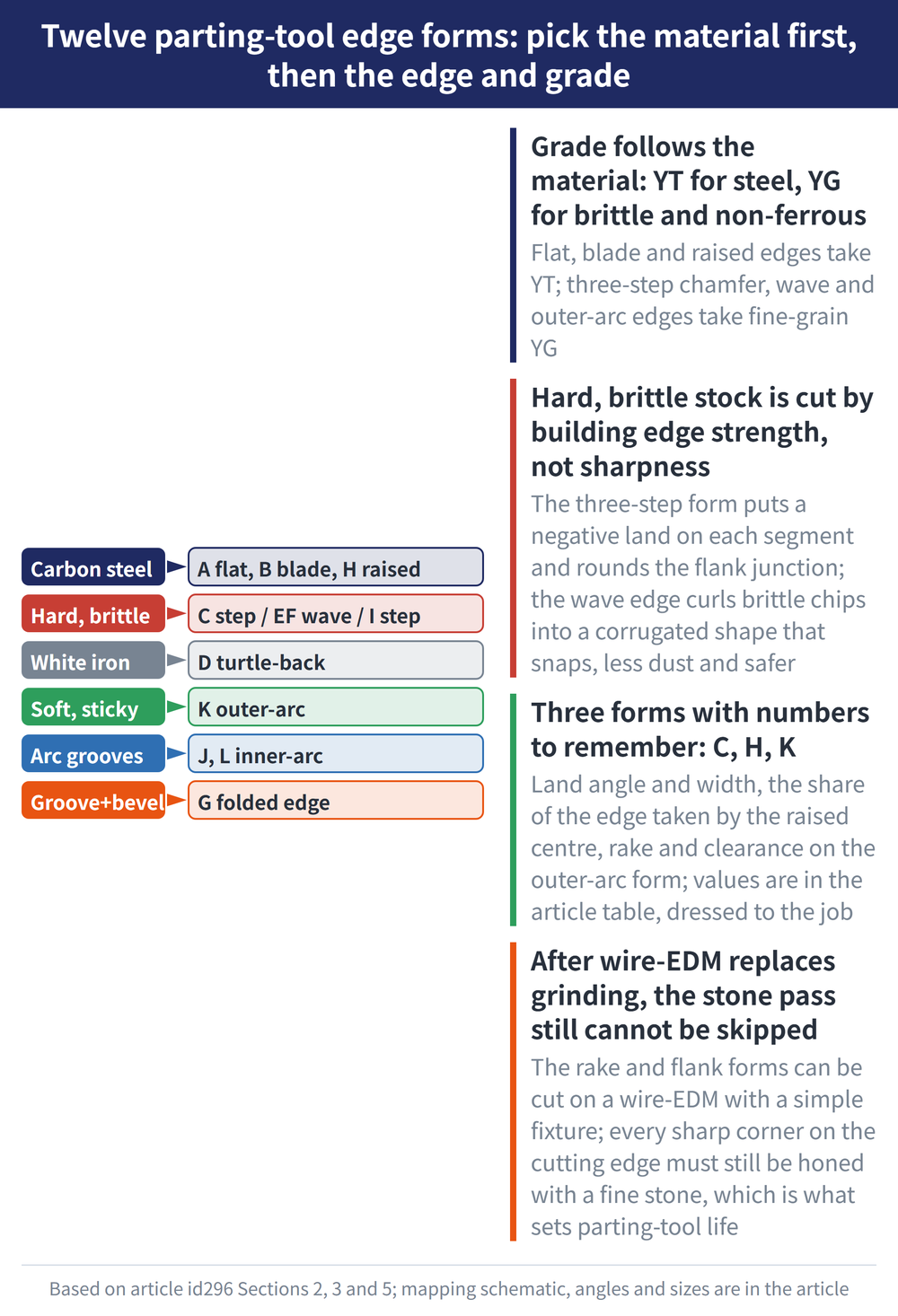
Two grade families run through the table: YT (tungsten-titanium-cobalt, ISO P, for steel) and YG (tungsten-cobalt, ISO K, for brittle and non-ferrous work). Grade codes are decoded in Carbide Grades Decoded.
| Edge form | Grade | Use and character |
|---|---|---|
| A Flat edge | YT | Volume parting of medium carbon steel |
| B Sword edge | YT | Heavier cuts, volume parting of carbon steels |
| C Three-segment landed edge | Fine-grain YG | Hardened steel, cast stone, glass and other hard brittle stock |
| D Turtleback edge | — | Domed rake, impact resistant; untempered and chilled cast iron |
| E, F Corrugated edge | YG | Brittle stock; debris curls and breaks, less dust and safer |
| G Folded edge | — | Shallow grooves plus a chamfer on one side in one operation |
| H Convex edge | YT | Self-feed parting of carbon and stainless bar; good guidance and chip splitting |
| I Double-step edge | — | Heavy cutting of brittle stock; the chip flips at the second step and snaps |
| J, L Internal arc edge | — | All internal and external radiused ring grooves |
| K Convex arc edge | Fine-grain YG | Rubber rollers, rubber-covered shafts, lead, aluminium and plastic bar |
3. The three forms that carry real numbers
| Edge form | Key dimensions |
|---|---|
| C Three-segment landed edge | Main edge split into three roughly equal segments, each landed −30°×2~3 mm; the lines where the major and both end flanks meet stoned to a 0.5~1 mm radius |
| H Convex edge | The central convex section takes 3/5 of the edge width; rake ground to a 12°~15° arc; every edge landed −15°~−20°×0.5~0.8 mm and each sharp corner stoned to about 45°×0.3 mm |
| K Convex arc edge | Rake close to 30°~45°, clearance 12°; the arc itself follows the part drawing |
Why a land rescues the edge is covered in What Else You Can Grind Into a Turning Tool, and the machinability of the iron family in K-Group Cast Iron Machining Guide.
4. The B sword edge: how one high-speed parting blade is built
Of the twelve, the B form is the one worth taking apart; it is the classic high-speed heavy-duty parting design:
| Stage | What is done |
|---|---|
| Tip and holder | The back of the YT15 tip and the holder pocket are both cut at 60°, raising braze strength so nothing debonds |
| Grinding order | Rough and semi-finish holder and tip to shape, then finish-grind the 120° nose angle, the rake, both approach angles and the clearance |
| Finishing | Every remaining edge on the tip is stoned carefully with fine silicon carbide |
| Setting up | Take the clearance out of every sliding element of the tool post; clamp both part and tool firmly |
A reservation on the numbers: there is a set of cutting data for this blade together with a reported efficiency gain of more than three times, but that is a single-source, single-setup measurement, so the figures are not reproduced here. Work out your own from Turning Cutting Conditions Guide.
5. After wire EDM takes over, one pass still cannot go
The rake and flank forms above used to be ground on various bench and tool grinders, which demanded real skill. Today a simple two-axis fixture on a wire EDM machine cuts them instead, and the job becomes straightforward.
One thing was not replaced: every sharp corner on the cutting edge still has to be stoned with a fine oilstone, and that is what actually buys tool life. Post-grinding inspection and common mistakes are not covered here. For working chipping and poor surface backwards, see Parting and Grooving Troubleshooting and Tool Wear Guide.
6. Frequently Asked Questions (FAQ)
Q: Which edge form parts glass or cast stone?
The C three-segment landed edge with a fine-grain YG tip. Splitting the main edge into three segments each landed at −30°, then radiusing the flank intersections, works by building edge strength rather than by making the edge keen.
Q: Brittle stock throws debris everywhere — is there a geometry for that?
The E and F corrugated edges. They make the flying debris deform and curl before it breaks, so there is visibly less dust and the job is safer. The I double-step edge is the other option, flipping the chip at the step to snap it.
Q: If the form is cut by wire EDM, is a stone still needed?
Yes. What wire EDM removes is the shaping of the rake and flank faces. Every sharp corner on the cutting edge still has to be stoned, or the blade will not hold up.
Q: Do aluminium, plastic and rubber need a different edge too?
They do. Soft or gummy stock takes the K convex arc edge with rake opened close to 30°~45° and 12° clearance, so the chip flows away instead of sticking and being squeezed.
This article is part of Tool Regrinding: The Complete Guide — Decide Whether to Grind, Then Look Up How, With What, and How to Check; that guide shows how the whole topic fits together.
Published: 2026-08-17|Last updated: 2026-10-21









