
M-Group Stainless Steel Machining Guide: Austenitic, Martensitic & Duplex
Most stainless steel falls in ISO 513's group M (insert colour: yellow). It is everywhere thanks to corrosion resistance and appearance, but it is also widely regarded as "hard to cut." The trouble comes mainly from three things: severe work-hardening, sticking (built-up edge), and poor thermal conductivity. Of these, work-hardening is the most critical — the moment the tool dwells or rubs with a light cut, the surface hardens fast, making the next pass harder and wearing the tool quicker. This guide covers the five stainless families, their grades and tool-selection direction; for the overview see "ISO Workpiece Material Classification."
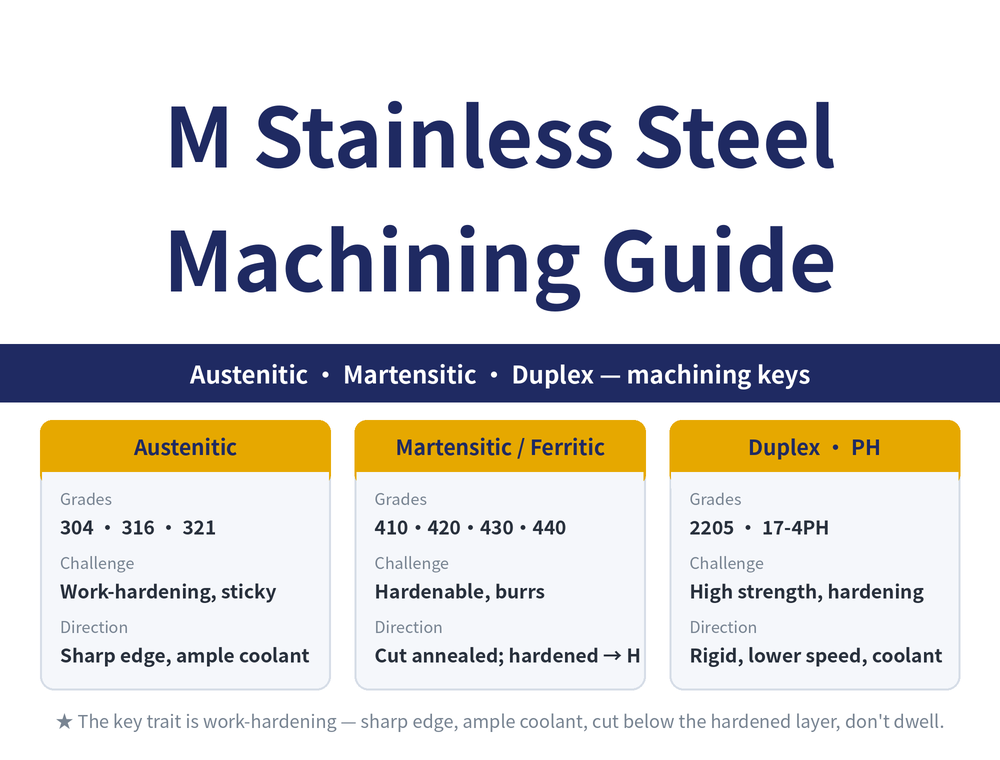
The five stainless families and their machinability
| Family | Representative grades | Characteristics | Main machining challenge | Tool / parameter direction |
|---|---|---|---|---|
| Austenitic | 304, 316/316L, 321 | Non-magnetic, very corrosion-resistant, tough | Severe work-hardening, sticking/BUE, low conductivity | Sharp edge, positive rake, ample coolant, no dwelling, TiAlN/AlCrN |
| Ferritic | 430, 409 | Magnetic, cheaper, moderate corrosion resistance | Easier to cut, but burr-prone | General carbide, sharp edge, watch deburring |
| Martensitic | 410, 420, 440C | Heat-treatable/hardenable, magnetic | Easy annealed; high HRC after hardening → near group H | Machine annealed; wear-resistant tool + AlCrN after hardening |
| Duplex | 2205, 2507 | High strength, high corrosion resistance | Even worse work-hardening, high cutting force, heat | High rigidity, sharp edge, heavy coolant, lower vc |
| Precipitation-hardening (PH) | 17-4PH (630) | High strength | High strength, high heat | Wear-resistant carbide + AlCrN, moderately lower speed |
In practice austenitic (304/316) is the most common and the most prone to work-hardening and sticking; duplex is harder and tougher — the most difficult; ferritic is relatively easy; martensitic depends on hardness state (annealed = group P, hardened = group H). Under ISO 513, group M covers only austenitic and duplex stainless; ferritic, martensitic and precipitation-hardening grades fall in group P.
The key challenge: work-hardening
With stainless (especially austenitic and duplex), as soon as you dwell, take light cuts, or rub with a dull tool, the surface work-hardens quickly — then the tool wears fast, chips, and dimensions drift. The right approach is to use a sharp edge, give enough depth to cut below the hardened layer, feed continuously without dwelling, and flood with coolant.
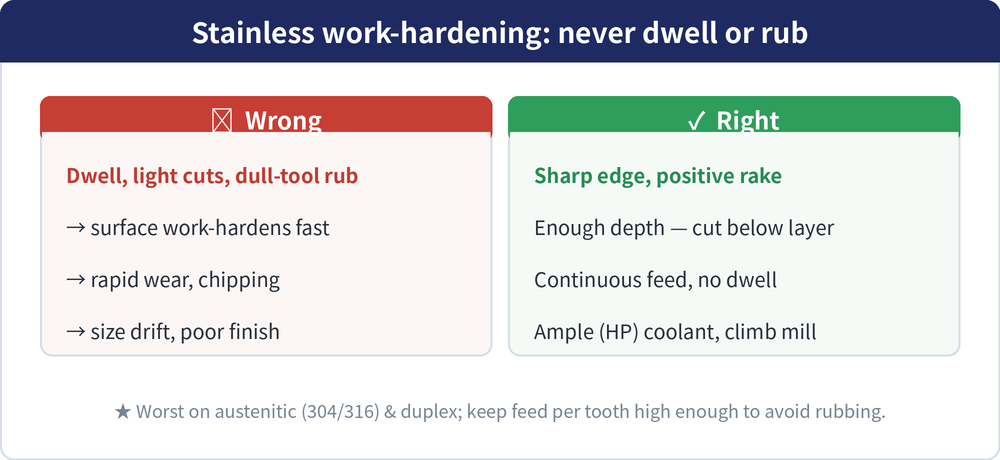
Two more challenges: sticking / built-up edge — stainless is tough and sticky, so use a sharp edge, positive rake and a moderate (not too low) cutting speed to suppress BUE; poor conductivity — heat concentrates at the tool tip, so use ample (high-pressure) coolant and a moderately lower speed to protect the edge.
Tool grade and coating direction
Stainless is mainly machined with carbide + PVD coatings: commonly TiAlN / AlCrN / AlTiN for heat and anti-stick performance. The edge must be sharp with a positive rake to reduce cutting force and BUE; raise tool and clamping rigidity for thin walls or interrupted cuts. For full grade and coating selection, see "Cutting Tool Material Classification."
Key cutting strategy
| Item | Description |
|---|---|
| Cutting speed | slightly lower than plain carbon steel; too low invites BUE, too high overheats the tip — pick a moderate range. |
| Feed | keep feed per tooth high enough to cut below the work-hardened layer; avoid tiny feeds that rub the surface. |
| Coolant | ample, ideally high-pressure, to carry away heat and chips and protect the edge. |
| Strategy | prefer climb milling with continuous feed and no dwelling; for thin walls raise rigidity and take light layered cuts. For specific vc/fz values, see "End Mill Cutting-Conditions Calculation Guide." |
Turning: why stainless sticks to the tool and the chip will not break
Turning stainless brings work hardening, sticking and poor chip breaking all at once, and the low conductivity keeps the heat at the tool nose.
| Item | What to do |
|---|---|
| What goes wrong | Tough chips that do not curl or break; low-carbon austenitic grades build up edge and tear the surface |
| Choosing the tool | Sharp edge and a large rake angle to limit work hardening; a smooth rake face to resist sticking |
| Starting conditions | Start from row M in section 6 of the cutting conditions guide; never feed so lightly that the edge rides on the hardened layer instead of cutting under it |
| Coolant and chips | Coolant must both lubricate and cool: emulsion for roughing, sulphurised cutting oil for most other turning |
| Common problems | Chips wrapping: switch to a full-radius chipbreaker. Finished size drifting: stainless expands a lot with heat, so watch part temperature when measuring |
For chip control see Turning Chip Control Guide: Chip Breaker & Cutting Conditions; for edge preparation see Turning Tool Edge Preparation Guide: Chamfer, Hone & Tool Life; for speed and feed see Turning Cutting Conditions Guide: Speed, Feed & Tool Life.
Milling: why stainless packs chips and wears out inserts
Milling is interrupted cutting: every edge enters and exits the cut on each turn. Stainless chips are sticky and long, so once chip room runs short they pack and get cut a second time, and work hardening then wears the edge down.
| Item | What to do |
|---|---|
| What goes wrong | Chips pack in the flutes or between inserts and are recut; worse in conventional milling, shortening tool life |
| Choosing the cutter | Sharp edge, positive rake; coarse pitch on face mills for chip room; trochoidal milling in deep slots |
| Starting conditions | Use the stainless row of the calculation guide; feed per tooth is lower than for most materials, but never so low that the edge rubs the hardened layer |
| Coolant and chips | Wet milling needs ample flow; before going dry, make sure the PVD coating and a difficult-material chip breaker are right |
| Common problems | Packed chips, torn surface: go coarse pitch or climb milling. Inserts chipping early: check coating and chip breaker before blaming dry cutting |
For coarse versus fine pitch see Face Mill Pitch Selection: Coarse, Fine and Differential; for why conventional milling hurts the tool see Climb Milling vs Conventional Milling; before going dry read Dry Milling by Material: Cast Iron, Steel, Aluminium and Stainless Strategies. Speed and feed conversions are in End Mill Cutting Conditions Guide.
Drilling: why stainless burns drills so quickly
Drilling is where stainless gives the most trouble: chips are trapped in the hole, heat cannot escape, and any dwell at the hole bottom work-hardens it. All three challenges above show up at once.
| Item | What to do |
|---|---|
| What goes wrong | High thrust; chips do not curl and pack; scored walls, oversize holes, burnt or broken drills |
| Choosing the drill | A modified point: chip-splitting notches, shortened chisel edge, double point angle; shorter drill and thicker web for rigidity |
| Starting conditions | HSS drills about 8-24 m/min cutting speed (typical range), lower than for carbon steel; do not let the feed get too small |
| Coolant and chips | Plenty of cutting oil, never interrupted; the deeper the hole, the more conservative the conditions and the more retracts |
| Common problems | Chips tangling: retract and check at once. Polygonal hole: check edge symmetry and whether clearance is too large |
The speed range varies with diameter and grade; follow the drill catalog. For conversions see Drilling Parameters Guide; for point grinds see Drill Point Types by Material and Hole; for fluids see Cutting Fluid Comparison for Drilling.
Tapping: why stainless makes taps stick and chip
Austenitic grades (304/316) combine high ductility and low yield strength with relatively high tensile strength: chips come off tough and long, flank friction is high, and once they are trapped in the hole the tap sticks and chips.
| Item | What to do |
|---|---|
| What goes wrong | Hard chips run straight and pack the flutes; material welds to the tap and the thread surface comes out rough |
| Choosing the tap | More flutes, a 45° high helix and a shorter threaded section to cut friction; a multilayer coating combining heat resistance with a low-friction outer layer |
| Starting conditions | About 3-9 m/min for cutting taps and 6-15 m/min for form taps (typical range); a synchronised spindle with a minimal-compensation holder |
| Oil and chips | A non-water-soluble cutting oil with good lubricity, used with an oxide-treated tap (the porous layer holds oil and resists welding) |
| Common problems | Chips wrapping and chipping the thread: lower the speed, use a high-helix tap. Rough thread: switch to an oxide-treated tap and keep the oil supply full |
Austenitic stainless is ductile enough for form taps, which make no chips but need about 2-3 times the torque of a cutting tap; see Cutting Tap vs Forming Tap. For RPM conversion see Tap Cutting Speed Guide; for regrinding fixes when small taps chip see Tap Chipping and Breakage Solved by Regrinding.
FAQ
What is the hardest part of machining stainless?
Work-hardening, especially austenitic (304/316) and duplex. The moment the tool dwells, takes light cuts or rubs, the surface hardens fast, causing rapid wear and chipping. Use a sharp edge, enough depth to cut below the hardened layer, continuous feed and ample coolant.
What should I watch when machining 304/316?
Use a sharp, positive-rake carbide with AlCrN/TiAlN coating; keep a moderate cutting speed and high-enough feed per tooth; feed continuously without dwelling; flood with (high-pressure) coolant and prefer climb milling — never rub the hardened layer.
Are martensitic stainless (420/440) group M or H?
It depends on the hardness state, and neither is group M. Annealed it is group P (ISO 513 group M covers only austenitic and duplex stainless) and easy to cut; once hardened to high HRC it is group H, needing wear-resistant tools, hard-material coatings and a light-and-fast strategy.
Why does stainless stick and form built-up edge?
Stainless is tough, low-conductivity and work-hardens easily, so chips adhere to the edge and form BUE. A sharp edge, positive rake, a moderate (not too low) cutting speed and ample coolant suppress it effectively.
This article is part of Workpiece Materials: The Complete Guide - Name the Metal First, Then Match the Tool; that guide shows how the whole topic fits together.
Further reading
Published: 2026-06-24 | Last updated: 2026-10-21









