
Why Dry Drilling Is Hard: Built-Up Edge, Geometry and Minimum Quantity Lubrication
Dry turning and dry milling are mature processes; dry drilling is acknowledged as the hardest of the three. The reason is not tool material but the semi-enclosed space the drill works in: heat cannot escape, and chips must travel back out of the same hole. This article traces how built-up edge forms, which way the three geometry parameters should move, and how far minimum quantity lubrication and cooled air can take you.
1. Why dry drilling is harder than dry turning or milling
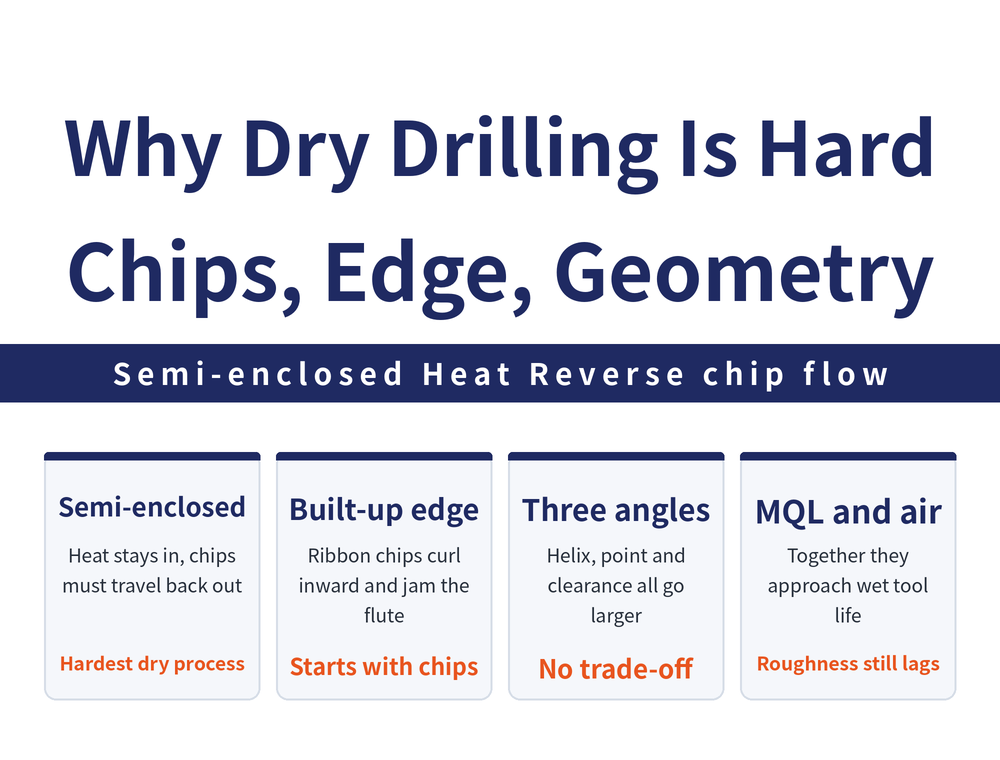
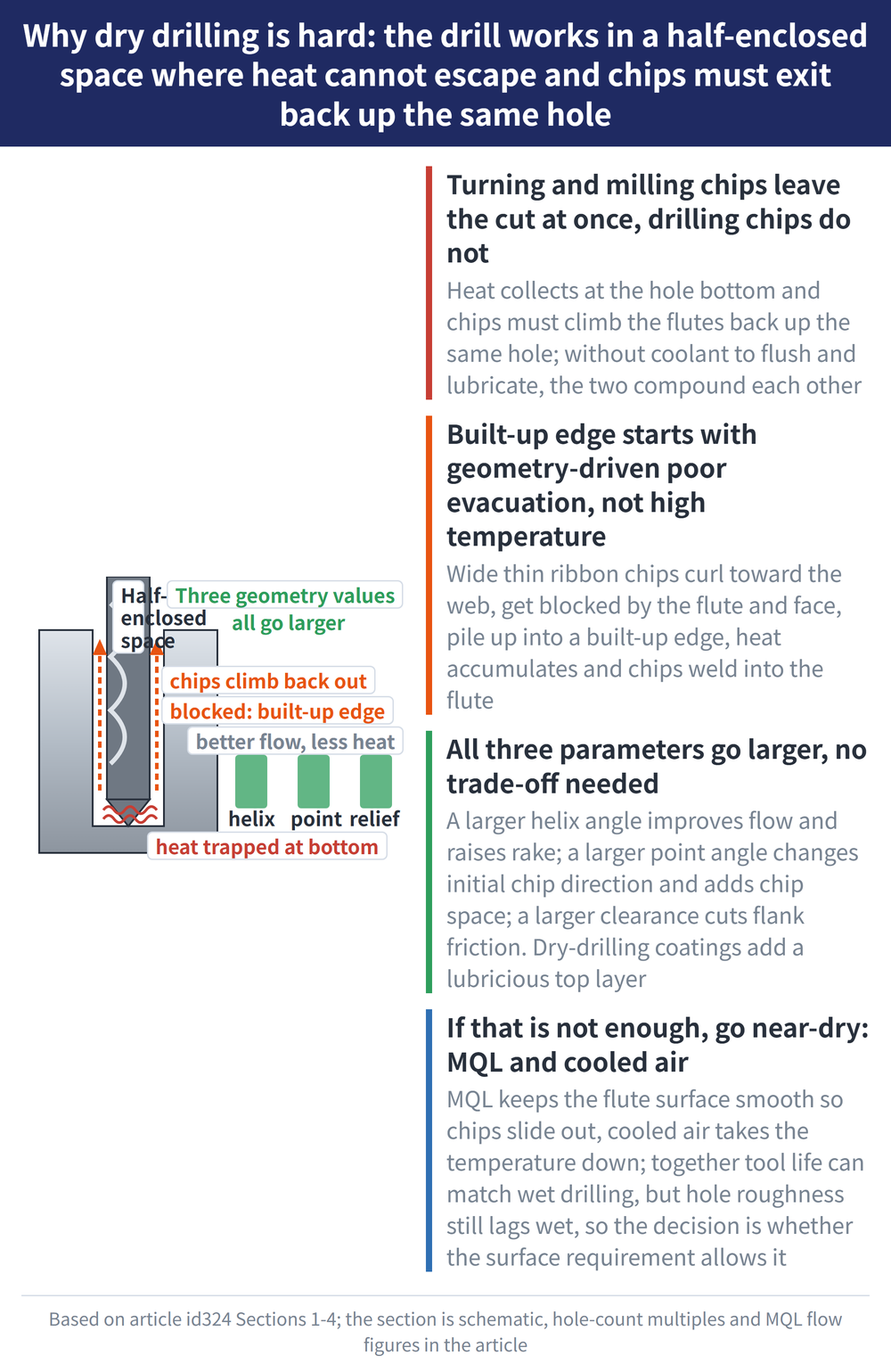
In turning and milling the chip leaves the cutting zone as soon as it leaves the edge. Drilling is different. The drill works inside a semi-enclosed space: the heat generated collects at the bottom of the hole with nowhere to go, and the chips still have to travel back out through that same hole along the flutes. Without coolant to flush and lubricate, these two problems reinforce each other, which is why dry drilling is regarded as the most difficult member of the dry machining family. For the overall coolant decision, see how to choose cutting fluid.
2. How built-up edge grows, step by step
Dry drilling an Al-Si-Cu cast aluminium alloy often produces severe built-up edge after only a handful of holes. The path is clear:
On a standard drill the chip flow velocity increases from the centre outward, so the whole main cutting edge produces a wide, thin ribbon chip that curls toward the drill centre. Blocked by the flute and the end face, those chips pile up into a built-up edge; larger chips then jam as well, heat accumulates in place, chips weld into the flute, and the drill loses its ability to cut.
Note that this path starts with geometry-driven poor chip evacuation, not with excessive temperature. The countermeasure therefore has to begin with geometry rather than with cooling alone. For distinguishing built-up edge from other wear modes see the tool wear analysis guide, and for reading chip shapes see drill chip formation.
3. Three geometry parameters, all pointing the same way
| Parameter | Direction | Effect |
|---|---|---|
| Helix angle | Increase | Better chip evacuation; rake angle rises, heat falls |
| Point angle | Increase | Changes initial chip flow, more chip space, less built-up edge |
| Clearance angle | Increase | Less flank-to-workpiece friction, less heat |
All three move in the same direction, which is a rare piece of good news in dry drilling — no trade-off between parameters is required. The source orthogonal trials also show that combinations of large helix angle with large point angle achieve noticeably more holes than small-angle combinations, while the effect on surface roughness is small (source: Dry Cutting, ch. 4; single-source trial results, follow the tool catalogue in practice). For how each parameter affects machining overall, see drill geometry and function.
Coating is the other route. Coating series developed specifically for dry drilling add a highly lubricious top layer over a TiAlN base, giving lubrication close to that of coolant during drilling, combined with a purpose-designed flute. For coating positioning see common tool coating materials.
4. Minimum quantity lubrication and cooled air: how far do they get you
If geometry and coating are not enough, the next step is near-dry. Two measures can be used alone or together:
Minimum quantity lubrication (MQL) is not about cooling — it is about keeping the flute surface smooth, preventing fine chips from depositing and welding onto the flute wall so that chips keep flowing out. Cutting fluid is atomised by compressed air and directed at the drill point, at a flow of a fraction of a cubic centimetre per minute, an entirely different scale from flood cooling.
Cooled air (AC) splits compressed air into cold and hot streams through a vortex tube, directing the cold stream at the drill point to disperse heat, reducing built-up edge and chip welding by lowering cutting temperature.
The source comparison gives a useful ranking of magnitudes: plain dry drilling achieves the fewest holes, cooled air raises that several times over, MQL raises it another step, and using both together gives drill life comparable to wet drilling. The same trials, however, show something that has to be stated honestly — hole surface roughness still lags clearly behind wet drilling. The decision point for dry drilling is therefore not "is tool life sufficient" but "does this hole's surface requirement allow it".
5. Deep holes and longer-term solutions
Deep-hole dry drilling has a dedicated structural answer: the pneumatic ejector drill replaces coolant with compressed air, letting part of the air enter the cutting zone through small ports while the remainder exits rearward through angled holes in the inner tube at high velocity, creating a low-pressure zone whose suction carries chips backward. It differs from a conventional ejector drill in one further respect — the insert cutting edges are arranged continuously along the drill centreline rather than staggered, reducing radial force asymmetry and drill tube deflection. For an overall comparison of deep-hole methods see the deep hole drill guide.
Another direction is the heat pipe drill: a bore is machined into the drill body, filled with liquid and sealed to form a heat pipe. Heat at the drill point boils the liquid; the vapour carries heat up to the holder, which acts as the heat sink, then condenses and flows back — no moving parts and no electronics, essentially a heat-driven pump. The source reports this can extend drill life by roughly forty to sixty percent over plain dry drilling (single-source measurement, for order-of-magnitude reference only).
6. Frequently Asked Questions (FAQ)
Q: Why is dry drilling harder than dry milling?
Because the drill works in a semi-enclosed space. Heat collects at the bottom of the hole and chips must travel back out through the same hole along the flutes, and the two problems reinforce each other.
Q: Built-up edge in dry drilling — what should I adjust first?
Geometry. Built-up edge starts from poor chip evacuation rather than from temperature alone, and increasing helix angle, point angle and clearance angle all help in the same direction.
Q: Should I choose MQL or cooled air?
They work by different mechanisms and can be combined. MQL keeps the flute smooth to aid chip evacuation, cooled air handles temperature; used together, drill life approaches wet drilling.
Q: Will holes from dry drilling have worse surface quality?
Yes. Even with MQL plus cooled air bringing tool life level with wet drilling, hole surface roughness remains clearly worse, so confirm the surface requirement before choosing dry.
This article is part of Drill Bits: The Complete Guide - Start From Depth-to-Diameter, Then Pick the Drill and Set the Conditions; that guide shows how the whole topic fits together.
This article is part of Dry Machining: The Complete Guide - Losing the Coolant, and How Five Processes and Three Techniques Cope; that guide shows how the whole topic fits together.