Machining Route Selection: 38 Process Chains for External, Hole and Flat Surfaces
The drawing says IT7 and Ra 0.8; what the shop has to decide is how many operations to run and what method each one uses. This article sets out 38 process chains across external, hole and flat surfaces, each with its economic accuracy and achievable roughness, so you can look up the shortest route that still meets the requirement.
1. What "economic machining accuracy" means
The accuracy column states economic machining accuracy, not the limit of the method. The difference matters.
The same grinder and the same operator can usually push one grade higher, but machining time, scrap rate and inspection cost rise non-linearly. Economic accuracy is the grade that is reliably achievable at sensible cost under normal conditions. So the table is not for looking up how good you could get; it is for deciding the minimum number of operations needed to meet the drawing — too few and it cannot be done, too many and money is wasted.
For IT grades and tolerance position see tolerance grades and fits; for the difference between Ra and Rz see surface roughness Ra vs Rz.
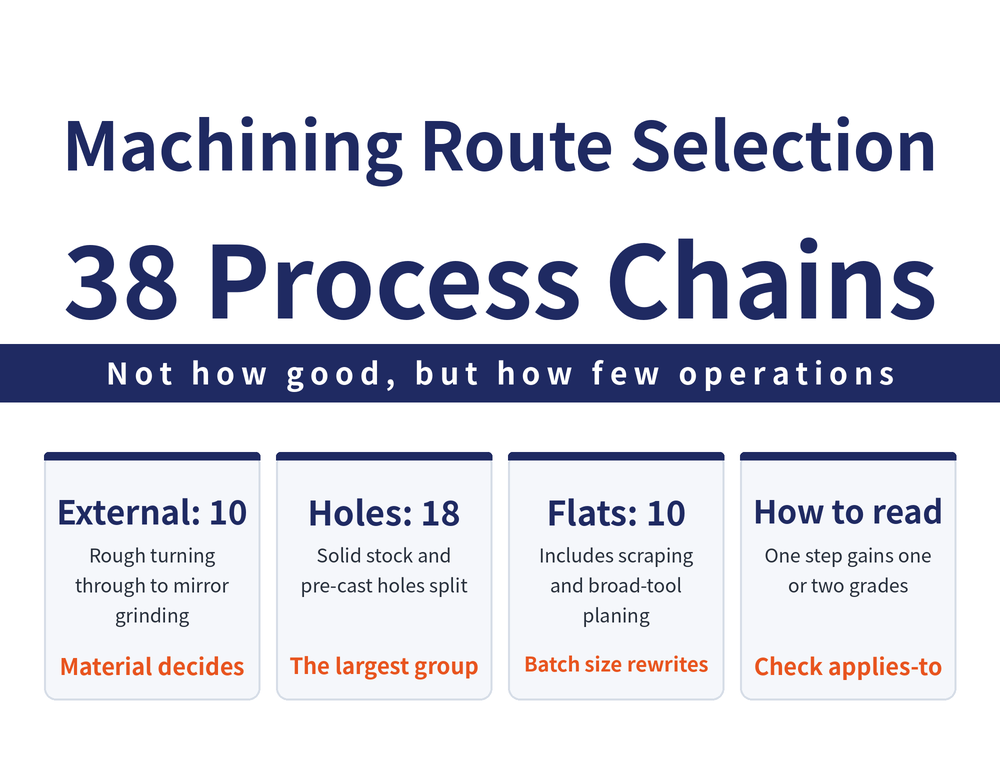
2. External surfaces: 10 routes
| Route | Applies to | Economic IT | Ra (μm) |
|---|---|---|---|
| Rough turn | Metals other than hardened steel | 11–12 | 50–12.5 |
| Rough → semi-finish turn | Same | 8–10 | 6.3–3.2 |
| Rough → semi-finish → finish turn | Same | 6–7 | 1.6–0.8 |
| Rough → semi-finish → finish turn → roller burnish or polish | Same | 5–6 | 0.2–0.025 |
| Rough → semi-finish turn → grind | Mainly hardened steel; not non-ferrous | 6–7 | 0.8–0.4 |
| Rough → semi-finish turn → rough grind → finish grind | Same | 5–6 | 0.4–0.1 |
| Rough → semi-finish turn → rough → finish grind → superfinish | Same | 5–6 | 0.1–0.012 |
| Rough → semi-finish → finish turn → diamond turn | Higher-requirement non-ferrous | 5–6 | 0.4–0.025 |
| Rough → semi-finish turn → rough → finish → ultra-fine or mirror grind | Very high accuracy steel or cast iron | Above grade 5 | <0.025 |
| Rough → semi-finish turn → rough → finish grind → lap | Same | Above grade 5 | <0.1 |
3. Holes (1): starting from solid
⚠ This section gives the process-combination against accuracy comparison. What each stage of hole machining is responsible for, where it goes wrong, and how single-point fine boring compensates for deflection are questions of route mechanics — see improving hole accuracy. This table does not repeat that; it only lets you look up which chain meets a given requirement.
| Route | Applies to | Economic IT | Ra (μm) |
|---|---|---|---|
| Drill | Solid blank, bore <20mm | 11–12 | 12.5 |
| Drill → ream | Same | 8–9 | 3.2–1.6 |
| Drill → rough ream → finish ream | Same | 7–8 | 1.6–0.8 |
| Drill → core drill | Solid blank, bore >20mm | 11 | 12.5–6.3 |
| Drill → core drill → ream | Same | 8–9 | 3.2–1.6 |
| Drill → core drill → rough ream → finish ream | Same | 7 | 1.6–0.8 |
| Drill → core drill → machine ream → hand ream | Same | 6–7 | 0.4–0.1 |
| Drill → (core drill) → broach or push broach | High-volume small parts, through holes | 7–9 | 1.6–0.1 |
4. Holes (2): blank already has a cast or forged hole
When the blank arrives with a hole, the starting point is boring or core drilling rather than drilling. What separates these routes is whether a grinder is available, and whether the workpiece is hardened steel.
| Route | Applies to | Economic IT | Ra (μm) |
|---|---|---|---|
| Rough bore or core drill | Blank already cast or forged with a hole | 11–12 | 12.5–6.3 |
| Rough → semi-finish bore | Same | 9–10 | 3.2–1.6 |
| Rough → semi-finish → finish bore or ream | Same | 7–8 | 1.6–0.8 |
| Rough → semi-finish → finish bore → floating-tool bore | Same | 6–7 | 0.8–0.4 |
| Rough → semi-finish bore → grind bore | Mainly hardened steel; not non-ferrous | 7–8 | 0.8–0.2 |
| Rough → semi-finish bore → rough grind → finish grind | Same | 6–7 | 0.2–0.1 |
| Rough → semi-finish → finish bore → diamond bore | Higher-accuracy non-ferrous | 6–7 | 0.4–0.05 |
| Drill → (core drill) → rough ream → finish ream → hone | Very high accuracy holes | 6–7 | 0.2–0.025 |
| Rough → semi-finish → finish bore → hone | Same (drill → broach → hone also applies) | 6–7 | 0.2–0.025 |
| Drill or rough bore → core drill or semi-finish → finish → diamond bore → pulse roller size | High-volume non-ferrous small holes, cast iron housings | 6–7 | 0.1 |
One further route replaces honing with lapping, reaching grade 5–6; its roughness value is not listed in this table. For how the boring methods divide up, see boring basics and methods.
5. Flat surfaces: 10 routes
| Route | Applies to | Economic IT | Ra (μm) |
|---|---|---|---|
| Rough → semi-finish turn | Faces | 8–9 | 6.3–3.2 |
| Rough → semi-finish → finish turn | Faces | 6–7 | 1.6–0.8 |
| Rough → semi-finish turn → grind | Faces | 7–9 | 0.8–0.2 |
| Rough plane or mill → finish plane or mill | General unhardened flats | 7–9 | 6.3–1.6 |
| Rough → finish plane or mill → hand scrape | Higher-accuracy unhardened flats | 5–6 | 0.8–0.1 |
| Rough → finish plane or mill → broad-tool finish planing | Same, suits larger batches | 6–7 | 0.8–0.2 |
| Rough → finish plane or mill → grind | Higher-accuracy hardened or unhardened flats | 6–7 | 0.8–0.2 |
| Rough → finish plane or mill → rough grind → finish grind | Same | 5–6 | 0.4–0.25 |
| Rough mill → broach | High volume, smaller flats | 6–9 | 0.8–0.2 |
| Rough → finish mill → grind → lap | High accuracy flats | Above grade 5 | <0.1 |
6. Three rules for reading the tables
One: each added operation gains roughly one to two grades. All three tables show the same rhythm — roughing lands at IT11–12, adding semi-finishing reaches IT8–10, adding finishing reaches IT6–7, and each further finishing step (burnishing, superfinishing, honing, lapping) mainly buys roughness rather than dimensional accuracy. Dimensional accuracy and surface roughness are not the same thing, which the last rows make clearest.
Two: the material decides which column you are in. For the same IT6, unhardened steel can take the finish-turning route, hardened steel only the grinding route, and non-ferrous metals suit neither well and go to diamond turning. The "applies to" column is not a footnote — it is a precondition.
Three: batch size rewrites the best answer. Broaching and broad-tool planing make no sense for one-offs but are the fastest route at volume; conversely honing and superfinishing carry a high equipment threshold, so small runs usually substitute grinding plus polishing.
7. What these tables do not answer
They answer which route to take, not how to set the parameters for each operation. For the roughness each method can reach see surface roughness by process (that article works along the roughness axis, this one along the process-chain axis); for hole and shaft tolerance values see hole tolerance chart and shaft tolerance chart.
The three tables are compiled from the machining route charts in a metal cutting technical handbook and are general process references; achievable accuracy depends on machine condition, tooling, workholding and operator, so confirm by trial cut.
8. Frequently Asked Questions (FAQ)
Q: How does economic accuracy differ from limit accuracy?
Economic accuracy is the grade reliably achievable at sensible cost under normal conditions. Pushing higher is usually possible, but time, scrap and inspection cost rise non-linearly. The table is for deciding the minimum number of operations.
Q: Why can hardened steel not take the finish-turning route?
Its hardness makes it difficult for ordinary turning tools to hold that accuracy with acceptable tool life, so high-accuracy requirements on hardened steel go to grinding. The "applies to" column is a precondition, not a note.
Q: Does adding a finishing step improve dimensional accuracy too?
Not necessarily. Burnishing, superfinishing, honing and lapping mainly improve surface roughness; the IT column barely moves in the last rows while the Ra column drops sharply.
Q: Should small batches use broaching or broad-tool planing?
Not advisable. Both carry high tooling and equipment costs that need volume to amortise; small batches usually substitute grinding with polishing or hand scraping at lower total cost.
This article is part of Manufacturing Process: The Complete Guide - Set the Datum First, Then Sequence, Allowance and Dry Cutting; that guide shows how the whole topic fits together.