Trochoidal and Dynamic Milling: Efficient Paths for Deep Slots
Slotting is slow because the tool cuts on three faces at once and the engagement angle approaches half a turn. Trochoidal milling advances in small overlapping arcs, trading a very small radial depth of cut for a very large axial one; dynamic milling has the CAM hold that engagement constant.
1. Read These Four Lines First
These four lines are the whole framework; the sections below fill in the detail.
| Stage | What happens | Conclusion |
|---|---|---|
| Problem | Full-slot cutting, engagement near half a turn | Force and heat both concentrate |
| Trochoidal | Overlapping small arcs keep instantaneous ae low | A large ap can go full depth in one pass |
| Dynamic | CAM holds the engagement angle constant | The load stays steady from start to finish |
| Feed | A smaller ae triggers chip thinning | Without compensation the tool only rubs |
2. Why Full-Slot Milling Struggles
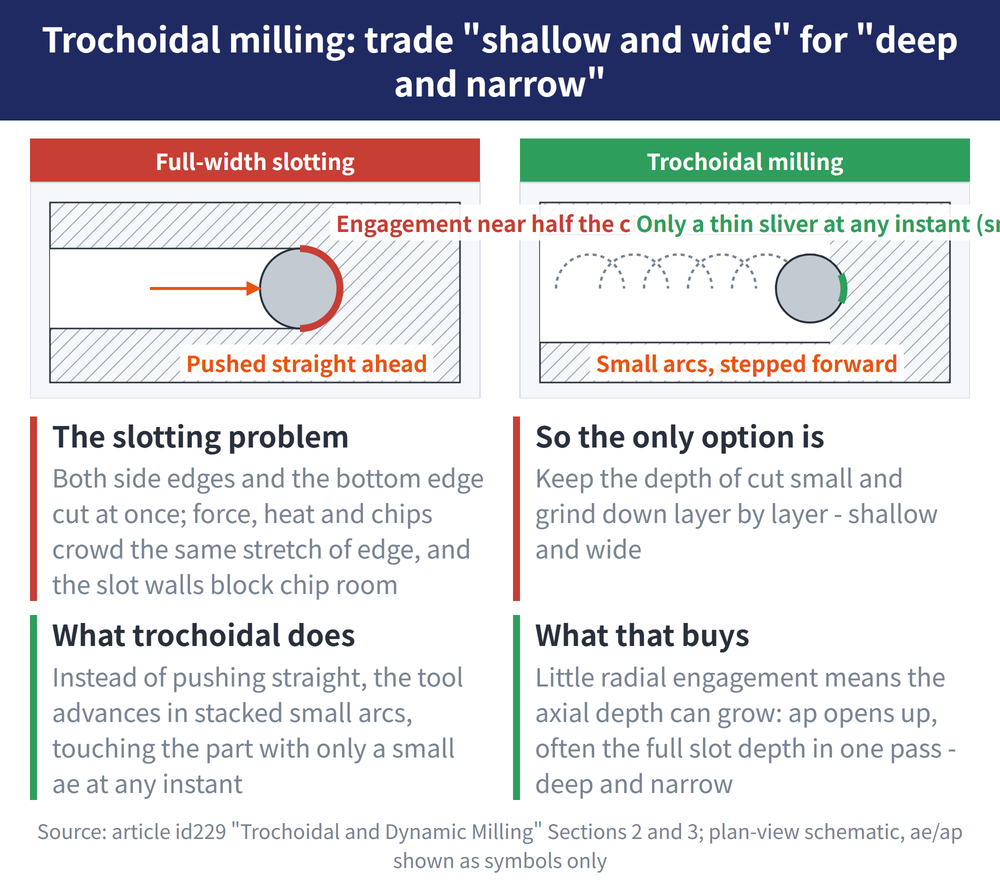
Cutting a slot directly puts both flank edges and the end edge into the material at the same time, with an engagement angle close to half a turn. Force, heat and chips all crowd into the same stretch of cutting edge.
The slot walls also close off the chip space, so chips are easily re-cut. The only way out is to reduce the depth of cut and grind through layer by layer.
| Problem | Consequence |
|---|---|
| Engagement near half a turn | The edge is buried in the workpiece and cannot shed heat, so temperature and wear rise |
| Three faces cut at once | Radial forces do not cancel, raising the risk of deflection and vibration |
| Chips cannot escape | Chips are crushed repeatedly, chipping the edge and spoiling the slot surface |
| Depth has to be reduced | The number of passes multiplies and total cycle time stretches out |
Concentrated load is also the condition under which chatter appears most readily; see Milling Chatter: Causes and Solutions.
3. Trochoidal Milling: Shallow-and-Wide Becomes Deep-and-Narrow
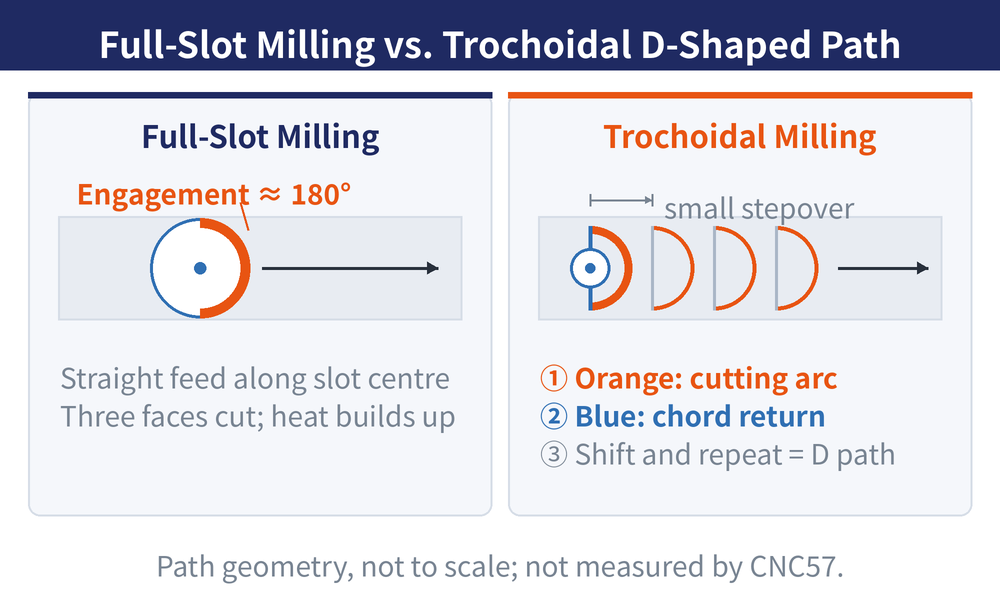
Trochoidal milling does not push the tool straight through. It advances in overlapping small arcs, so at any instant only a very small ae (radial depth of cut) is in contact with the workpiece.
Taking less radially means you can afford to take more axially: ap (axial depth of cut) can be set very large, often deep enough to reach full slot depth in a single pass.
| Benefit | Reason |
|---|---|
| Cutting force drops noticeably | A small engagement angle means a short length of edge is cutting at any moment |
| Heat dissipation improves | The edge cuts a short arc and then leaves, giving it time to cool |
| Chip evacuation is smooth | The arc path leaves room for the chips to clear |
| Tool life is extended | Wear spreads evenly along the edge instead of concentrating at one point |
| A large ap can go full depth at once | Side loads are small, so even long-edge tools hold up |
| Machine rigidity demands are lower | The load is steady and does not rely on bursts of torque |
A large ap calls for a long-edge tool; for the relation between overhang and deflection see End Mill Length and Deflection.
4. Dynamic Milling: Holding the Engagement Angle Constant
Dynamic milling is the broader idea: the CAM system continuously holds the engagement angle constant, adjusting path and feed automatically at corners and internal radii. Trochoidal motion is only one way to achieve it.
| Comparison | Trochoidal milling | Dynamic milling |
|---|---|---|
| Level | One specific path shape | A strategy covering several path types |
| Core method | Overlapping small arcs that keep instantaneous ae low | Real-time engagement calculation with path and feed in step |
| At corners and internal radii | The arcs cushion the change, but load can still fluctuate | Actively steers and slows down to flatten the load |
| Typical use | Slotting, keyways, hole enlargement | Roughing and bulk removal across whole pockets |
| CAM dependency | Lower; some controllers have a ready-made cycle | High; needs a module that supports the algorithm |
Both buy efficiency with the toolpath; the other route is to buy it with tool geometry, see High-Feed Milling (HFM).
5. Where It Pays Off
The value lies in the hard cases; for open face milling it is not necessarily worth it.
| Suitable case | Why |
|---|---|
| Deep slots, keyways and other closed slot forms | Full-slot cutting suffers most here, so the gain is most obvious |
| Stainless steel, titanium and heat-resistant alloys | Thermal load is spread out and the edge gets time to cool |
| Thin-wall and easily deformed parts | Side loads are small, so there is less chance of push-off and vibration |
| Machines limited in rigidity or power | The load is steady, so older machines can use it too |
For the overall strategy on difficult-to-cut materials see Machining Titanium and Superalloys (ISO S).
6. What to Check Before You Adopt It
| Point to check | Explanation |
|---|---|
| A smaller ae triggers chip thinning | Feed per tooth has to be compensated upwards, or the edge only rubs instead of cutting |
| CAM support is required | The path cannot be hand-written and older software cannot produce it |
| More code and more air-cutting travel | NC files grow larger and the controller has to keep up with the read rate |
| Feed rate and acceleration must keep up | If the machine decelerates at every arc, the time saved is eaten away again |
| Choose long-edge tools | A short edge cannot reach full depth, so the advantage of a large ap is wasted |
For the compensation formula see Chip Thinning and Feed Compensation; the actual ratio between ae and ap follows the catalogue and trial cuts, see End Mill Cutting Conditions Guide.
The tables above give typical orientations; follow the catalogue or standard. Not measured by CNC57.
7. Frequently Asked Questions (FAQ)
Q: Are trochoidal milling and dynamic milling the same thing?
No. Trochoidal milling is one specific path made of overlapping arcs. Dynamic milling is the whole strategy of holding the engagement angle constant, and trochoidal motion is only one way of achieving it.
Q: There is more air-cutting travel, so why is it still faster?
Because the axial depth of cut can be several times larger, which cuts the number of passes dramatically. The passes saved usually outweigh the extra arc distance travelled.
Q: Does the feed need adjusting after switching to a trochoidal path?
Yes. A smaller radial depth of cut produces chip thinning, so feed per tooth must be compensated upwards; otherwise the edge is only rubbing.
Q: Can I still use trochoidal paths without CAM support for dynamic milling?
Usually yes. A plain trochoidal slotting path is relatively simple and some CAM systems and controllers offer a ready-made cycle. Only full constant-engagement control requires a dedicated module.
This article is part of Milling Toolpaths: The Complete Guide - Roughing Strategy, Where to Plunge, and Choosing a Finishing Pattern; that guide shows how the whole topic fits together.
Last updated: 2026-08-07