Workholding and Fixture Basics: Six Degrees of Freedom, 3-2-1 Location and Vise Practice
Hold the part badly and no machine or cutter, however expensive, can rescue the job. Workholding solves one very specific problem: constraining all six degrees of freedom of the part. This article starts from those six degrees and the 3-2-1 location principle, then moves to vise practice and where magnetic and vacuum chucks each belong.
1. What Location Actually Solves: Six Degrees of Freedom
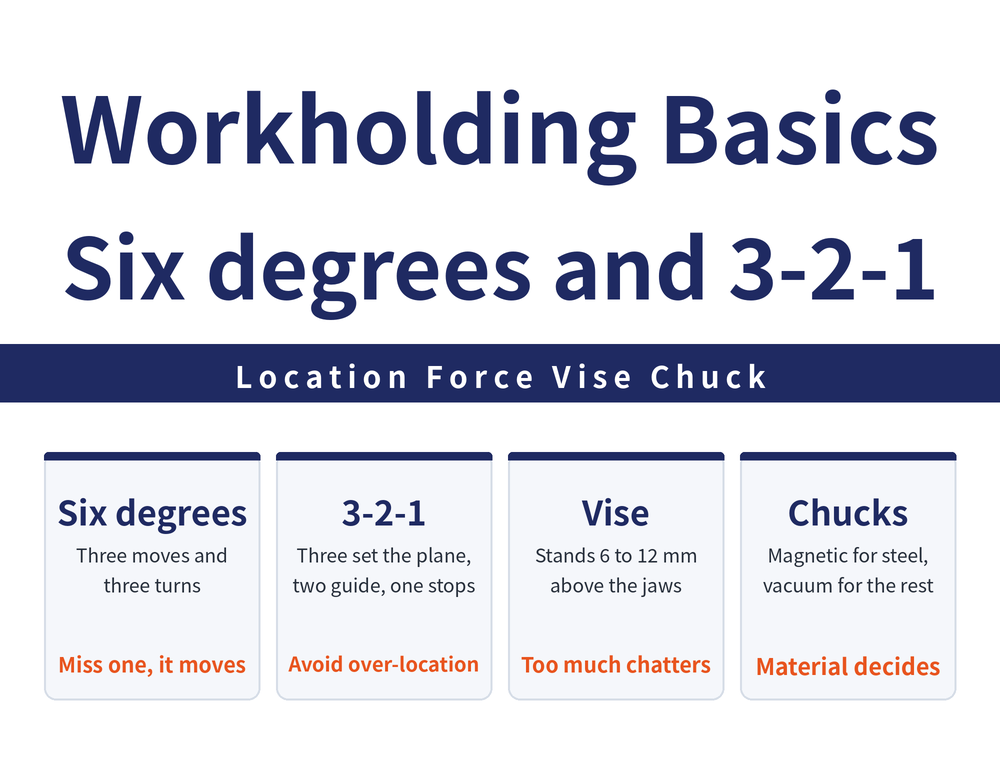
An unconstrained part has six degrees of freedom in space — translation along X, Y and Z, plus rotation about each of those three axes.
Location exists to constrain all six. Leave one unconstrained and the part has a direction in which it can move during cutting; constrain the same one twice and you have over-location, which either stops the part seating flat or distorts it under clamping.
2. The 3-2-1 Location Principle
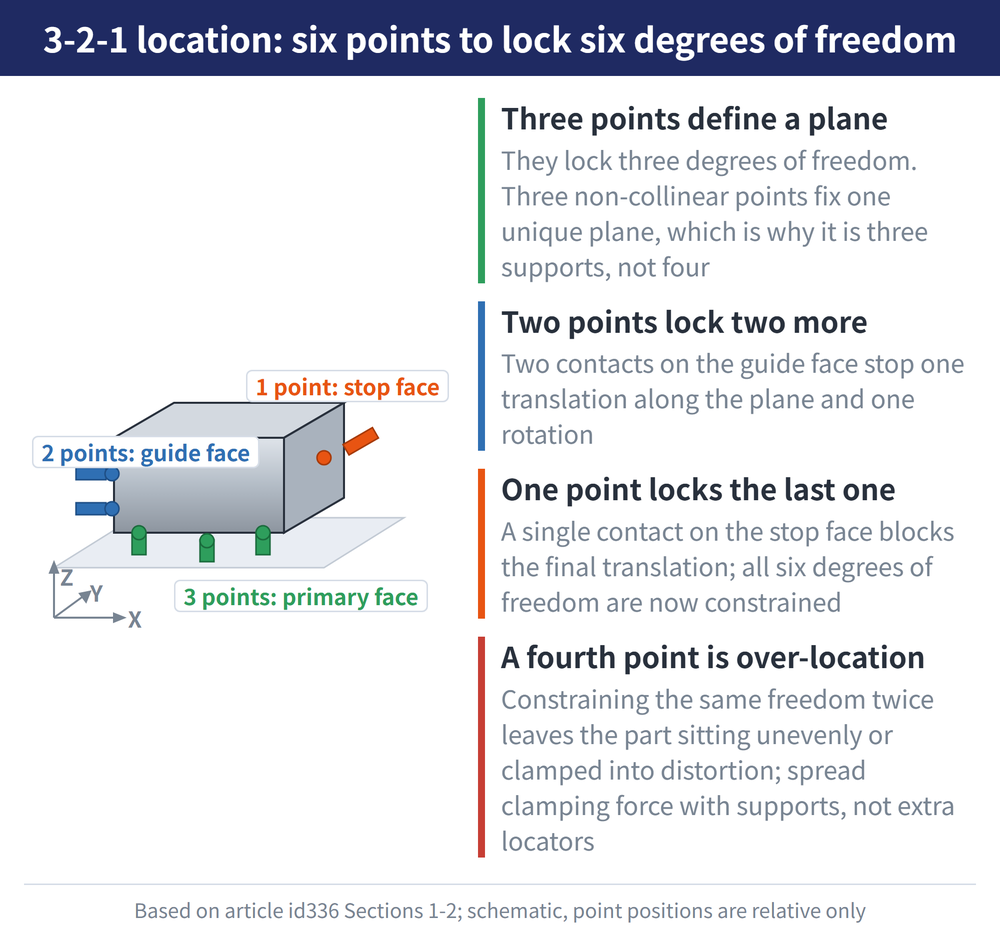
To constrain six degrees of freedom with the fewest contact points, the standard method is 3-2-1:
| Support points | What they constrain |
|---|---|
| Three (primary locating face) | Define a plane, constraining three degrees of freedom |
| Two (guiding face) | Constrain two degrees of freedom |
| One (stop face) | Constrains the last degree of freedom |
Three points define a plane because three non-collinear points determine exactly one plane — which is why the count is three and not four.
3. How Much Clamping Force
The criterion is a single sentence: clamping force must at least absorb the cutting force. If it does not, the part shifts during cutting — at best the dimensions drift, at worst it is thrown out of the fixture.
But more is not better. Excessive clamping force distorts thin or low-rigidity parts — they spring back once released, and the measured size bears no relation to what was machined. Parts like this need more support points to spread the load, not a harder squeeze.
4. Vise Practice
The vise is the most common holding method on the shop floor, and several of these figures come from official skills certification standards:
| Item | Practical requirement |
|---|---|
| Part height above the jaws | About 6 to 12 mm |
| Parallels | Used in matched pairs under the part to set its height |
| Single-sided clamping | Add a packing piece on the other side so the jaw does not skew |
Too little standing proud and the cutter hits the vise; too much and the unsupported length grows, rigidity falls and vibration follows. The figures above are cited from Ministry of Labor skills certification standards (Class B 18201, Class C 18500).
5. Magnetic and Vacuum Chucks
Parts a vise cannot hold — thin plate, irregular shapes, large flat panels — need another method. The dividing line is simple: is the material magnetic?
| Method | Suitable materials | Principle |
|---|---|---|
| Magnetic chuck | Magnetic materials (carbon steel, cast iron) | Magnetic attraction |
| Vacuum chuck | Non-magnetic materials (aluminium, copper, plastics) | Negative pressure |
Vacuum chucks suit thin, irregular parts particularly well — because they hold across the whole face rather than gripping two sides as a vise does, the load is spread and the part is far less likely to be distorted. Combined with a zero-point locating system they also cut changeover time.
Holding force and vacuum level vary widely between products, so work from the maker's data for the equipment you have. Workholding feeds directly into machining accuracy; on process sequencing see Improving Hole Accuracy.
6. Frequently Asked Questions (FAQ)
Q: Why are there three support points and not four?
Three non-collinear points determine exactly one plane. A fourth point creates over-location, which either stops the part seating flat or distorts it under clamping.
Q: Is more clamping force always better?
No. It must at least absorb the cutting force, but excessive force distorts thin parts, which then spring back after release and measure out of size. Spread the load with more support points instead.
Q: How far should the part stand above the vise jaws?
Certification standards give roughly 6 to 12 mm. Too little and the cutter reaches the vise; too much and the unsupported length grows, rigidity falls and vibration follows.
Q: Can aluminium parts be held on a magnetic chuck?
No, aluminium is not magnetic. Non-magnetic materials need a vacuum chuck, which holds across the whole face by negative pressure and is also gentler on thin parts.
This article is part of Workholding and Fixtures: The Complete Guide - Locate First, Then Clamp; How Much Force and Where It Comes From; that guide shows how the whole topic fits together.