Cutting Tool Materials Guide: Diamond, CBN, Ceramic & Carbide
The choice of cutting tool material directly affects machining efficiency, tool life and quality. Diamond, CBN, ceramics and carbide each involve a clear trade-off between hardness and toughness. This guide covers each material's hardness, thermal conductivity and applications, and the selection logic to quickly pick the right tool material. For each workpiece's ISO group, see ISO Workpiece Material Classification.
Basic Concept of Tool Materials
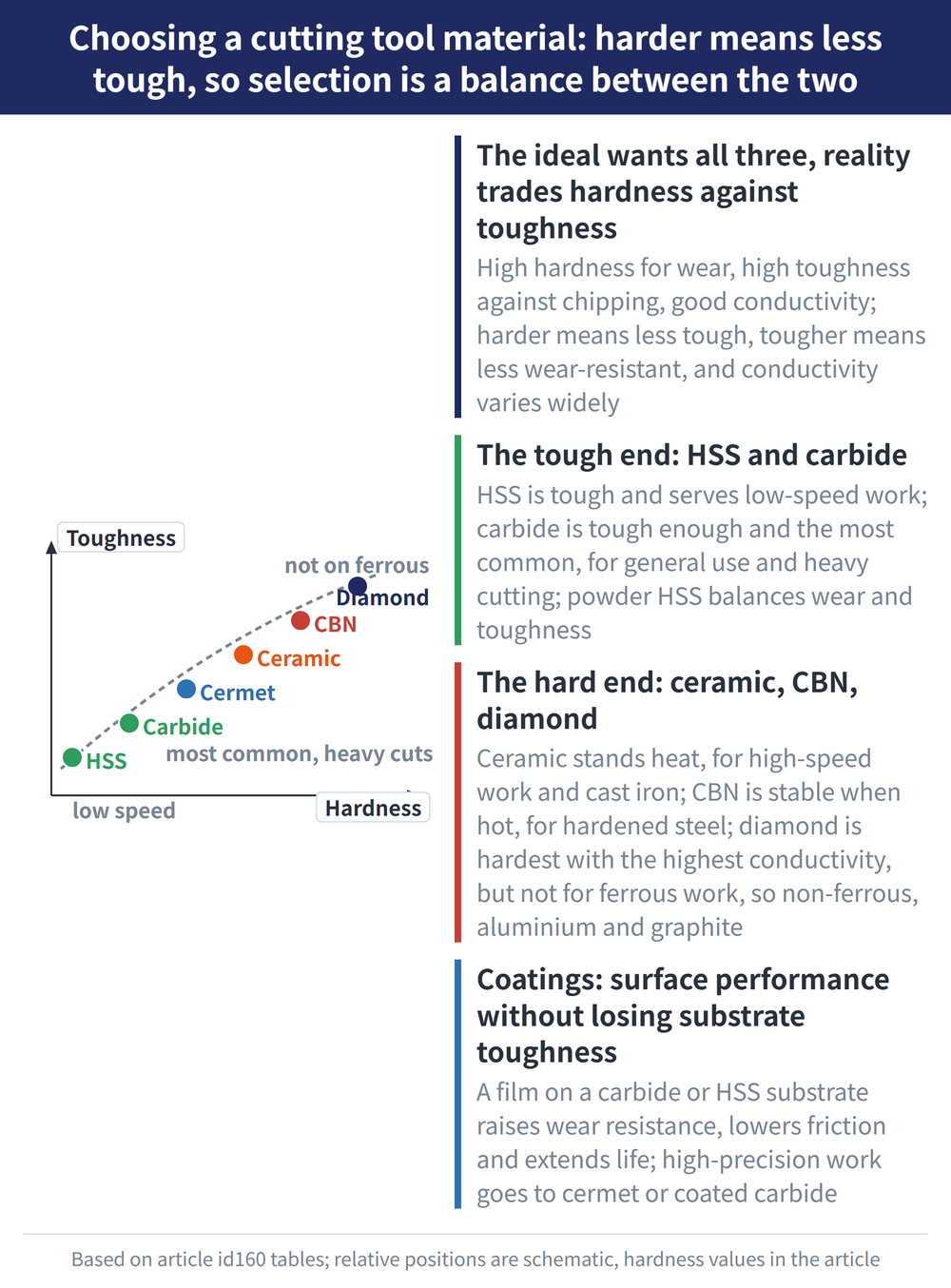
An ideal tool material needs high hardness (wear resistance), high toughness (chip resistance) and good thermal conductivity—but in practice these conflict, so there is a clear trade-off.
| Ideal requirement | Real trade-off |
|---|---|
| High hardness (wear resistance) | Higher hardness → lower toughness |
| High toughness (chip resistance) | Higher toughness → lower wear resistance |
| Good thermal conductivity | Conductivity varies widely, affecting heat and life |
So material selection balances "hardness ↔ toughness" according to the operation.
Overview of Tool Materials
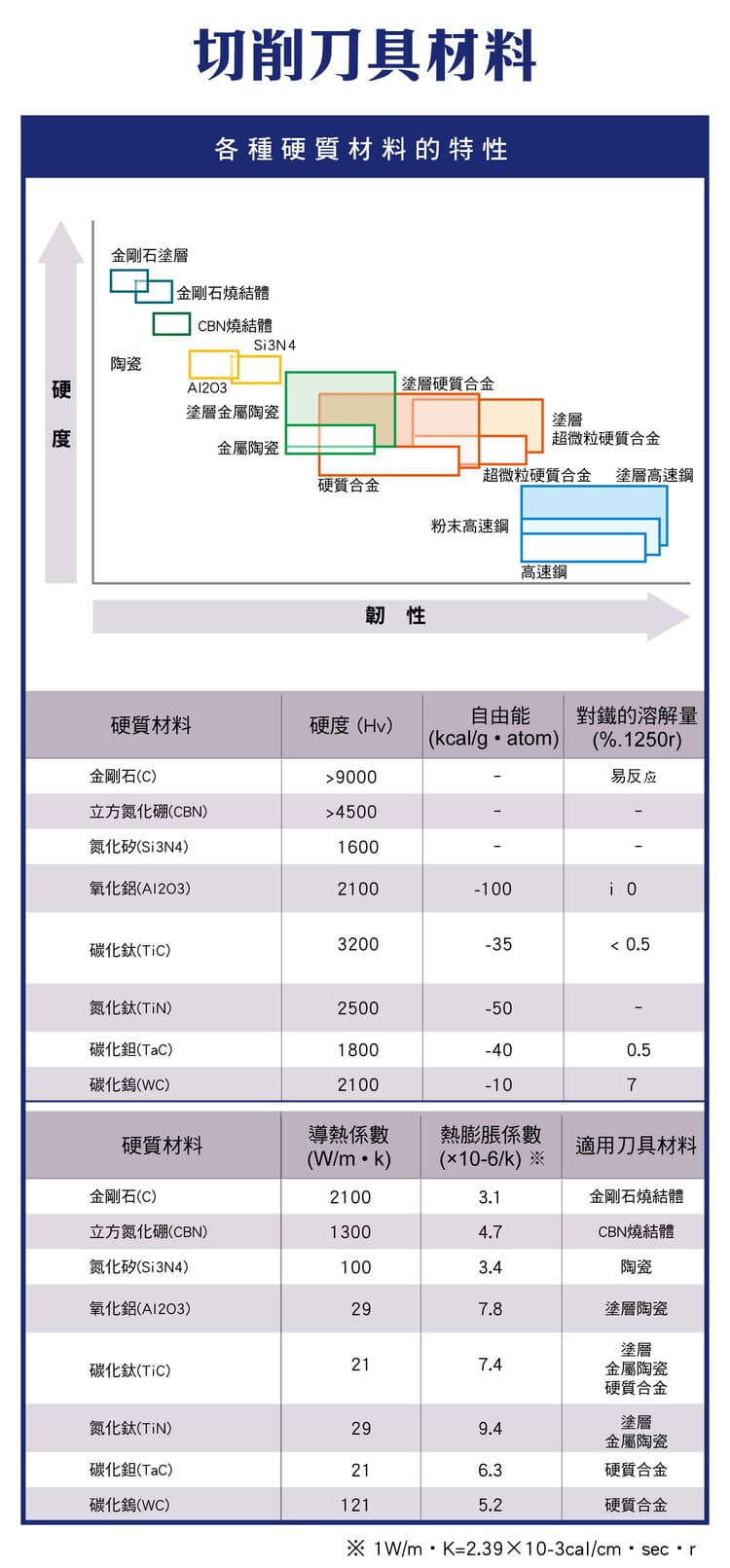
Hardness, traits and applications below; hardness is in HV (Vickers, values indicative).
| Material | Hardness (HV, indicative) | Key traits | Application |
|---|---|---|---|
| Diamond PCD | > 9000 | Hardest, very high conductivity; unsuitable for ferrous (reacts) | Non-ferrous metals, aluminum, graphite |
| CBN (cubic boron nitride) | > 4500 | Excellent high-temperature stability | Hardened steel, hardened materials |
| Silicon nitride Si₃N₄ (ceramic) | Ceramic | High-toughness ceramic | High-speed machining |
| Alumina Al₂O₃ (ceramic) | Ceramic | High heat resistance | Cast iron, high-temp cutting |
| Cermet | — | Good surface finish | Finishing |
| Tungsten carbide WC (carbide) | ~2100 | Good toughness, most common | Broad use, heavy cutting |
| TiC / TiN / TaC | — | Improve wear resistance | Coatings or composites |
| High-speed steel HSS | — | High toughness | Low-speed machining |
| Powder HSS | — | Better than conventional HSS; wear + toughness | High-precision, long-life tools |
Coated Tool Materials
Coating a carbide or HSS substrate greatly improves surface performance without sacrificing the substrate's toughness.
| Common coating | Trait |
|---|---|
| TiN (titanium nitride) | Improves wear resistance, lowers friction |
| TiAlN (titanium aluminum nitride) | High heat resistance, good for high-speed/dry cutting |
| AlCrN (aluminum chromium nitride) | High oxidation resistance, longer life |
Coatings overall raise wear resistance, lower friction and extend tool life. For per-brand coating grades, see Carbide Insert Coating Chart.
Material Performance Comparison
| Property | Comparison (high → low) |
|---|---|
| Hardness (HV) | Diamond > CBN > TiC > WC (carbide) |
| Thermal conductivity | Diamond highest; ceramics lower |
| Thermal expansion | Ceramics higher; diamond lowest |
CNC Material Selection Advice
| Scenario | Recommended material |
|---|---|
| High-speed machining | Ceramic / CBN |
| High-precision machining | Cermet / coated carbide |
| Heavy cutting | Carbide (WC) |
| Aluminum machining | Diamond (PCD) tools |
After choosing the material, set speed and feed by machine, tool diameter and workpiece hardness—see End Mill Cutting Conditions Guide. For hardened steel and other high-hardness work, also see the tool material series (P/M/K/N/S/H) classification.
※ Hardness values are indicative and vary by grade and maker; also weigh operation, machine rigidity and cost when selecting.
FAQ
Why can't diamond tools machine ferrous metals?
Diamond (carbon) reacts with iron at high temperature (carbon diffusion), causing rapid wear. So diamond/PCD tools suit non-ferrous metals, aluminum and graphite, not steels. See PCD and Diamond Coating Guide: Machining Aluminium, Non-Ferrous and Composites for details.
What materials suit CBN?
CBN is second only to diamond in hardness with excellent high-temperature stability, ideal for hard turning/milling of hardened steel and hardened materials. See CBN and PCBN Tool Guide: Machining Hardened Steel and Cast Iron for details.
Carbide or HSS — how to choose?
Carbide (tungsten carbide) is hard and wear-resistant for high-speed and heavy cutting—the most common tool material; HSS is tougher and more impact-resistant for low-speed or interrupted cutting. Powder HSS serves higher demands. See HSS Grades Decoded: SK, SKH, M/T Series, Cobalt and Powder Metallurgy for details.
What do tool coatings do?
Coatings such as TiN, TiAlN and AlCrN raise wear resistance, lower friction and improve heat resistance, extending tool life while keeping the substrate's toughness.
This article is part of Tool Materials and Coatings: The Complete Guide - Separate Substrate From Coating, Then Work Back From the Workpiece; that guide shows how the whole topic fits together.