PCD and Diamond Coating Guide: Machining Aluminium, Non-Ferrous and Composites
Diamond tooling splits into two routes — PCD (Polycrystalline Diamond) and diamond coatings — and its home ground is high-silicon aluminium, copper and brass, carbon fibre composites and graphite electrodes. One rule comes first, though: diamond must not be used on steel, cast iron or other ferrous materials; use CBN there instead.
1. The First Rule: Diamond Tools Never Touch Ferrous Materials
Diamond is carbon, and at cutting temperatures carbon has a chemical affinity for iron, causing graphitisation and diffusion wear. The edge degrades as if it were dissolving, and tool life collapses.
One-line test: if a magnet sticks to the part and it is iron-based (carbon steel, alloy steel, cast iron, stainless), do not use diamond tooling. Use CBN (Cubic Boron Nitride) instead — second only to diamond in hardness and, unlike diamond, it does not react with iron.
For hard ferrous work, see Hard Turning Guide: Replacing Grinding at HRC45–65 and Hardened Steel Machining Guide; for cast iron, see Cast Iron Machining Guide.
2. PCD vs Diamond Coating: Where the Difference Lies
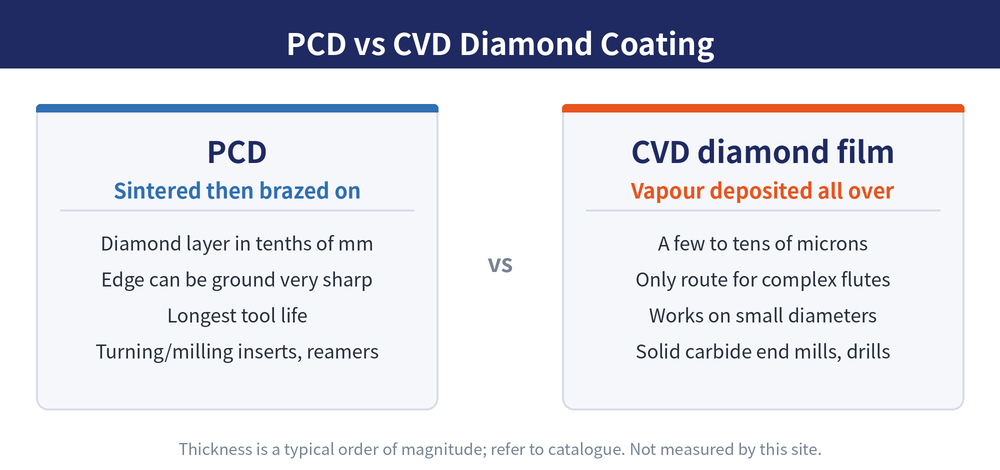
Both are diamond; the difference is how they are made and how sharp and thin they can go. PCD is sintered under high temperature and pressure, while diamond coatings use CVD (Chemical Vapour Deposition) to grow a diamond film directly on the tool surface inside a vacuum chamber.
| Type | Process | Typical thickness | Suitable tool types and uses |
|---|---|---|---|
| PCD (polycrystalline diamond) | Diamond powder sintered onto a tungsten carbide substrate, then brazed or tipped onto the tool body | Diamond layer on the order of a few tenths of a mm | Turning inserts, milling inserts, tipped reamers; the edge can be ground very sharp and life is longest |
| CVD thin-film diamond coating | A diamond film grown by chemical vapour deposition over the whole carbide tool | On the order of a few to a few tens of μm | Solid carbide end mills and drills; the only way to put diamond on complex flute forms and small diameters |
| CVD thick-film diamond | A thicker free-standing diamond wafer is deposited, then cut and brazed to the tool body | Between thin film and PCD | Pure diamond with no metallic binder phase, better heat and chemical resistance, for highly abrasive materials |
Thicknesses and applications are typical values — refer to the tool catalogue or standard; not measurements taken by this site.
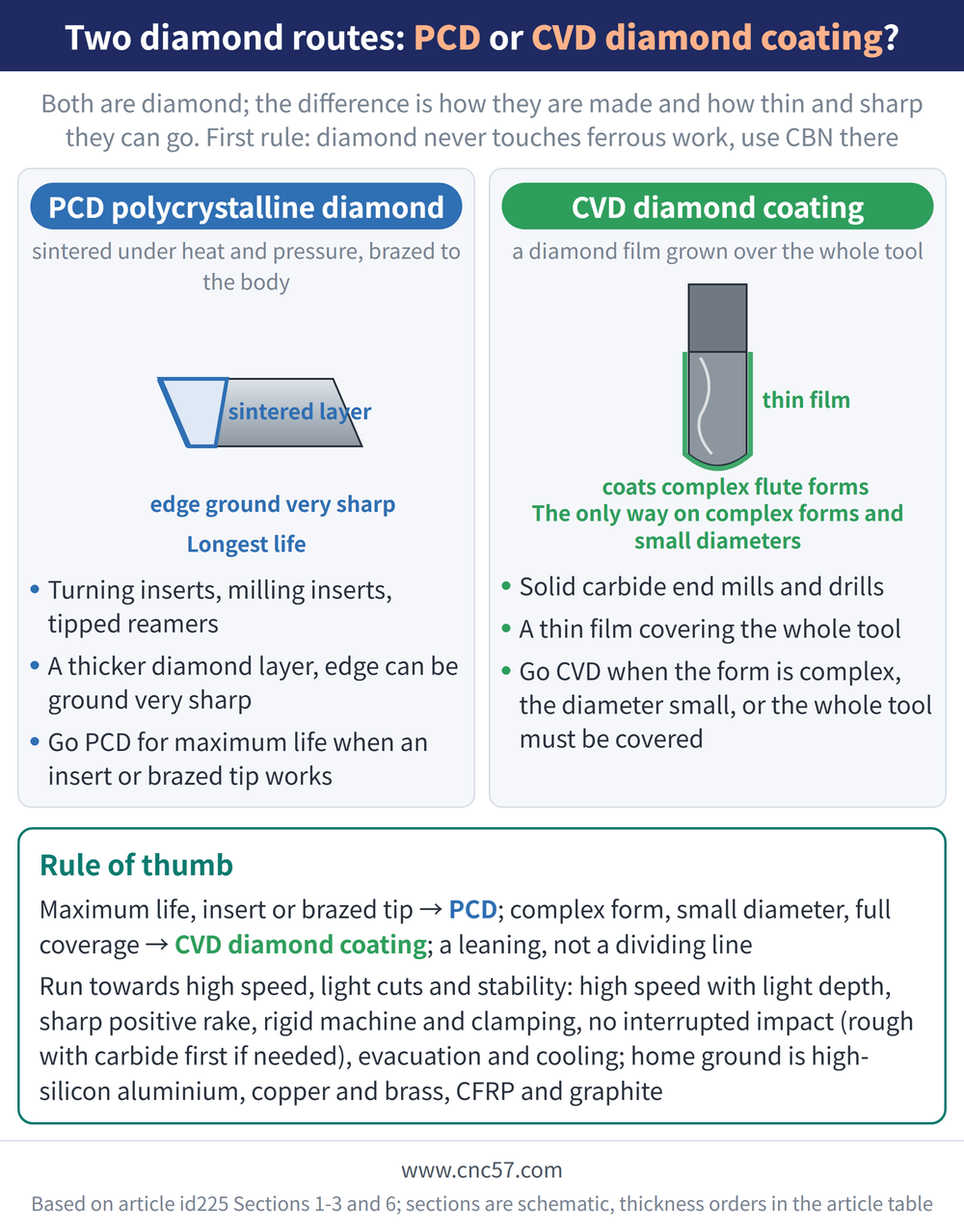
3. How to Choose: PCD for Maximum Life, CVD Diamond for Complex Forms and Small Diameters
The short version: go PCD when you want maximum life and the tool can be built as an indexable insert or a brazed tip; go CVD diamond coating when the flute form is complex, the diameter is small, or the whole tool has to be covered. Treat this as a leaning, not a dividing line — PCD is also brazed onto solid-body end mills, reamers and drills, and diamond coating is available on inserts too. For the coating processes themselves, see PVD vs CVD Coating Guide and Tool Coating Types Guide; for reading substrate grades, see Carbide Grade Decode Guide.
A note on the term: CVD in this section means a diamond film. It is not the same thing as the multilayer CVD (TiCN / Al2O3) coating common on indexable inserts; for that trade-off see the coating comparison linked above.
4. Home Ground, Part 1: High-Silicon Aluminium, Aluminium Alloys, Copper and Brass
Diamond earns its keep on materials that are highly abrasive and iron-free: carbide edges are worn round quickly by the abrasive phase, and switching to diamond usually extends tool life markedly. The metals come first.
| Material | Difficulty | Why diamond works |
|---|---|---|
| High-silicon aluminium (hypereutectic Al-Si alloys) | Hard silicon particles act like sandpaper and quickly round off a carbide edge | Diamond is far harder than the silicon particles and resists abrasive wear; low affinity for aluminium limits built-up edge |
| Pure and cast aluminium alloys | Smearing and built-up edge cause surface drag marks and burrs | Low friction and low adhesion at the diamond face, the first choice for mirror finishes and long stable runs |
| Copper, brass and other non-ferrous metals | Highly ductile and prone to sticking; precision parts demand a mirror surface | The edge can be ground extremely sharp and stays sharp, suiting precision turning and mirror finishing |
This is a general selection comparison, not measurements taken by this site.
For the wider non-ferrous strategy, see Aluminum and Non-Ferrous Machining Guide.
5. Home Ground, Part 2: CFRP, Graphite, Ceramics and Plastics
With non-metals such as CFRP (Carbon Fibre Reinforced Plastic, a light, high-strength composite of carbon fibre and resin), graphite, ceramics and plastics, the main risks are delamination and fibre burrs, and edge sharpness matters more than parameters.
| Material | Difficulty | Why diamond works |
|---|---|---|
| CFRP carbon fibre composites | Carbon fibre is extremely abrasive; a dull edge causes delamination, fuzzing and tear-out | Diamond stays sharp longest, which is the key to controlling delamination and fibre burrs |
| Graphite electrodes | Powdery abrasive chips give carbide tools very short life | Diamond coating resists graphite-dust wear well and opens a clear life gap |
| Some ceramics and engineering plastics | Hard brittle fillers and glass-fibre reinforcement are just as abrasive, and brittle stock chips easily | Diamond keeps the edge sharp longest, and the low cutting force helps limit edge chipping and melted smearing |
| Steel, cast iron, stainless (ferrous) | — | Not applicable: carbon reacts with iron at high temperature, causing graphitisation and diffusion wear; use CBN |
This is a general selection comparison, not measurements taken by this site; the life gap depends on material batch, machine and parameters.
For matching tool material and coating to the workpiece, see Material and Coating Selection by Workpiece.
6. How to Run Them: High Speed, Sharp Positive Rake, Rigidity, No Impact
Diamond is extremely hard but brittle, so impact — not wear — is the enemy. Set up towards high speed, light cuts and stability.
| Key | Detail |
|---|---|
| 1. High spindle speed, light depth of cut | Diamond resists wear but not shock; high speed with a lighter depth of cut yields better life than heavy loading |
| 2. Sharp edge, positive rake | A positive rake and sharp edge cut forces and adhesion, the key to suppressing built-up edge and burrs |
| 3. Rigid machine and clamping | Spindle runout and long overhang subject the edge to alternating impact and chipping; keep overhang short |
| 4. Avoid interrupted impact | Porosity, as-cast skin and heavily interrupted cuts fracture diamond edges; rough with carbide first if needed |
| 5. Chip evacuation and cooling | Aluminium and composites need strong evacuation to avoid recutting; graphite is usually cut dry with dust extraction |
Do not apply generic cutting speed and feed values; decide them from the tool catalogue and a trial cut. For the calculation method, see Turning Machining Formula Handbook. For the full tool-material picture, see Cutting Tool Materials Guide, and for selection by tool type, see Tool Material Selection by Tool Type.
Last updated: 2026-08-08
7. Frequently Asked Questions (FAQ)
Q: Can diamond tools really never machine steel?
In practice it is treated as prohibited. At cutting temperature carbon reacts with iron, causing graphitisation and diffusion wear that collapses tool life, so ferrous materials always go to CBN.
Q: How do I choose between PCD and CVD diamond coating?
If an insert format works and you want maximum life and mirror finish, choose PCD. For complex flute forms or small-diameter solid tools such as end mills and drills, CVD diamond coating is the only option.
Q: Is diamond worth it on ordinary aluminium alloys?
It is worth it for high volumes, mirror finish requirements or long unattended runs. For short runs, small batches or heavily interrupted cuts, carbide is usually more economical.
Q: Why do diamond tools tend to chip rather than wear out?
Diamond is extremely hard but brittle, so its weak point is impact rather than abrasion. Spindle runout, long overhang or interrupted cutting all fracture the edge, and improving rigidity while avoiding impact fixes most cases.
For the full reading guide on this topic, see Tool Life and Wear: A Complete Reading Guide.
This article is part of Tool Materials and Coatings: The Complete Guide - Separate Substrate From Coating, Then Work Back From the Workpiece; that guide shows how the whole topic fits together.