
Choosing a Tool Holder for Drilling: Shank, Runout and Coolant
Drilling is an axial cut with low side load and high axial load, so the first priority for the holder is not rigidity but runout. The selection order is shank type first, which fixes the holder family, then runout, then the coolant supply path. This guide uses five tables to cover shank-to-holder mapping, what runout does to a hole, and the trade-offs in coolant and clamping length.
1. Drilling Asks Something Different From a Holder
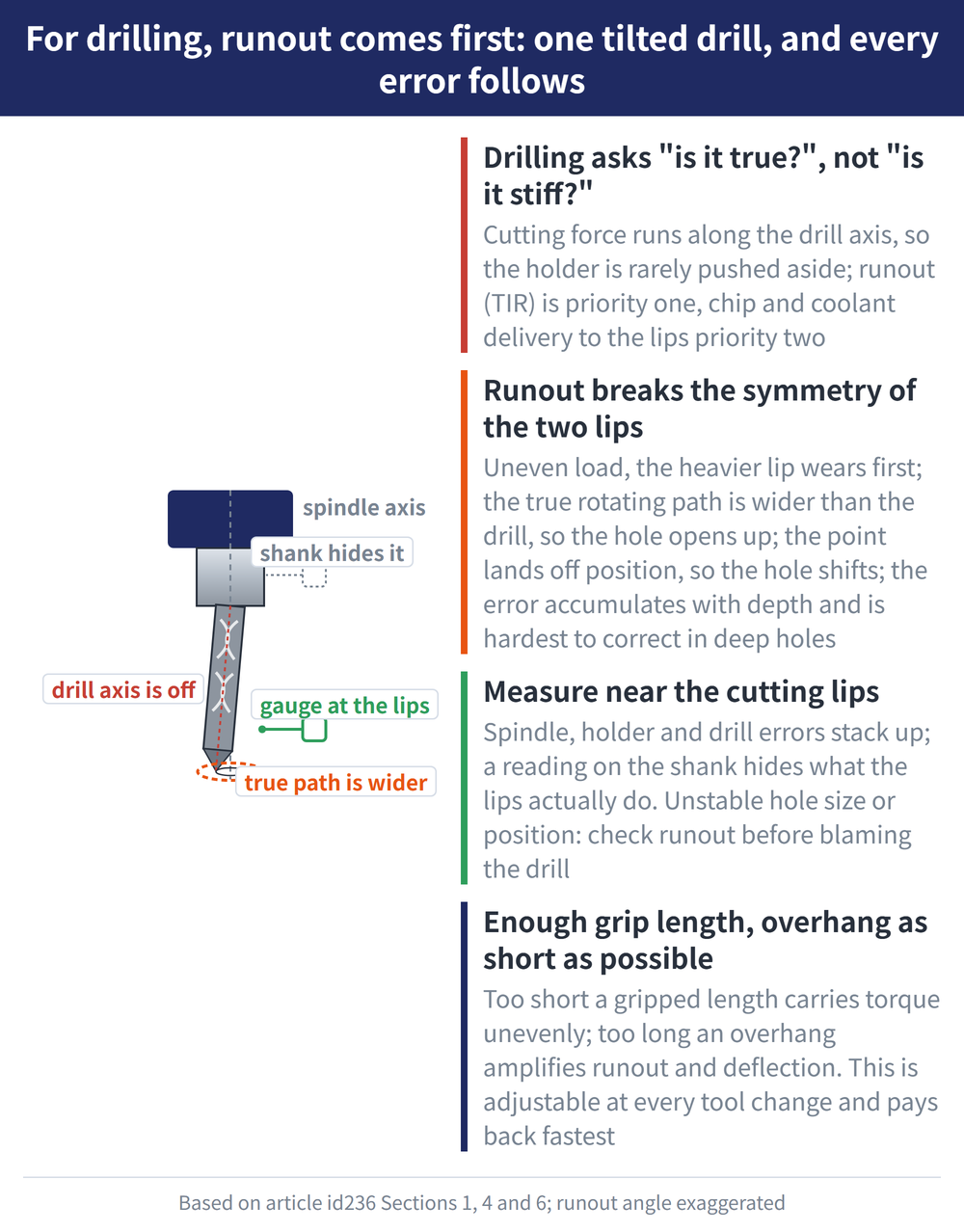
In drilling the cutting force runs mainly along the axis of the drill, the tool is rarely pushed sideways, and rigidity is therefore not the first priority.
First priority is runout (TIR, the radial deviation of the edge as the tool turns one revolution).
Second priority is the path that carries chips out and coolant in. The deeper the hole, the harder chips are to clear, and that depends on whether the holder can deliver fluid to the point.
| Item | Milling | Drilling |
|---|---|---|
| Direction of cutting force | Mainly sideways, so the tool is easily pushed away | Mainly axial, with low side load and high axial load |
| First priority for the holder | Rigidity, then runout and balance; see Choosing a Tool Holder for Milling | Runout, then chip evacuation and the coolant supply path |
| What it looks like when it falls short | Chatter, a regular pattern on the surface, chipped edges | Oversized holes, off-position holes, tool life dropping sharply |
| Role of coolant | Mostly cooling support and washing chips away | In deep holes it decides whether the job runs at all |
The table gives general direction only; follow the catalogue or the relevant standard — not measurements taken by this site.
Milling picks a holder for stiffness, drilling picks one for concentricity and delivery. Get that order wrong and an expensive holder still will not help.
2. The Shank Fixes the Holder Family: Straight and Morse Taper
The first fork is the shank of the drill, not the clamping method. Change the shank type and the whole set of usable holders usually changes with it.
| Shank type | Matching holder | Key point |
|---|---|---|
| Straight cylindrical shank (most common) | Collet chuck (an interchangeable elastic sleeve, each size covering one band of shank diameters), milling chuck, shrink fit, hydraulic | All four grip a cylindrical shank, and the trade-off is between runout, grip and change-over convenience; shank tolerance also shows up as runout, see Straight Shank Drill Specification and Runout |
| Morse taper shank (MT, a standard taper shank that locates and transmits torque through the taper face) | Morse taper sleeve, for a tightening-thread end (DIN 228 form A) or a tang end (DIN 228 form B) | The taper is self-locking, so no extra radial grip is needed; common on large-diameter drills, with dimensions in the Drill Shank and Morse Taper Guide |
The table gives general direction only; follow the catalogue or the relevant standard — not measurements taken by this site.
3. Side Lock Shanks and Indexable Drills
For these two the key point is runout in both cases, but for different reasons: one comes from the clamping, the other from the tool structure.
| Shank type | Matching holder | Key point |
|---|---|---|
| Side lock flatted shank (Weldon, a flat on the shank for a side screw to press on; per manufacturers' catalogues: DIN 1835 B / DIN 6535 HB) | Side lock holder | The screw on the flat cannot slip and the tool cannot be pulled out axially; but the single-sided force pushes the tool off centre, so runout is higher; one maker's hydraulic chuck precautions also rule out this kind of shank |
| Indexable drill (an insert drill, where replaceable inserts take the place of a ground point) | Usually a cylindrical shank, held in a collet chuck or a dedicated chuck | The two inserts are not symmetric, so demands on runout and through coolant are higher than for a twist drill; see the Indexable Drill Guide |
The table gives general direction only; follow the catalogue or the relevant standard — not measurements taken by this site.
Only after the family is fixed does the clamping comparison matter. For a point-by-point comparison see Tool Holder Clamping Methods Comparison, and for the collet standards themselves see Collet System Comparison and Selection.
4. Why Runout Is So Damaging in Drilling
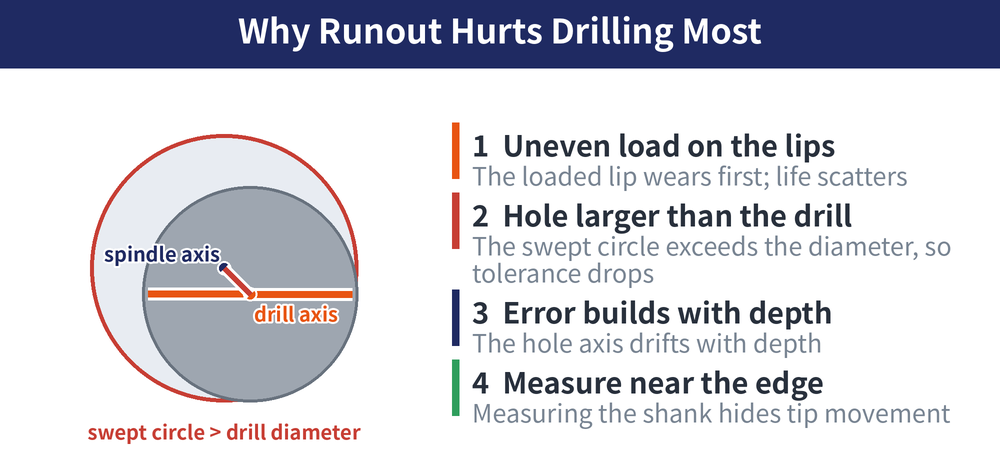
A drill centres itself because its two edges cut symmetrically. Runout breaks that symmetry, and the damage travels down the hole from there.
| What runout does | Consequence |
|---|---|
| Uneven load between the two edges | The loaded edge wears first, and tool life scatters widely within one batch |
| Swept path larger than the drill diameter | The hole comes out larger than the drill, and the achievable tolerance grade drops |
| The point is off target at entry | The hole lands off position, and thin plate or sloped faces make it worse |
| Deviation accumulates with depth | The hole axis drifts, and a deep hole gets harder to correct the further it goes |
| One edge takes an excessive shock load | Risk of chipping at the point rises, and a bad case scraps the whole drill |
The table gives general direction only; follow the catalogue or the relevant standard — not measurements taken by this site.
One practical rule matters here: measure close to the cutting edge, not on the shank. Spindle, holder and drill deviations stack up, and a reading on the shank hides what the point is really doing.
For measurement and for ways to bring runout down, see Tool Runout: Effects and Control. When hole size and position wander, check runout before blaming the drill. If the hole is reamed next, the reamer's holder is chosen on runout too; see Tool Holders for Reaming.
5. Through Coolant: Getting Fluid to the Cutting Edge
Coolant through tool (fluid fed from the spindle through the centre of the holder to the cutting edge) is the main chip-clearing force in drilling. External flood cannot reach the bottom of the hole, and it fails as soon as depth grows.
| Decision | Direction | Notes |
|---|---|---|
| Coolant outlet compatibility | Holder and drill must match | On a coolant-through holder, where the coolant comes out depends on the collet fitted, and the coolant holes at the drill end must also be compatible or the fluid never reaches the edge; see the Coolant-Through Tool Holder Guide |
| Coolant type at the drill end | Confirm by shank type | The oil-hole arrangement of a through-coolant drill varies with its shank, so match both ends before ordering; see the Through-Coolant Drill Guide |
| Where through coolant is essential | Indexable drills, small-diameter deep holes | Both have limited chip space and barely run without through coolant; for alternatives see the Deep Hole Drilling Methods Overview |
| When there is no through coolant | Add peck drilling | Retracting in steps buys chip space at the price of a longer cycle; for the settings see the Peck Drilling Guide |
The table gives general direction only; follow the catalogue or the relevant standard — not measurements taken by this site.
Coolant capability is a specification question: order it wrong and peck drilling is the only patch left.
6. Clamping Length and Overhang
Clamping length has to be sufficient and overhang as short as possible. Too little clamping length makes torque transfer unreliable, while extra overhang magnifies runout and deflection; the minimum grip length follows the holder catalogue.
This is the item adjusted at every setup, which makes it the most direct return.
Last updated: 2026-10-24
7. Frequently Asked Questions (FAQ)
Q: Does drilling always need a shrink fit or hydraulic holder?
No. For ordinary depths and ordinary tolerances a collet chuck is enough. Small diameters, deep holes and tight hole-size tolerances are what justify shrink fit or hydraulic.
Q: Can a side lock (Weldon) holder be used for drills?
Yes, and with a flat on the shank it will neither slip nor pull out. Runout is higher though, so avoid it where hole size and position are tightly controlled.
Q: How is runout controlled on a Morse taper drill?
The taper face is the locating surface, so both the socket and the shank must be clean and undamaged. Every extra adapter sleeve adds accumulated deviation, so use one layer fewer wherever possible.
Q: Without through coolant, is a deep hole impossible?
No, peck drilling can still clear the chips in steps. The cycle simply takes longer, and it gets harder the deeper the hole goes.
For the full reading guide on this topic, see Hole Accuracy: A Complete Reading Guide.
This article is part of Tool Holders: The Complete Guide - One End Meets the Spindle, the Other Holds the Cutter; that guide shows how the whole topic fits together.









