K-Group Cast Iron Machining Guide: Grey & Ductile Iron
Cast iron is ISO 513's group K (insert colour: red), classed by graphite form into grey iron, ductile iron and others. Its chips are usually short and it is relatively easy to cut — but don't be fooled by "easy": cast iron's real trouble is that graphite and hard points wear tools fast, dry cutting raises a lot of dust, and brittleness chips the edges/exit, plus the cast skin often contains sand and hard points. This guide covers the cast-iron types, their grades and tool-selection direction; for the overview see "ISO Workpiece Material Classification."
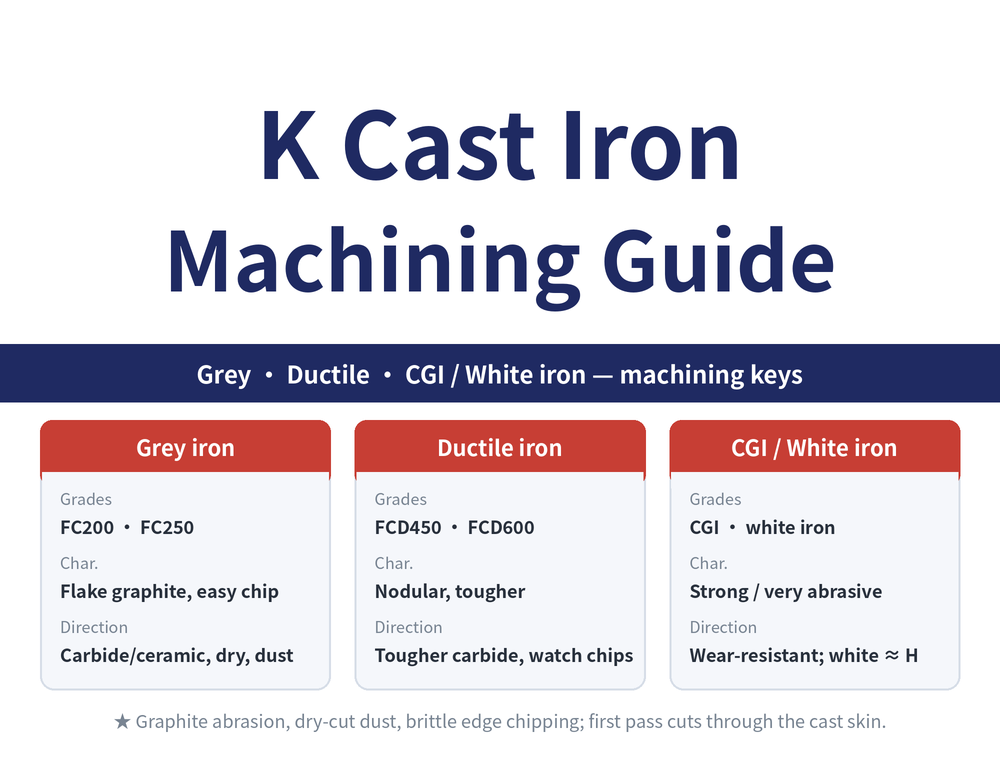
Cast-iron types and machinability
| Type | Representative grades | Graphite form / characteristics | Main challenge | Tool / direction |
|---|---|---|---|---|
| Grey iron | FC200, FC250 | Flake graphite, easy chipping, damping, good conductivity | Graphite abrasion, dust, brittle edge chipping | Carbide/ceramic, often dry, wear coating, dust extraction |
| Ductile iron | FCD450, FCD600 | Nodular graphite, tougher, higher strength | Longer chips, still abrasive | Tougher carbide, watch chip control, AlCrN |
| Compacted graphite (CGI) | engine blocks, etc. | Between grey/ductile, high strength | Highly abrasive, harder to cut | Wear-resistant tool, lower vc, stable cooling |
| White iron | white, high-carbide | High hardness, very abrasive | Very hard to cut | CBN/ceramic, light cuts, near group H |
In practice grey iron is the most common and easiest (good chipping, dry-cuttable); ductile iron is tougher and stronger with longer chips, needing chip control and more force; CGI is abrasive and harder; white iron is essentially a hard material, machined like group H.
Three machining keys for cast iron
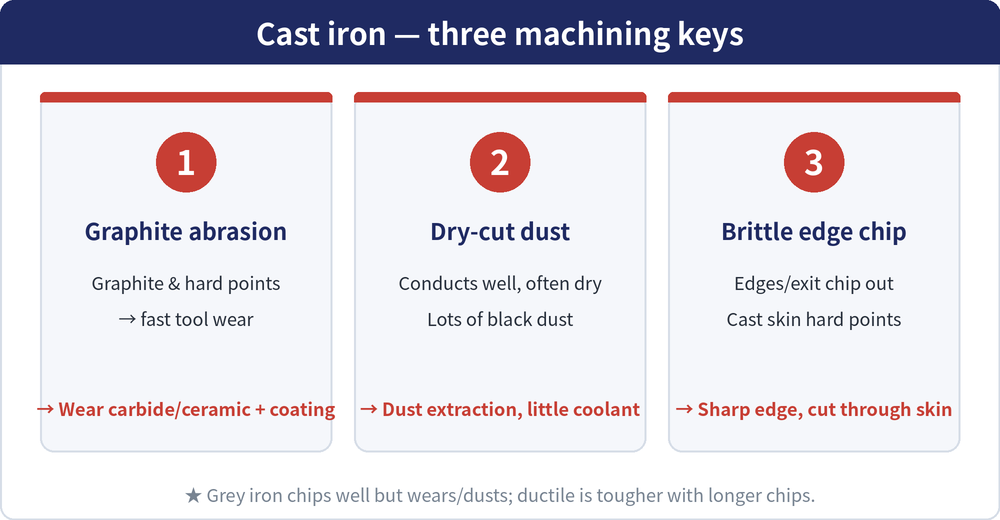
| Item | Description |
|---|---|
| Graphite abrasion | graphite, silicon and casting hard points/sand make cast iron abrasive and shorten tool life — use wear-resistant carbide or ceramic with a wear coating. |
| Dry-cut dust | grey iron conducts heat well and chips finely, so it is often cut dry (adding coolant turns iron powder into slurry that hinders evacuation), but it raises a lot of black dust — use dust extraction and protection. |
| Brittle edge chipping | cast iron is brittle, so edges and exits chip easily; use a sharp edge, climb milling and controlled exit to reduce it. |
| Cast skin hard points | the cast skin often holds sand, scale and hard points — make the first pass deep enough to cut through the skin, never rubbing lightly on it. |
Tool grade and coating direction
For grey iron, turning often uses ceramic or CBN (fast, wear-resistant) and milling mostly uses carbide + wear coating (TiAlN/AlCrN); ductile iron is tougher, so pick a tougher carbide and watch chip control; white iron and hard CGI are handled with CBN/ceramic and light, fast cuts. For full grade and coating selection, see "Cutting Tool Material Classification."
Key cutting strategy
| Item | Description |
|---|---|
| First pass | cut deep enough to pass through the cast skin's hard points; never rub lightly on the skin. |
| Coolant | grey iron is mostly cut dry with dust extraction; ductile iron or finishing may use coolant as needed. |
| Strategy | prefer climb milling and control the exit to reduce chipping; for interrupted cuts choose a tougher coating to avoid edge chipping. |
| For specific vc/fz values, see "End Mill Cutting-Conditions Calculation Guide." | |
FAQ
Can cast iron be cut dry?
Grey iron is often cut dry — it conducts heat well and chips finely, and adding coolant turns iron powder into a slurry that hinders chip evacuation. But dry cutting raises a lot of dust, so dust extraction and protection are essential. Ductile iron or finishing may use coolant as needed.
Why does cast iron wear tools so much?
Cast iron contains graphite, silicon and casting hard points/sand, making it abrasive and shortening tool life. Use wear-resistant carbide or ceramic/CBN with a wear coating, and cut the first pass through the cast skin's hard points to reduce wear.
How does machining grey iron differ from ductile iron?
Grey iron chips well and is dry-cuttable but brittle and edge-chip-prone, with clear graphite abrasion and dust; ductile iron is tougher and stronger with longer chips, needing chip control and handling higher cutting force — use a tougher tool.
Why do casting edges/exits chip out?
Cast iron is brittle, so material at the exit lacks support and chips easily. Use a sharp edge, prefer climb milling, lower the feed at the exit and watch the cast skin's hard points to reduce chipping.
For the full reading guides on this topic, see Tool Life and Wear: A Complete Reading Guide and Chip Control: A Complete Reading Guide.
This article is part of Workpiece Materials: The Complete Guide - Name the Metal First, Then Match the Tool; that guide shows how the whole topic fits together.