H-Group Hardened Steel Machining Guide: Hard Milling
Hardened steel is ISO 513's group H (insert colour: grey), driven by hardness state — typically HRC45–65 quenched/heat-treated steel, such as hardened SKD11, DC53 and SKD61, plus bearing steel SUJ2 and powder high-speed steels. It is hard, high-strength, high in cutting force, prone to tool wear and chipping, and runs hot at the tip, though chips are short and brittle. Today it is largely hard-milled directly on quenched parts, partly replacing EDM and grinding. This guide covers tool-selection direction for the hardened-steel types; for the overview see "ISO Workpiece Material Classification."
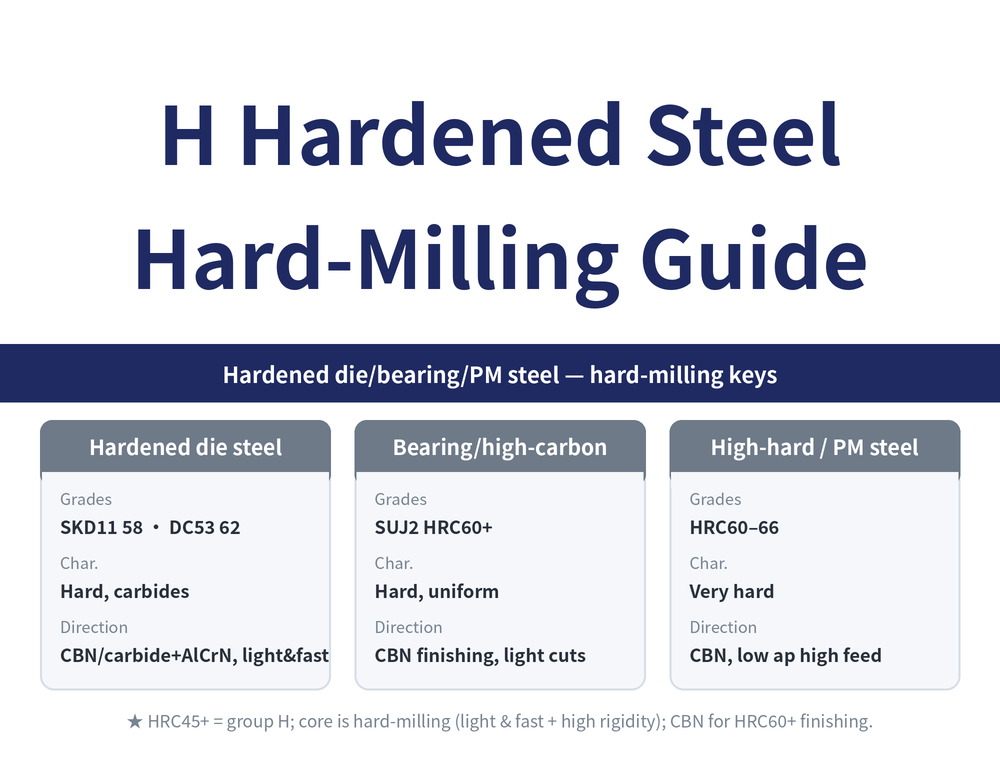
Hardened-steel types and machinability
| Type | Representative grades / hardness | Characteristics | Main challenge | Tool / direction |
|---|---|---|---|---|
| Hardened cold-work die steel | SKD11 HRC58–62, DC53 HRC62 | Hard, Cr/V carbides | Fast wear, chipping, high force | CBN / fine-grain carbide + AlCrN, light & fast |
| Hardened hot-work die steel | SKD61 HRC48–52 | Tough, hard, heat-resistant | High force, heat | Fine-grain carbide + AlCrN/nano, high rigidity |
| Bearing / high-carbon steel | SUJ2 HRC60+ | Hard, uniform structure | Wear, chipping | CBN finishing, light cuts |
| Powder HSS / high-hard die steel | HRC60–66 | Very hard, wear-resistant | Extreme wear, very hard to cut | CBN, low ap high feed, high rigidity |
The common logic: the harder the steel, the smaller the load per tooth. HRC45–55 is mostly hard-milled with fine-grain carbide + AlCrN/nano coating; for HRC58 and above, especially finishing, CBN (cubic boron nitride) is the first choice. Note: the same steel is group P and easy to cut when annealed, and only moves to group H after hardening (see the dual-listing in the "P-Steel Machining Guide").
Three hard-milling keys for hardened steel
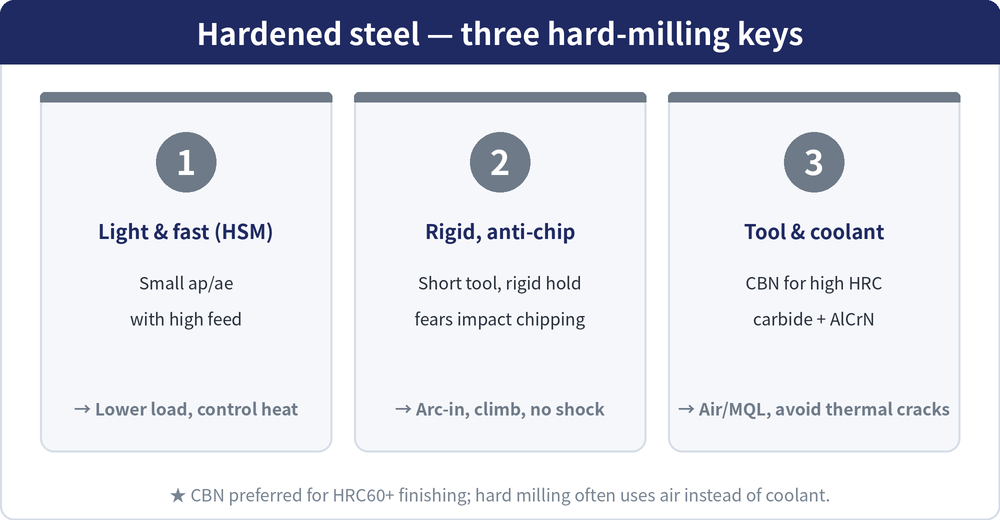
| Item | Description |
|---|---|
| Light & fast (HSM) | use a high-speed strategy of small depths (ap/ae) + high feed to lower the load per tooth and heat build-up, protecting the edge and extending life. |
| Rigidity & anti-chipping | hardened steel fears impact chipping — use a short tool, shrink-fit holder and rigid machine, and reduce shock with arc-in entry, climb milling and no sudden heavy cuts. |
| Tool & coolant | for high HRC (especially HRC60+ finishing) use CBN; for medium hardness use fine-grain carbide with AlCrN/nano heat-resistant coating. Hard milling often replaces coolant with air/MQL to avoid thermal shock cracking the CBN/coating. |
Tool grade and coating direction
Medium hardness (HRC45–55) mainly uses fine-grain carbide + AlCrN/nano coating; high hardness (HRC58+, especially finishing) prefers CBN for heat and wear resistance and edge retention. Rough out leaving an even stock for finishing; finish with light, fast paths and constant edge engagement. For full grade and coating selection, see "Cutting Tool Material Classification."
Key cutting strategy
| Item | Description |
|---|---|
| Light & fast | small ap/ae, high feed and high rpm to lower load per tooth and heat. |
| High rigidity, low shock | short overhang, rigid fixturing, arc-in entry and climb milling to avoid chipping. |
| Coolant | hard milling mostly uses air/MQL to avoid thermal-shock cracking; adjust per tooling system. |
| For specific vc/fz values, see "End Mill Cutting-Conditions Calculation Guide." | |
FAQ
How hard is "group H"?
Generally HRC45 and above after quenching/heat treatment (commonly HRC45–65). The same steel is group P and easy to cut when annealed, and only becomes group H after hardening — with a completely different strategy.
Carbide or CBN for hardened steel?
HRC45–55 is mostly hard-milled with fine-grain carbide + AlCrN/nano coating; for HRC58 and above, especially finishing, CBN (cubic boron nitride) is the first choice for heat/wear resistance and edge retention.
Should I use coolant for hard milling?
Hard milling often uses air or MQL instead of coolant. On quenched parts, the thermal shock from coolant (rapid heating/cooling) can micro-crack and chip CBN or coatings, so dry/air is common — adjust per the tooling system's recommendation.
Can hard milling replace EDM or grinding?
In many mould applications it partly can — hard-milling quenched parts directly saves EDM and some grinding steps and shortens lead time. But it demands high machine and clamping rigidity and the right tooling/paths (light & fast), so the whole setup must be matched for stability.
This article is part of Workpiece Materials: The Complete Guide - Name the Metal First, Then Match the Tool; that guide shows how the whole topic fits together.