Is Dry Tapping Viable: Tap Choice for Through and Blind Holes, and Why Forming Wins
Tapping has the worst chip-space conditions of any cutting operation: the edges are buried in the hole and the chips have nowhere to go. Traditionally that is held together by chlorinated extreme-pressure emulsion, which is also the most polluting fluid in the shop. Dry tapping is possible, but it requires tap selection, coating and machine conditions to be handled together — and the cleanest route is to produce no chips at all.
1. Why tapping is the hardest case for dry cutting
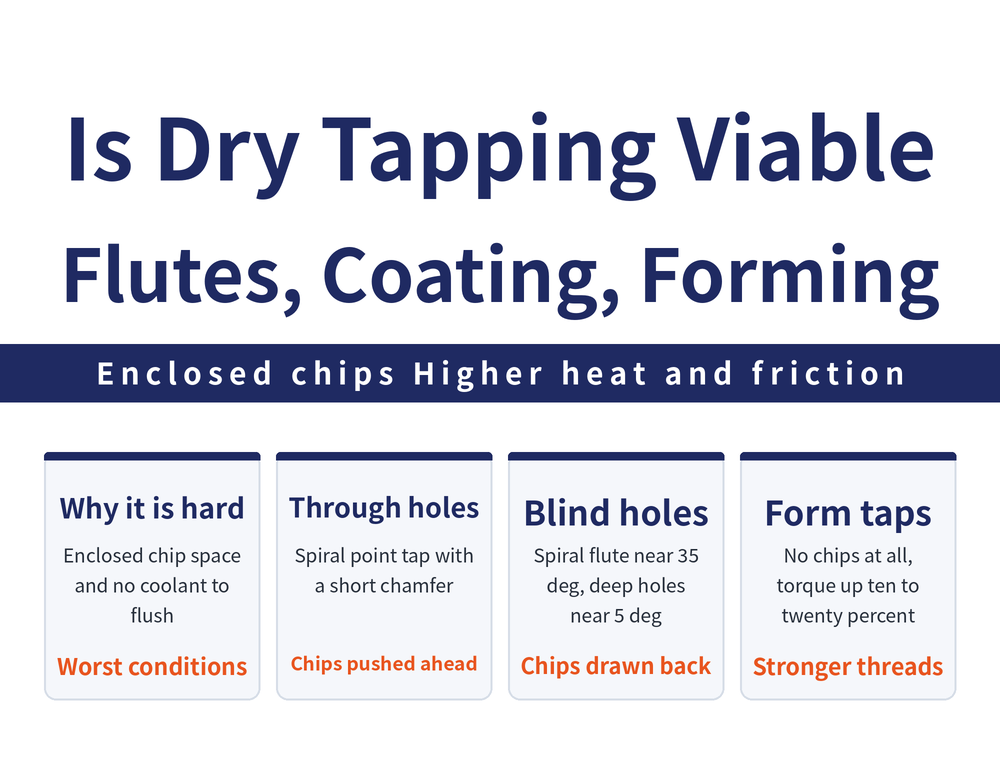
Thread machining works in an enclosed or semi-enclosed chip space, so conditions are already worse than in general cutting. Remove the coolant and three things happen at once: cutting temperature rises further, friction at the tool–chip and tool–work interfaces increases, and chip evacuation gets worse still. That is why tapping has traditionally relied on chlorinated extreme-pressure emulsion — which is also the most polluting member of the cutting fluid family. For the overall coolant decision, see how to choose cutting fluid.
Making dry tapping work leaves only two levers: the tap substrate and coating, and the flute design.
2. What the substrate cannot carry, the coating does
Moving the tap substrate to high-cobalt high speed steel, powder metallurgy high speed steel or ultra-fine grain carbide raises strength, toughness and wear resistance, but tool life under dry conditions is still not sufficient. What actually brings dry tapping into a usable range is the surface coating, which lowers the tool–chip friction coefficient and raises temperature capability, allowing a tough substrate and a dry-capable cutting edge to coexist.
The difference between coating grades is substantial. Dry tapping an aluminium-silicon alloy of around 9% silicon, the source compared three taps: a composite coating (molybdenum disulphide plus TiAlN) achieved roughly four times the number of tapped holes of a single TiAlN coating, while an uncoated ultra-fine grain carbide tap managed two orders of magnitude fewer (source: Dry Cutting, ch. 4; single-source measurement, for order-of-magnitude reference). In dry conditions, in other words, coating is not an upgrade but a prerequisite. For tap surface treatments see the tap surface treatment guide.
3. Through holes and blind holes need different flutes
The source gives a clear set of matching rules for dry tapping:
| Hole type | Tap type | Key point |
|---|---|---|
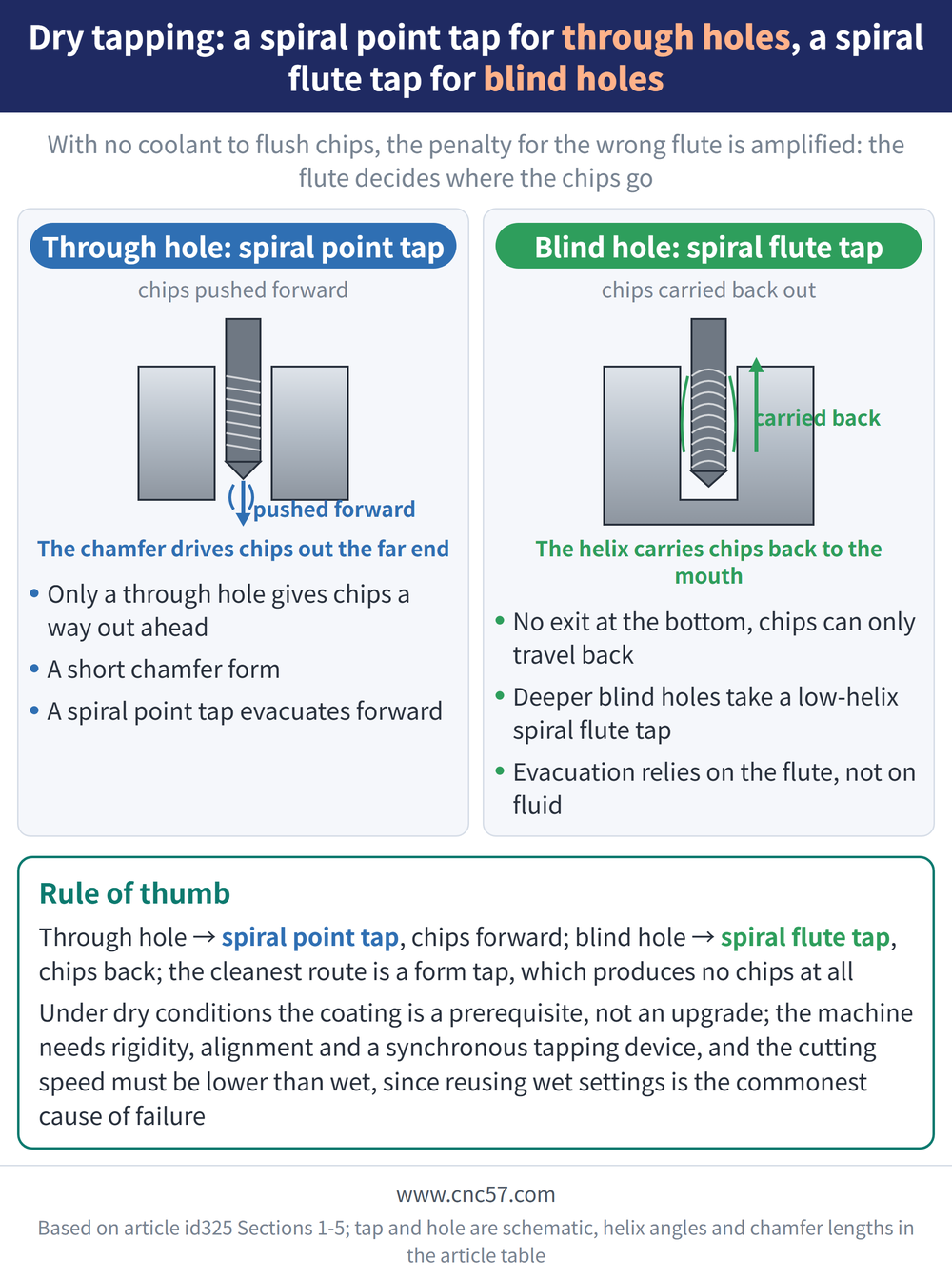
| Through hole | Spiral point tap | Type B chamfer (2–3 threads), chips pushed forward |
| Blind hole | Spiral flute tap | Helix angle around 35°, chips carried back out |
| Blind hole deeper than 2× nominal diameter | Low helix spiral flute tap | Helix angle reduced to around 5° |
The table reflects rules developed for a dry cutting tap series (same source); follow the catalogue of the tap actually used. The logic is the same as in wet tapping — but without coolant to flush chips, the penalty for choosing the wrong flute is amplified. For the basics of flute types see tap flute design, and for chip direction with spiral point taps see what a spiral point tap is.
4. The cleanest route: produce no chips
Every difficulty above revolves around one thing — chips that cannot get out. The form tap removes that premise entirely: it forms the internal thread by plastic deformation, producing no chips at all, so the hardest problem in dry tapping simply does not arise.
Two sets of source measurements support this. First, a dry-cutting form tap producing M4 through-hole threads in cold rolled steel sheet reached several times the hole count of an ordinary form tap with no welding or significant wear. Second, comparing dry and wet forming in a high-ductility aluminium: dry forming torque runs roughly ten to twenty percent higher than wet, yet the resulting thread strength and surface roughness are both better.
The same trials compared three tap manufacturing methods: rolled taps tend to chip in dry tapping, ground taps broadly meet requirements, and TiN-coated form taps satisfy both thread quality and tool life. For form tap principles and hole size see the complete form tap guide, and for the trade-off against cutting taps see cutting tap vs form tap.
5. Five things the machine side has to provide
| Item | Requirement |
|---|---|
| Machine condition | Sufficient rigidity, accuracy and power, with alignment properly set |
| Tapping device | Rigid or synchronous tapping simplifies setup; otherwise calibrate carefully |
| Cutting speed | Use a lower speed than wet, to protect tool life |
| Tap type | Selected by workpiece material and hole structure (see above) |
| Flute and geometry | Designed so chips curl easily and friction stays low |
The lower cutting speed is the item most often overlooked — carrying wet parameters straight over to dry is one of the most common causes of failure in dry tapping. For speed conversion see the tap cutting speed guide, and for holder and synchronous feed pairing see the tap holder and machine setup guide.
6. Frequently Asked Questions (FAQ)
Q: Is dry tapping actually viable?
Yes, but under stricter conditions than wet. A coated tap, the correct flute type, a lower cutting speed and a sufficiently rigid machine all have to be in place; miss one and tool life drops noticeably.
Q: Which tap should be the first choice for dry tapping?
Where the material allows plastic forming, consider a form tap first, because no chips means no evacuation problem. If cutting is required, use a spiral point tap for through holes and a spiral flute tap for blind holes.
Q: Dry forming needs more torque — will taps break more often?
Source measurements put dry forming torque about ten to twenty percent above wet, which is a predictable margin. The point is to allow for it in spindle torque and holder selection rather than reusing the wet settings.
Q: Can an uncoated tap be used dry?
Not advisable. Under dry conditions the coating carries the friction reduction and temperature capability; an uncoated tap gives a hole count too low to be of production value.
This article is part of Dry Machining: The Complete Guide - Losing the Coolant, and How Five Processes and Three Techniques Cope; that guide shows how the whole topic fits together.