How Easy Is a Material to Cut? Reading the Machinability Rating and Its Limits
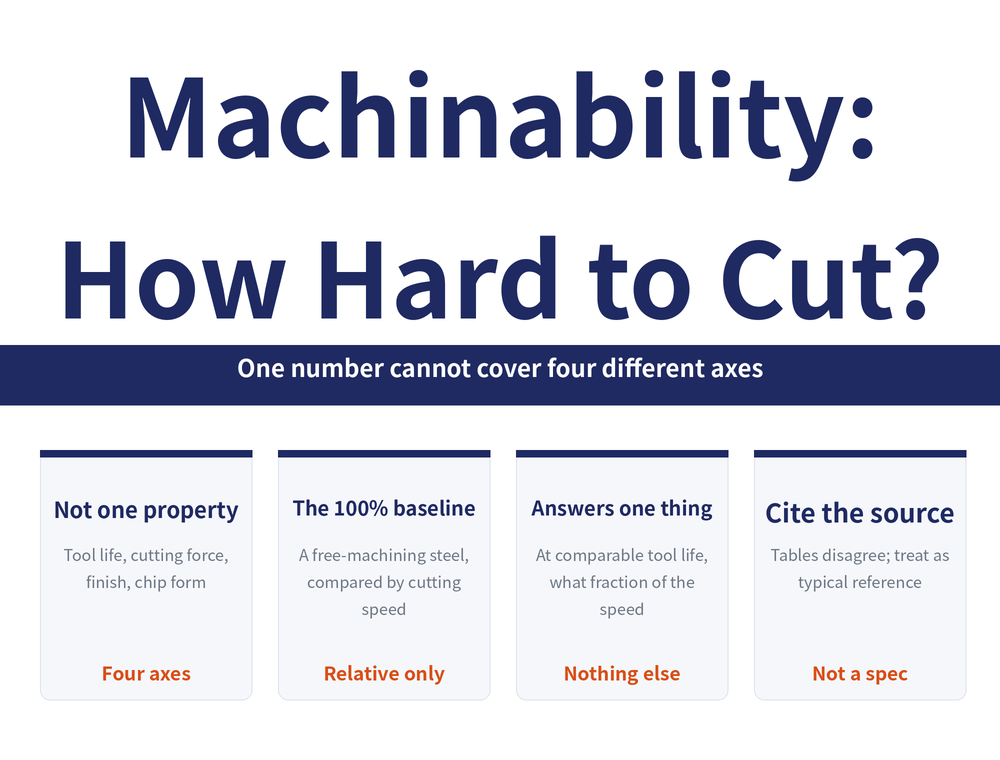
Machinability, or how easy a material is to cut, is not a property one number can express. Rank the same material by tool life, by cutting force, or by surface finish and the order can change completely. The most widely quoted machinability rating sets a free-machining steel at 100% and answers only one question: at comparable tool life, what fraction of the baseline cutting speed can you run? This article explains how that baseline is defined, gives typical reference values for representative materials, and shows what the number cannot tell you.
1. Machinability has four dimensions, not one score
"Is this material easy to cut" means different things to the estimator, the programmer and the quality engineer. Technical literature generally splits machinability into four criteria.
| Criterion | What it measures | When it matters most |
|---|---|---|
| Tool life | How long the edge lasts before it is scrapped | Volume production, costly tool changes |
| Cutting force and power | Energy needed to remove a unit volume | Limited spindle power or rigidity, thin parts |
| Surface finish | Whether built-up edge tears the surface | Finishing, no-grind requirements |
| Chip form | How well chips break and evacuate | Swiss lathes, deep holes, lights-out running |
These four criteria can contradict each other. The classic example is titanium alloy: it rates reasonably by surface finish, poorly by tool life, and in between by power consumption. So when someone quotes "machinability 35%", the first question is which criterion produced it.
2. What exactly is the 100% baseline?
The machinability rating comes from a comparison method established by the American Iron and Steel Institute (AISI): one free-machining steel is fixed at 100%, and every other material is expressed as the fraction of that baseline cutting speed it can run at comparable tool life.
Baseline conditions as quoted in public sources: cold-drawn free-machining steel at roughly 160 HB (Brinell hardness), turned with a high speed steel (HSS) tool and a suitable cutting fluid at 180 sfm (surface feet per minute), defined as 100%. This is the definition of the baseline, not a recommended parameter.
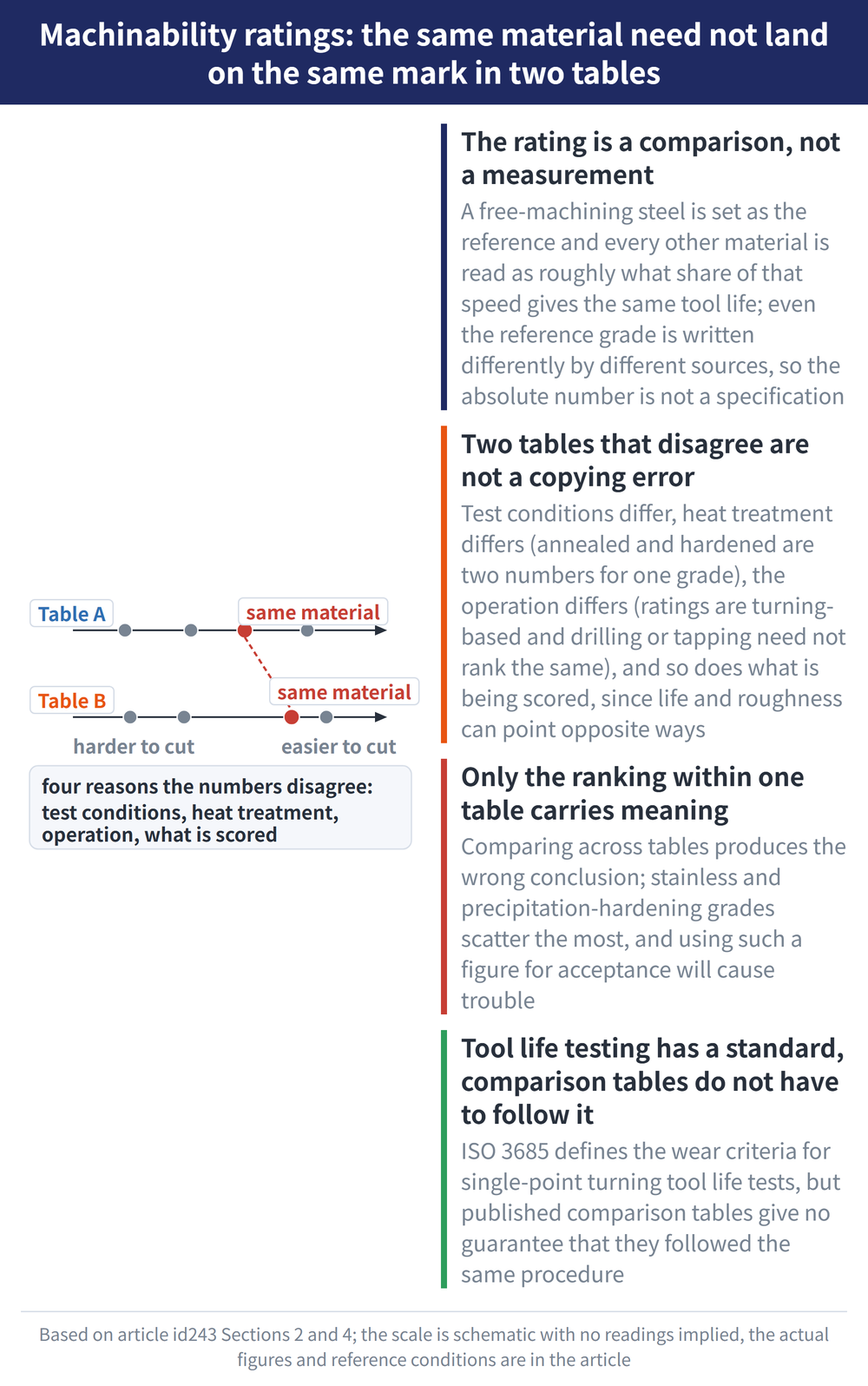
The baseline designation is not consistent across sources: older literature writes B1112 or 1112, current charts mostly write AISI 1212, and all are resulfurized free-machining steels. So the absolute number should not be treated as a specification; what carries meaning is the relative order within one chart. Note also that the baseline was established with high speed steel tooling, whose grades differ as described in HSS Grade Decode Guide.
3. Typical reference values for representative materials
The table below gives typical reference values compiled from public comparison charts, with AISI 1212 as 100%. Use them for ranking difficulty only; mill certificates and tooling catalogues govern in practice.
| Material | Typical reference rating |
|---|---|
| Aluminium alloy (cast) | approx. 450 |
| Aluminium alloy (cold drawn) | approx. 360 |
| 12L14 leaded free-machining steel | approx. 170 |
| 1215 free-machining steel | approx. 136–138 |
| 416 stainless (annealed) | approx. 110 |
| AISI 1212 | 100 (baseline) |
| 1018 low carbon steel | approx. 78 |
| 303 stainless (annealed) | approx. 78 |
| Aluminium alloy (die cast) | approx. 76 |
| 4140, 8620 (annealed) | approx. 66 |
| 304 stainless (annealed) | approx. 45 |
| 316 stainless (annealed) | approx. 40–45 |
| Ti-6Al-4V | approx. 35 |
| D2 tool steel | approx. 27 |
| Inconel 718 | approx. 16 |
Two things are worth noting. First, free-machining steels sit far above the baseline because manganese sulphide (MnS) inclusions or dispersed lead particles break the chip and cut friction; those are deliberate additions. Second, although it is still aluminium, die-cast aluminium falls below the baseline, because the abrasion from high silicon content is priced into the rating. For matching workpiece groups to tool materials and coatings, see Material and Coating Selection by Workpiece.
4. Why do charts disagree on the same material?
Put two public charts side by side and the same material often will not line up. Nobody miscopied; the test conditions were never standardised.
| Source of variation | What actually happens |
|---|---|
| Different test conditions | Tool material, edge geometry and coolant change the result |
| Different heat treatment | Annealed and hardened are two numbers; charts often list only annealed |
| Different operation | Ratings are turning-based; drilling and tapping may rank differently |
| Different criterion | Scoring by tool life and by surface finish can reverse the conclusion |
For example, 316 stainless appears as 40 in one chart and 45 in another, and the precipitation-hardening grades 15-5PH and 17-4PH diverge further still. Tool life testing does have standards such as ISO 3685 (tool life testing with single-point turning tools) that define wear criteria, but circulating machinability charts do not all follow one procedure. The rating is fine for ranking, not for acceptance criteria.
5. How to use the rating, and how not to
As a coarse scale of difficulty it works well: estimating cycle time, setting tool-change intervals, comparing incoming lots. Trouble starts when you try to convert a rating into parameters.
| What you want to know | Can the rating answer it |
|---|---|
| How much harder this lot is than the last | Yes, but only within one chart |
| Which tool material and coating to pick | No, go back to the workpiece groups |
| What speed and feed to run | No, follow the tooling catalogue |
| Whether chips tangle or burrs pile up | No, that is chipbreaker design |
In short, the rating tells you the material will eat tools faster; it does not tell you which tool to switch to. For the grouping logic see Cutting Tool Material Classification; trade-offs also differ by tool type, as covered in Tool Material Selection by Tool Type. Low-rating materials are usually rescued with a different grade and coating, see Cutting Tool Materials Guide and Tool Coating Types Guide.
6. Frequently Asked Questions (FAQ)
Q: What does a machinability rating of 100% mean?
100% is the reference point, the behaviour of the free-machining steel chosen by AISI (written B1112 or 1112 in older literature, AISI 1212 in most current charts) under defined test conditions. Other materials are expressed as the fraction of that baseline cutting speed they sustain at comparable tool life.
Q: Why does the same material get different numbers in different charts?
Because tool material, edge geometry, coolant and heat-treat condition are not standardised between charts. 316 stainless, for instance, appears as both 40 and 45, so treat the figures as a ranking only.
Q: Does a high rating mean lower machining cost?
Not necessarily. The rating mainly reflects tool life and usable cutting speed, not the cost of chip evacuation, surface finish or deburring, and leaded free-machining steel also carries price and regulatory considerations.
Q: Can I convert a rating directly into a cutting speed?
Not advisable. The baseline test used high speed steel tooling, which is far removed from today's carbide and coated tools, so actual parameters should come from the tooling catalogue and a trial cut.
For the full reading guides on this topic, see Surface Finish: A Complete Reading Guide and Tool Life and Wear: A Complete Reading Guide.
This article is part of Workpiece Materials: The Complete Guide - Name the Metal First, Then Match the Tool; that guide shows how the whole topic fits together.
Published: 2026-08-08 | Last updated: 2026-08-08