
How to Drill Deep Holes with a Long Drill: Pilot Hole, Slow Entry, Drilling and Retraction
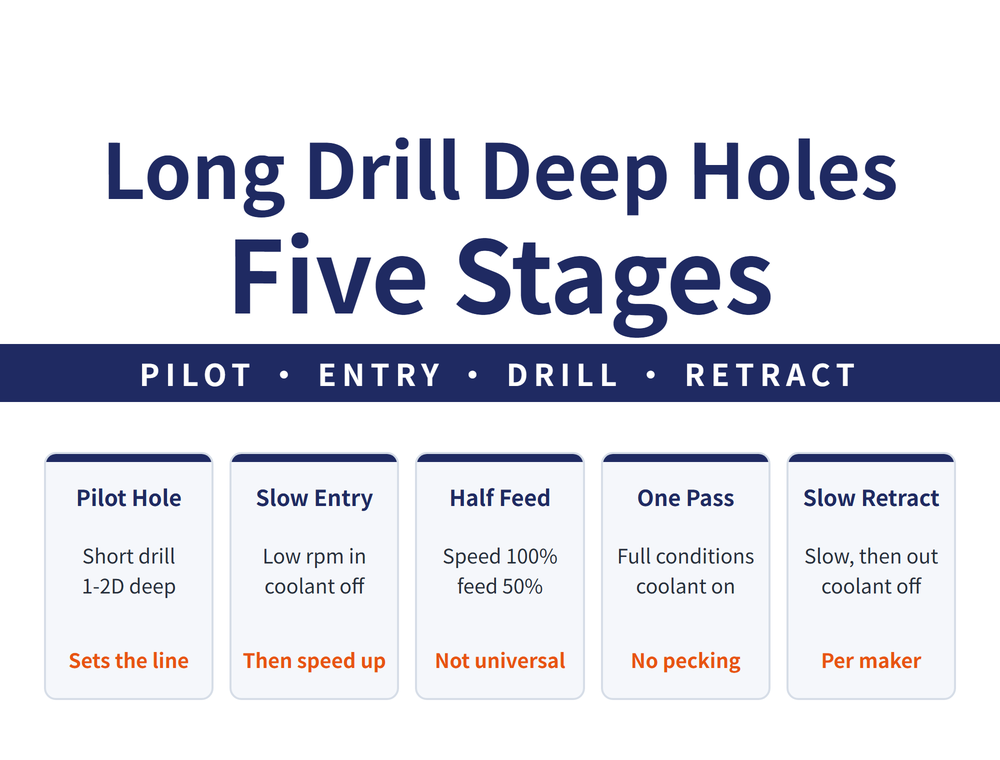
Drilling a hole deeper than 10 times its diameter with a long drill takes five steps: spot a pilot hole with a short drill, feed the long drill into it at low speed, restore the speed and drill a short section at half feed, drill to full depth in one pass, then slow down and retract. Manufacturers' entry and retraction speeds differ by an order of magnitude, so always follow the recommendation for the drill in your hand.
Why You Can't Just Mount It and Drill
A long drill is thin and long, so its radial rigidity is inherently low. Spinning fast in free air, the tip whips; once it whips, the hole starts off line at the entry and the rest of the hole follows. A small-diameter long drill can even snap at this stage.
That is why manufacturers split one hole into stages, each with its own speed, feed and coolant setting. Three independent manufacturer sources give exactly the same order: pilot hole → slow entry → drilling → slow retraction.
1. The Five Steps in One Table
| Step | What to do | Speed / feed | Coolant |
|---|---|---|---|
| 1. Pilot hole | Drill a pilot section with a short drill | Normal conditions for the short drill | On or off |
| 2. Slow entry | Feed the long drill into the pilot at low speed; stop near the bottom | Low speed (see Section 3) | Off |
| 3. Spotting | Restore speed and cut a short section gently | Speed 100%, feed 50% | On |
| 4. Deep drilling | Drill to depth in one pass, no pecking | Speed and feed 100% | On |
| 5. Slow retraction | Reduce speed near the bottom, then return to start | Low speed (see Section 3) | Off (reversed for some tools, see Section 4) |
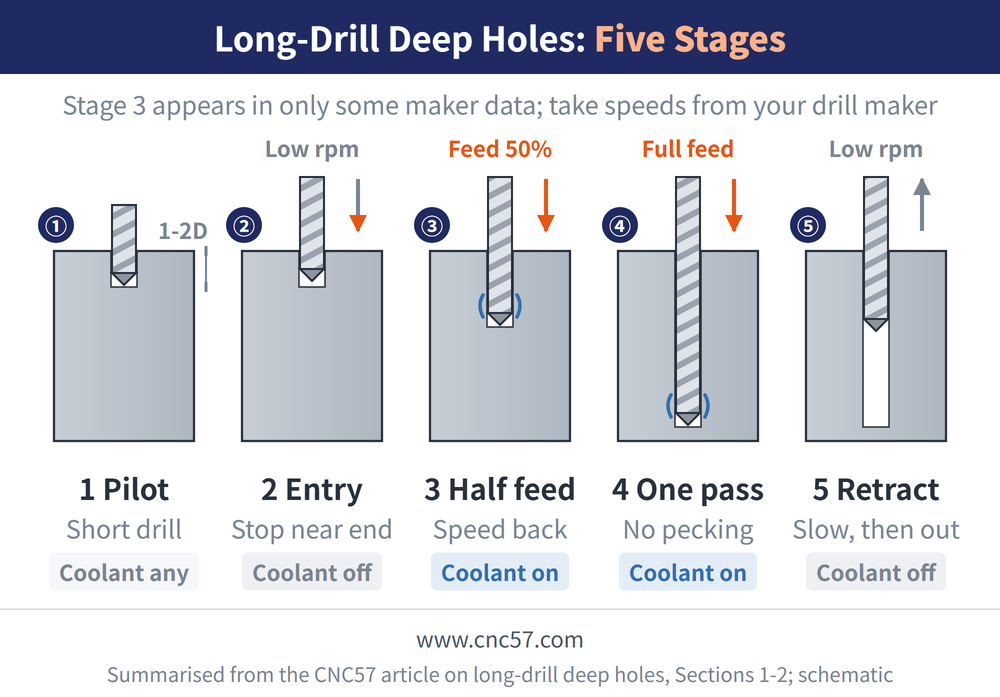
⚠ Step 3 appears in only one of the manufacturer sources. Another says to drill "in one pass, without pecking" right after entry and has no half-feed section. Whether to add it depends on the instructions for your drill.
2. The Pilot Hole Sets the Direction of the Whole Hole
A long drill does not find its own center; it follows the pilot hole. If the pilot is off, no amount of care later will bring it back.
| Item | Key point |
|---|---|
| Point angle | The pilot drill's point angle must not be smaller than the long drill's |
| Depth | Usually about 1-2 x D; deeper for longer drills |
| Which drill | A short 3-5 x D class drill: rigid and accurate |
| Accuracy | The pilot must be accurate; it is the long drill's guide rail |
The point-angle rule is the same logic as spot drilling: the center of the long drill should touch the workpiece first, not its outer corners. Outer corners touching first create impact loads; see How to Start a Hole. On depth, one manufacturer gives the example that a long drill of 50 x D needs a pilot of about 7 x D.
🔴 The other rule you may see, "pre-drill 8-12 x D", is about a different tool. It applies to deep hole drilling systems such as gundrills, without a support bushing, for total depths of 20-30 x D. This article is about twist-type long drills; do not mix the two. Using the wrong rule gives a pilot that is either too shallow or wastes cycle time. For how gundrills start, see Gun Drilling Guide.
3. Entry and Retraction: Low Speed, but the Numbers Vary Widely
On entry, raise the speed only after the shoulders of the cutting edges are fully inside the pilot and supported by its wall. On retraction, slow down first: once the tip leaves the bottom, nothing in the hole supports the drill, and high speed makes it whip just the same. The table lists three manufacturer sources side by side, without picking one:
| Item | Source A | Source B | Source C |
|---|---|---|---|
| Entry speed | Cutting speed 20-30 m/min, feed 0.2-0.3 mm/rev | About 500 min⁻¹ | 500 min⁻¹ |
| Where entry stops | 0.5-1 mm from pilot bottom | - | About 1.5 x D deep (pilot 2 x D) |
| Retraction speed | Flat: same as entry; inclined, interrupted: about 1000 min⁻¹ | About 500 min⁻¹ | 100 min⁻¹ |
| Retraction feed | About 3000 mm/min | 2000-3000 mm/min | - |
"-" means that source does not list the item. The x D depths in column C are dimension marks on the manufacturer's diagram, which does not state where they are measured from; this article reads them as measured from the hole entry.
Retraction speeds differ by an order of magnitude, and none of the three sources states the drill diameter or material they apply to. So do not apply one manufacturer's numbers to every drill; follow the recommendation for the drill in your hand. Source A gives a cutting speed, so converting it to spindle speed requires the drill diameter:
Spindle speed n (min⁻¹) = 1000 × cutting speed vc (m/min) ÷ (π × drill diameter D (mm))
Example: D = 16 mm, vc = 20-30 m/min → n is about 400-600 min⁻¹. This is a unit conversion only; it does not mean the three sources agree at this diameter.
For starting speeds and feeds by material and diameter, see Drilling Parameters Guide.
4. Coolant: When It Goes On and Off
One manufacturer source marks the coolant setting for every step: off for the slow entry and retraction, on for the two cutting steps, and either way for the pilot hole. It marks on and off only and gives no reason.
🔴 Gundrills follow the opposite rule: keep coolant flowing for the entire retraction and stop only after the drill is fully out. A gundrill relies on guide pads pressing on the hole wall, and chips caught there scratch the wall. They are different tool systems; follow each one's own procedure and do not mix them. For gundrill coolant points, see Gun Drilling Guide.
For small-diameter coolant-through long drills, prepare the coolant system before starting:
| Item | Manufacturer recommendation |
|---|---|
| Filtration | Fine filter, 5 μm or finer, so chips do not block the small coolant holes |
| Supply pressure | 1.5 MPa or more with water-soluble fluid; higher is more stable |
| Tool changes | Slow the ATC down; the impact can damage a slender drill |
For choosing the fluid, see Cutting Fluid Comparison for Drilling; for coolant-through types, see Through-Coolant Drill Guide.
5. How "One Pass to Depth" Fits with Peck Drilling
Step 4 of the manufacturer procedure says one pass, no pecking, while other articles on this site explain when to peck. They do not conflict; the difference is whether the chips can get out:
| Situation | What to do |
|---|---|
| Coolant-through long drill, enough supply, chips clear | Follow the procedure: one pass to depth |
| No coolant holes, or chips already packing | Switch to pecking, short retract first |
Why short retract for long drills: a full retract re-enters the hole on every peck, repeating the unstable step 2 each time; see Drilling Cycle Selection. For how deep coolant-through long drills can go, see Deep Hole Drill Guide.
6. Inclined Entry or Breakthrough: Two More Things
When the surface is inclined or irregular, or the hole breaks out on such a surface, the edges meet interrupted cutting, and the procedure adds two things:
| When | What to add |
|---|---|
| Before the pilot hole | Make a flat with a flat drill or end mill, about 1 x D deep |
| Near breakthrough | Cut feed to about half of normal; slow down after breakthrough, then retract |
Interrupted cutting at breakthrough is what damages the edges most easily, so do not skip this step. For how much to reduce feed on inclined surfaces, see Drilling on Inclined and Irregular Surfaces.
7. When Something Goes Wrong, Trace It Back to the Step
Most long-drill problems trace back to one of the five steps. The table lists only what to check first with a long drill; for the general symptom, cause and remedy table for drilling, see Drilling Troubleshooting Guide.
| Symptom | Check which step | What to check |
|---|---|---|
| Hole starts off position | ① Pilot hole | Is the pilot hole accurate? Is its point angle smaller than the long drill's? |
| Breaks on entry | ① ② | Was a pilot hole drilled? Was speed raised before the shoulder entered? |
| Straight at the mouth, drifts deeper | ④ Deep drilling | Spindle and holder runout; is the feed too high? |
| Chips packing | ④ Coolant | Clogged filter or oil holes? Normal pressure does not mean enough flow |
| Long, stringy chips | ④ Feed | Is the feed too cautious? Too slow and the chips will not break |
| Edge chips at breakthrough | Before breakthrough (section 6) | Was the feed cut to about half near breakthrough? |
If chips are already packing, switch to peck drilling, preferably with short retracts (section 5). For how to judge coolant flow, see Drilling Coolant: Chase Flow, Not Pressure. Gun drills and BTA are different tool systems; for their problems see Gun Drilling Guide and BTA vs Ejector Deep-Hole Drilling.
Frequently Asked Questions (FAQ)
Q: Does a long drill always need a pilot hole?
Yes. A long drill has low radial rigidity and does not center itself, so it whips when spinning fast in free air; a pilot drilled with a short drill gives it a guide rail to follow and makes small long drills less likely to snap at the start.
Q: How deep should the pilot hole be?
For twist-type long drills, usually about 1-2 x D, deeper for longer drills. Deep hole drilling systems such as gundrills use a separate, deeper pre-drill rule; do not mix the two.
Q: What speed should I use for entry and retraction?
Always low, but manufacturers' figures range from 100 to 1000 min⁻¹ and none states the diameter or material they apply to, so follow the recommendation for your drill.
Q: Should I peck when drilling deep holes with a long drill?
With a coolant-through long drill, enough supply and chips clearing, the manufacturer procedure is one pass to depth; switch to pecking only without coolant holes or when chips pack, and use short retracts so the drill does not re-enter on every peck.
Sources: Source A = Mitsubishi general catalog (advanced use of long drills, p.1578); B = NACHI general catalog 2025-2026 (p.795); C = WINSTAR Holemaking catalog C024, Deep Hole Drilling Application Guide. Pre-drill rules for deep hole drilling systems per ISCAR Drilling Handbook.
This article is part of Drill Bits: The Complete Guide - Start From Depth-to-Diameter, Then Pick the Drill and Set the Conditions; that guide shows how the whole topic fits together.
Last updated: 2026-10-31









