
Machining Aluminum and Non-Ferrous Metals: The Complete Guide - Soft Does Not Mean Easy
Aluminium is soft, but soft and easy are two different things. What stops the job is not cutting force, it is sticking and built-up edge - chips weld to the cutting edge, and from there the finish degrades and the size drifts. This guide takes aluminium as the trunk and arranges the site content in working order: read the grade and temper, understand how built-up edge forms, then pick the tool, set the data and finish the surface. Copper, brass and magnesium each get a signpost.
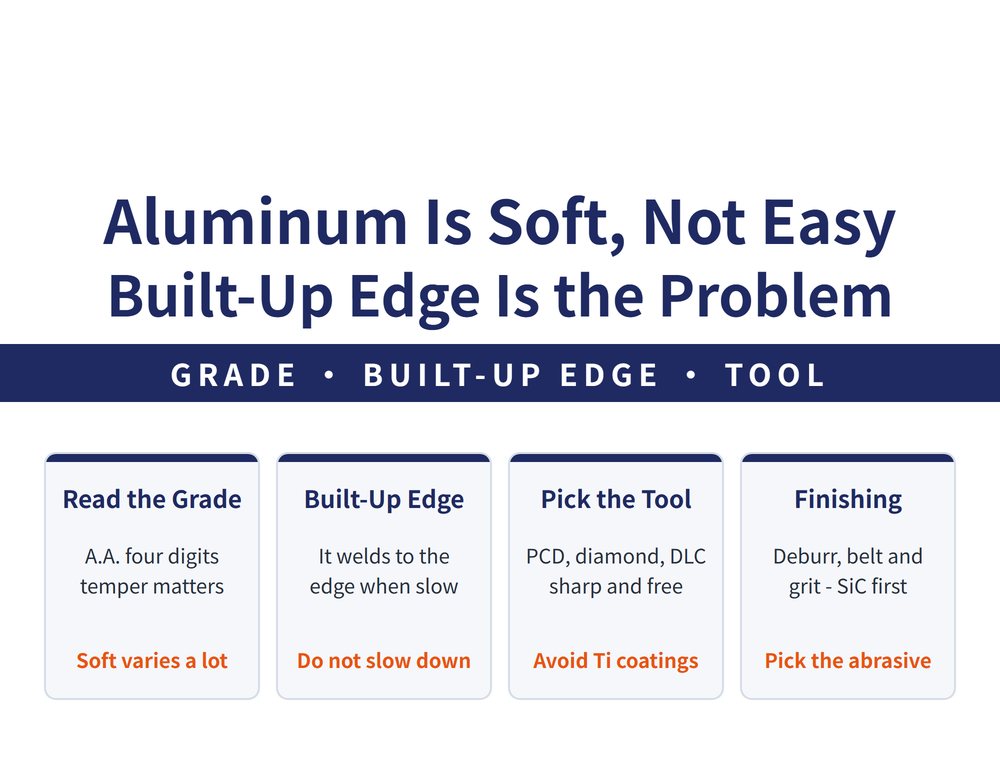
1. The Order of This Line, and What It Deliberately Leaves Out
Non-ferrous covers a lot of ground. This guide takes aluminium as the trunk and gives copper, brass and magnesium a signpost each, rather than equal space - covering all of them evenly would produce a little of everything and enough of nothing.
| Step | What it answers | Section |
|---|---|---|
| 1 Read the grade | How the code works, and what the temper means | Section 2 |
| 2 Know why | How built-up edge forms, and why slower is worse | Section 3 |
| 3 Tool and data | Sharp, free-cutting, and what dry cutting costs | Sections 4-5 |
| 4 Surface and the rest | Grinding aluminium, plus copper, brass, magnesium | Sections 6-7 |
The common misread is right at step one: taking "low hardness" to mean "easy to cut". The trouble with aluminium is not cutting force, it is that it welds itself to the tool - and that has nothing to do with hardness.
2. Step One: Grade and Temper
Aluminium grades differ more than people expect. Same series, different temper, and it is effectively two materials in the cut.
| Article | When to read it |
|---|---|
| ISO N Aluminium and Non-Ferrous Guide | To learn how this group behaves in the cut. Read this one first |
| Reading Aluminium and Titanium Grades | When you see 6061 or 7075 and want the A.A. four-digit rules |
One thing beyond the grade code: silicon content. High-silicon cast aluminium is noticeably abrasive, and tool life is not in the same league as cutting 6061, so ask before choosing the tool. Section 4 comes back to this.
3. The Real Trouble: Built-Up Edge and Sticking
Built-up edge is the main character in this line. Chips weld to the cutting edge and are pressed into a false edge, and from there size and finish stop behaving.
| Article | When to read it |
|---|---|
| Why Dry Drilling Is Hard | To follow how built-up edge forms step by step. It works through an aluminium example |
| Ten Tool Wear Patterns | When the tool has already failed and you want to read the cause from the wear |
Here is the counter-intuitive part: too slow is what grows built-up edge. Reacting to a poor finish by dropping the speed usually makes it worse. The direction that works is a sharper edge, enough speed, and chips that get out - all three, not one of them.
4. Tool and Coating: Sharp, and Free to Clear
Tool choice for aluminium is unusually focused: a keen edge, generous chip room, and a surface the material will not stick to.
| Article | When to read it |
|---|---|
| PCD and Diamond Coating Guide | When cutting aluminium or non-ferrous metals with PCD or diamond coating |
| How to Use DLC Coating | When you want to know which substrates suit DLC and how life compares |
| Cutting Tool Materials in Full | When you are narrowing the field at the tool material level |
One mismatch is worth naming: titanium-based coatings usually do not help in aluminium and can stick more. A coating name says nothing about the workpiece it suits; what matters is friction behaviour and surface energy, and all three articles cover it.
5. Process by Process: Milling, Dry Cutting and Its Cost
Aluminium is one of the few materials where dry cutting genuinely works, but working is not the same as free - know the cost first.
| Article | When to read it |
|---|---|
| End Mill Cutting Conditions Guide | Milling aluminium, when you need surface speed and feed per tooth |
| How to Do Dry Milling | When dry milling aluminium and you need the right set of measures |
| The Cost of Dry Cutting | To learn where dry cutting is the wrong call. Read this before deciding |
The key to dry cutting aluminium is not doing without coolant, it is getting the chips out. With no fluid washing the flutes, chips stay in and get recut - and recutting is exactly where the Section 3 loop starts.
6. Surface and Finishing: Grinding Aluminium Is Not Grinding Steel
Aluminium has a problem of its own at the abrasive stage: it loads the belt. Pick the wrong grain and the belt dies quickly, and it drags marks across the part on the way.
| Article | When to read it |
|---|---|
| Deburring and Finishing by Material | When deburring and surface work has to follow the material |
| Choosing the Abrasive Grain | When the grain choice is unclear, or belts keep loading up |
| Reading Coated Abrasive Specs | When you need to read the fields on a coated abrasive spec |
Deburring needs care too: aluminium burrs are ductile, they do not snap off, and often just get pushed to the other side. That is different from how steel burrs behave, so the tools and the sequence differ as well.
7. Copper, Brass and Magnesium: What to Watch
None of these three has its own line on the site yet, but two things are worth knowing now.
| Article | When to read it |
|---|---|
| Is Magnesium Easy to Machine | When cutting magnesium and you want the myths cleared up first |
Copper and brass are covered inside ISO N Aluminium and Non-Ferrous Guide from Section 2 - that guide spans aluminium, copper and brass together, and is currently the most complete home for those two on the site. Magnesium gets its own article, because its safety considerations are unlike the others and do not belong in a shared treatment.
8. Frequently Asked Questions (FAQ)
Q: If aluminium is soft, how does it still wreck tools?
Because cutting force is not the only thing that kills a tool. Aluminium melts at a low temperature and has an affinity for tool materials, so chips weld to the edge and form a built-up edge. That lump changes the working shape of the cutting edge, finish and size drift with it, and when it breaks away it can take a piece of the edge with it. High-silicon cast grades add abrasive wear on top. See Why Dry Drilling Is Hard in Section 3.
Q: When the finish gets worse, should I drop the speed?
Usually the opposite. Low speed is exactly the condition built-up edge forms in, so slowing down often makes the finish worse. The more reliable direction is a sharper edge, confirmed chip evacuation, and enough surface speed and feed per tooth. If you are also cutting dry, check the chips are genuinely clearing first - see Section 5.
Q: Why does this guide not give copper, brass and magnesium equal space?
Because that would turn it into a little of everything and enough of nothing. The site content on non-ferrous is most complete for aluminium; copper and brass are covered inside the same guide linked in Section 2, and magnesium has an article of its own. Rather than dividing the page evenly, this one keeps the trunk clear and gives the other two a direct signpost.
Q: How is this different from Workpiece Materials Complete Guide?
Different scope. That one runs across: how every material is classified and how the class points to a tool, with one entry per ISO group. This one runs down a single group, from reading the grade to finishing the surface. If you are not yet sure which group your stock belongs to, read that one first. Once you know it is ISO N, stay here.
Published: 2026-09-25 | Last updated: 2026-09-25









