Deep-Hole Drilling Methods: Twist, Gun and BTA Compared
The hard part of deep-hole drilling is chip evacuation and hole straightness — the deeper you go, the harder chips are to clear and the more the drill wanders. Choosing the right method comes down to the depth-to-diameter ratio (L/D) and the hole diameter, which then decide between a twist drill, a gun drill or BTA (Boring and Trepanning Association deep-hole system, chips evacuated inside the tube, for large-diameter holes).
1. Why Depth Makes Drilling Harder
The deeper the hole, the longer the chip evacuation path and the more cutting heat accumulates; with insufficient guidance the drill deflects, and torque rises with depth. Depth is judged not by absolute value but by the depth-to-diameter ratio (L/D = hole depth / hole diameter).
Depth-to-diameter ratio L/D
L/D = hole depth ÷ hole diameter. A 100mm depth is L/D=5 in a Ø20 hole but L/D=20 in a Ø5 hole — a world apart in difficulty. Selection follows the ratio, not the depth figure.
2. How the Three Deep-Hole Methods Differ
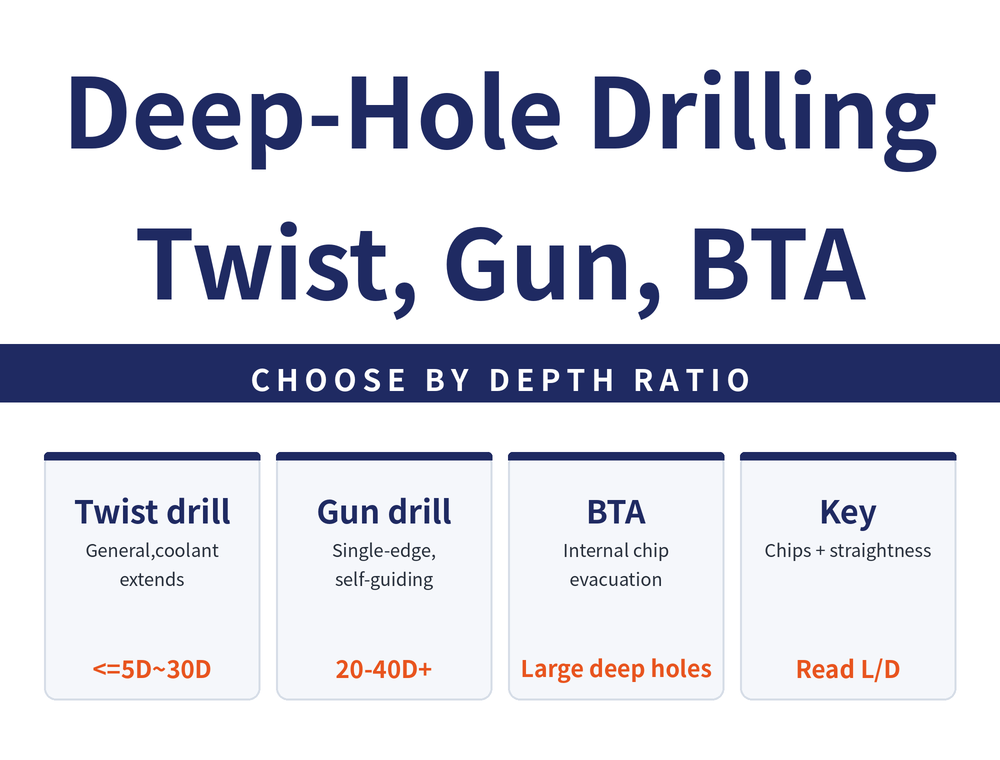
The three mainstream methods differ in chip evacuation direction and achievable L/D. The table gives typical ranges; real capability varies with the system and material.
| Method | Typical L/D range | Chip evacuation and cooling | Best suited to |
|---|---|---|---|
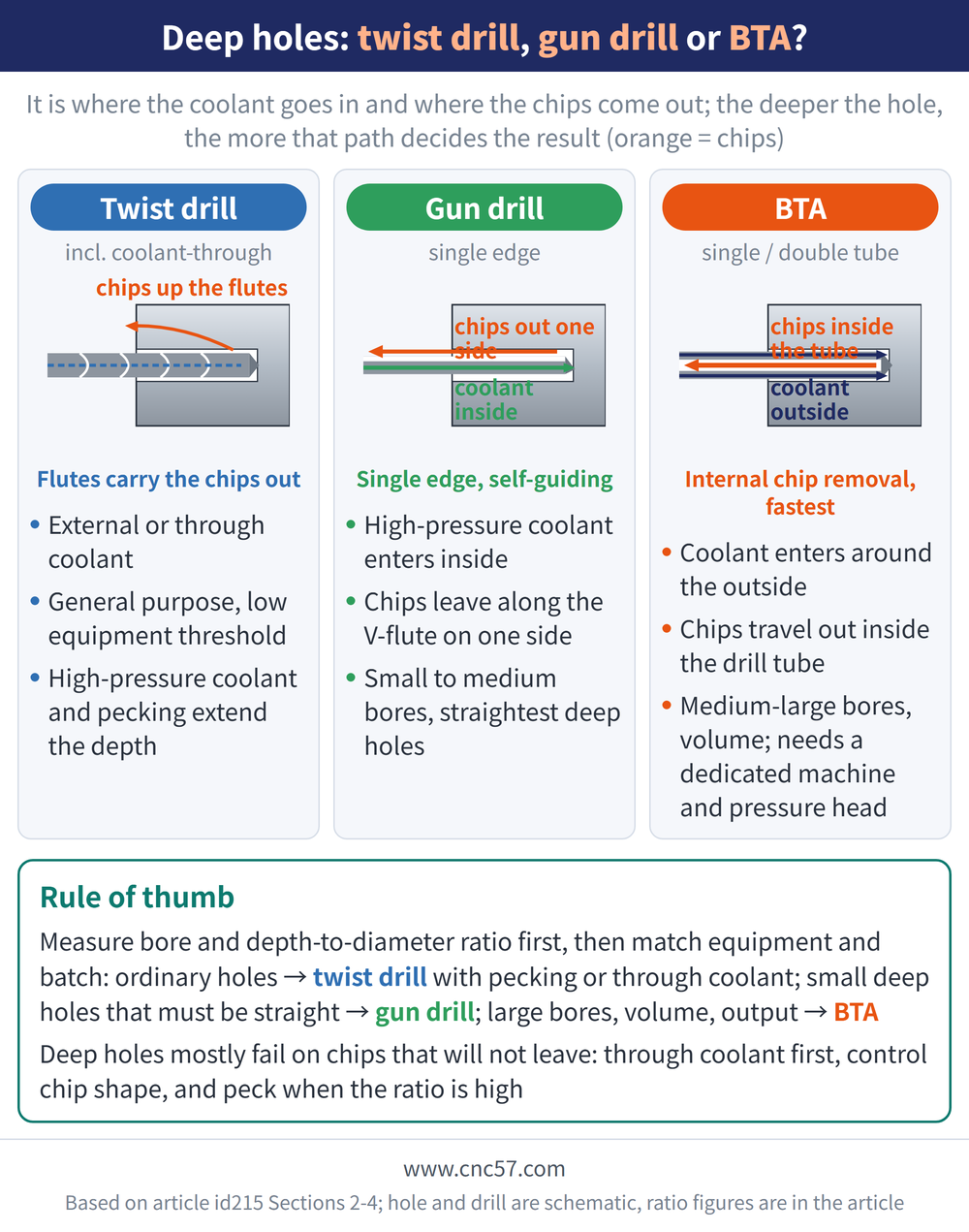
| Twist drill (incl. long through-coolant) | Generally L/D≤5; with high-pressure through-coolant and peck drilling it extends to about 10–30D (system dependent) | Helical flutes carry chips upward; external or through-tool coolant | General-purpose holes, low equipment barrier |
| Gun drill (single-flute) | Typically very high, about 20–40D and beyond | Single edge, self-guiding; high-pressure coolant fed internally, chips carried out one side along the V-groove | Small to medium diameters, high-straightness deep holes |
| BTA (single-tube / double-tube) | High L/D, high efficiency | Coolant enters through the outer annulus, chips exit through the inside of the drill tube | Medium to large diameters, high-volume deep holes |
L/D and diameter ranges are typical values; refer to the catalogue or standard. Actual limits shift with machine pressure, coolant system and material.
In one line: twist drills evacuate through the flutes and are general-purpose; gun drills evacuate on one side and hold straightness; BTA evacuates through the tube for the highest efficiency but needs a dedicated machine and pressure head.
3. Selection Logic: Diameter and L/D First, Then Equipment and Batch
The order is to measure diameter and L/D first, then match against the machines on hand and the batch size. The table below shows common correspondences.
| Situation | Recommended method | Reason |
|---|---|---|
| General hole, modest L/D | Twist drill + peck / through-coolant | Low equipment barrier, general-purpose; pecking and coolant clear the chips |
| Small deep hole, high straightness required | Gun drill | Single-edge self-guiding, excellent straightness, very high L/D |
| Large diameter, high volume, efficiency needed | BTA | Internal evacuation is highly efficient for production deep holes; needs a dedicated machine |
For peck settings, see Peck Drilling Guide; for the full route that brings hole accuracy into tolerance, see How to Improve Hole Accuracy; for deep-hole use of through-coolant drills, see Deep Hole Drilling Guide.
4. Chip Evacuation and Cooling Decide Deep-Hole Success
Most deep-hole failures trace back to chips that cannot get out: packed chips scratch the wall, raise torque and can snap the drill. Favour through-coolant, control the chip shape, and add peck drilling to break and clear chips at higher L/D.
For through-coolant methods and how through-coolant drills differ, see Through-Coolant Drill Guide; for how feed relates to chip shape, see Drilling Feed Rate vs Chip Formation.
Specific speeds, feeds and coolant pressures depend on material and diameter; calculate them via the Hole Machining Formula Handbook. This article lists no fixed figures.
Last updated: 2026-07-26
5. Frequently Asked Questions (FAQ)
Q: What L/D counts as a "deep hole"?
In practice an L/D of about 5 and above is generally treated as deep-hole drilling, where chip evacuation and straightness problems become pronounced. This is a typical threshold; refer to the catalogue or standard.
Q: How deep can a twist drill go?
A standard twist drill is generally L/D≤5; with a high-pressure through-coolant long drill and peck drilling it extends to roughly 10–30D. These are typical values; the real limit depends on machine pressure and the coolant system.
Q: How do gun drilling and BTA differ, and how do I choose?
A gun drill is single-edge with chips carried out one side along an external V-groove, suiting small to medium diameters at high straightness; BTA carries chips out through the drill tube at high efficiency, suiting medium to large diameters and high volumes, but needs a dedicated machine and pressure head. See Gun Drilling Guide: Structure, Self-Guiding and Practice for details.
Q: Why do deep holes wander, and how do I fix it?
Insufficient guidance and poor chip flow both make the drill deflect. Remedies are choosing a self-guiding method such as a gun drill, shortening overhang, drilling a pilot hole first, and strengthening through-coolant and peck evacuation.
For the full reading guides on this topic, see Chip Control: A Complete Reading Guide and Hole Accuracy: A Complete Reading Guide.
This article is part of Drill Bits: The Complete Guide - Start From Depth-to-Diameter, Then Pick the Drill and Set the Conditions; that guide shows how the whole topic fits together.