Peck Drilling: When You Need It and How to Set It
Peck drilling means drilling a little, then backing off, so chips clear out and coolant gets back in. Not every hole needs it — used in the wrong place it just wears the tool and lengthens cycle time. The key is judging when to peck, and how to set the retract amount and peck depth.
1. What Peck Drilling Actually Solves
In a deep hole, chips that cannot escape wrap the tool, pack the flutes, cause re-cutting and build up heat — at best scratching the wall, at worst snapping the drill. Peck drilling uses an interrupted retract to carry chips out and let coolant re-enter the bottom of the hole, pulling chip evacuation out of continuous cutting and handling it on its own.
Core idea
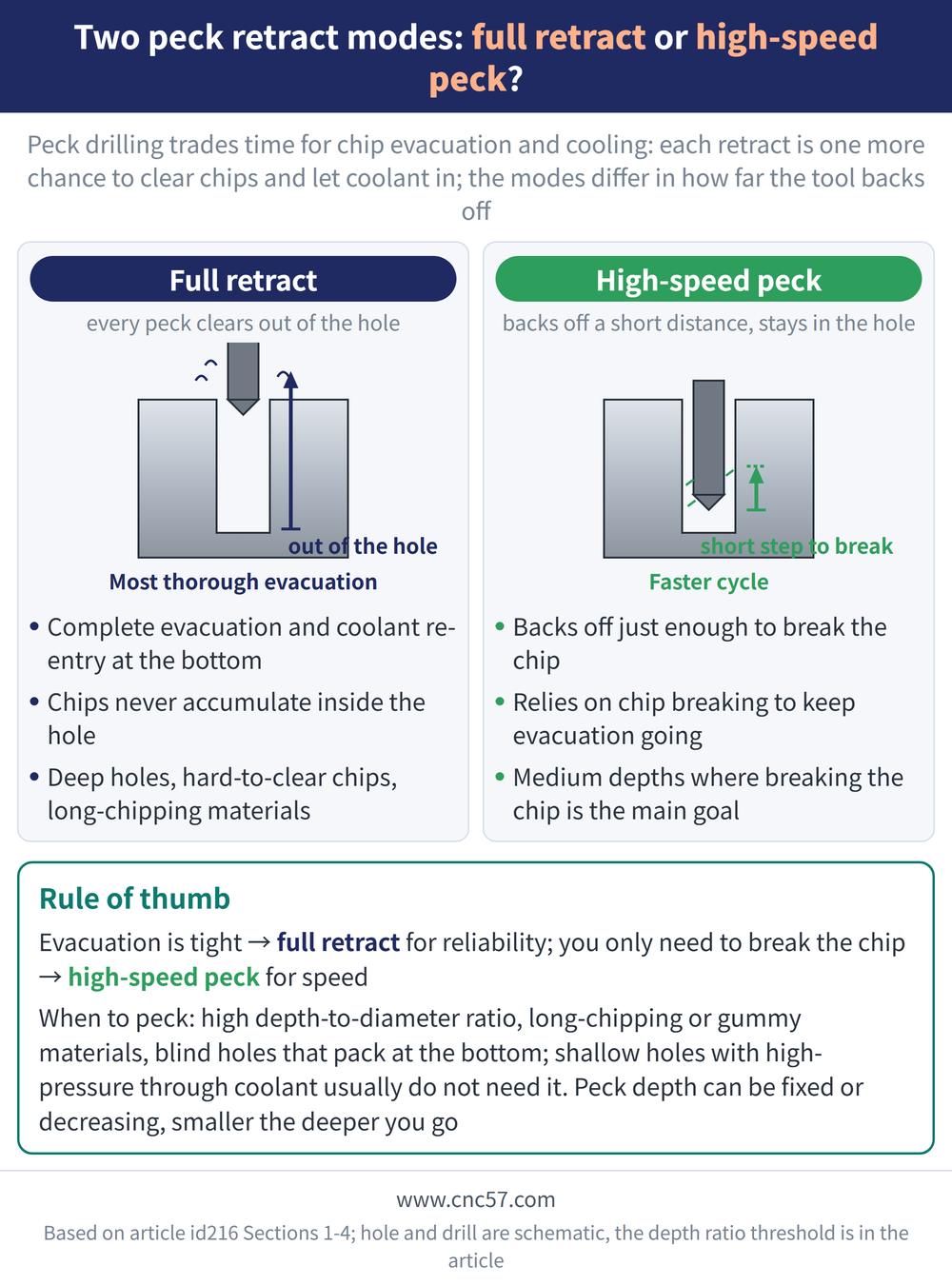
Peck drilling trades time for chip evacuation and cooling: each retract is one more chance to clear chips and let coolant in. The cost is a longer cycle, so peck only when the hole genuinely needs it.
2. Choosing Between the Two Retract Modes
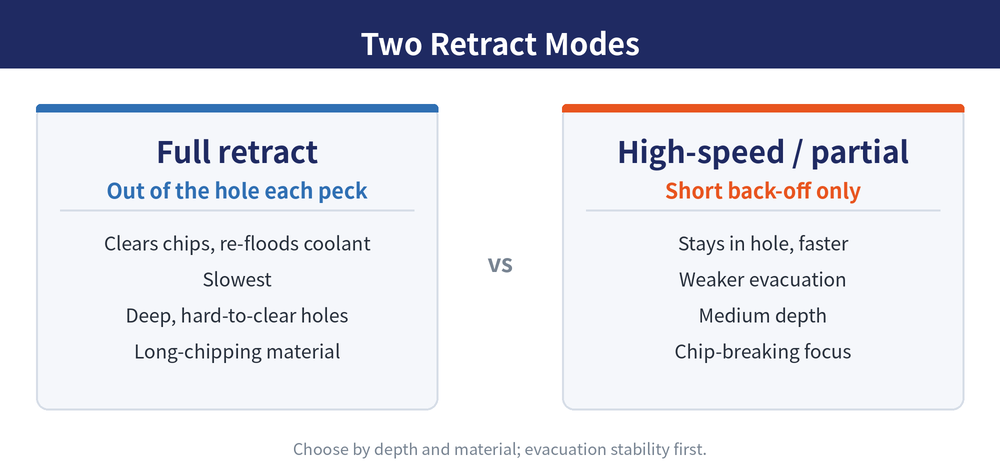
Peck drilling comes in two retract strategies, differing in how far the tool backs off and how much evacuation that buys:
| Mode | Action | Advantage | Best for |
|---|---|---|---|
| Full retract | Every peck clears right out of the hole for complete chip evacuation and re-entry of coolant | Most thorough evacuation; chips never accumulate inside the hole | Deep holes, hard-to-clear chips, long-chipping materials |
| High-speed / partial peck | Backs off only a short distance to break the chip, without leaving the hole | Faster cycle; relies on chip breaking to keep evacuation going | Medium depths where breaking the chip is the main goal |
In short: when evacuation is tight, full retract buys reliability; when you only need to break the chip, high-speed peck buys speed. For the overall deep-hole strategy, see the Deep-Hole Drilling Methods Overview.
3. When You Need to Peck
Whether to peck is not a matter of habit but of hole depth, the material's chip form and the cooling method. Use one table to decide:
| Situation | Peck drilling recommended? |
|---|---|
| High depth-to-diameter ratio (roughly L/D>3–5, typical) | Yes: the deeper the hole, the harder chips clear, so interrupted retracts are needed to clean them out |
| Long-chipping / gummy materials | Yes: chips resist breaking, so a retract is used to drag the whole chip out |
| Shallow holes with high-pressure through-tool coolant | Usually not: the internal coolant already flushes chips out, and pecking only lengthens cycle time |
| Blind holes where chips pack at the bottom | Yes: the bottom has nowhere to clear to, so a retract is needed to remove chips and avoid re-cutting |
The depth-to-diameter threshold is a typical value; refer to the catalogue or standard. Whether pecking is actually needed still depends on the material, cooling method and drill geometry.
If chip evacuation or chip wrapping is already going wrong, use the Drilling Troubleshooting Guide to find the root cause first, then decide whether pecking is the fix.
4. How to Set the Parameters
Peck depth can be fixed or decreasing: a decreasing scheme (smaller pecks the deeper you go) keeps chips from getting too long where evacuation is hardest. Match it with the right feed — too low actually causes rubbing and work hardening, especially when re-entering the cut at the hole bottom.
Specific speeds and feeds are not invented here; work them out by diameter and material with the Hole Machining Formula Handbook. For the principles of chip formation and chip breaking, see Drilling Feed Rate vs Chip Formation. For deep-hole-specific drills such as oil-hole drills, see the Deep Hole Drilling Guide.
Peck depth and the decreasing ratio are typical practice; refer to the catalogue or standard. Confirm actual values against the drill maker's recommendation and a trial cut.
Last updated: 2026-07-26
5. Frequently Asked Questions (FAQ)
Q: When is peck drilling a must?
A high depth-to-diameter ratio (roughly L/D>3–5, typical), long-chipping or gummy materials, and blind holes that pack chips at the bottom usually need pecking to carry chips out and let coolant back into the hole bottom.
Q: What is the difference between full retract and high-speed peck?
Full retract clears out of the hole on every peck — the most thorough evacuation but the slowest, suiting deep holes and hard-to-clear materials. High-speed peck backs off only a short distance to break the chip without leaving the hole — faster but with weaker evacuation, suiting medium depths where breaking the chip is the main goal.
Q: How much peck depth should I set?
Peck depth can be fixed or decreasing, with a decreasing scheme taking smaller pecks the deeper you go to avoid over-long chips. Actual values are typical practice — refer to the catalogue or standard — and compute speeds and feeds with the Hole Machining Formula Handbook, then confirm with a trial cut.
Q: Do shallow holes need pecking too?
Usually not. Shallow holes clear chips easily, and with high-pressure through-tool coolant flushing them out, pecking only lengthens cycle time — unless it is a blind hole packing chips at the bottom that needs a retract to clear them.
For the full reading guide on this topic, see Chip Control: A Complete Reading Guide.
This article is part of Drill Bits: The Complete Guide - Start From Depth-to-Diameter, Then Pick the Drill and Set the Conditions; that guide shows how the whole topic fits together.