Jobber, Stub and Taper Length Drill Bits: How Length Affects Rigidity
The same drill diameter comes in several lengths, and stub, jobber and taper length are not packaging variants — they are rigidity variants. The rule for choosing length is a single sentence: long enough to reach, and no longer. This article covers the length-rigidity relationship, how to read depth-to-diameter ratio, and when to stop extending the drill and switch systems.
1. Length governs rigidity, not how deep you can drill
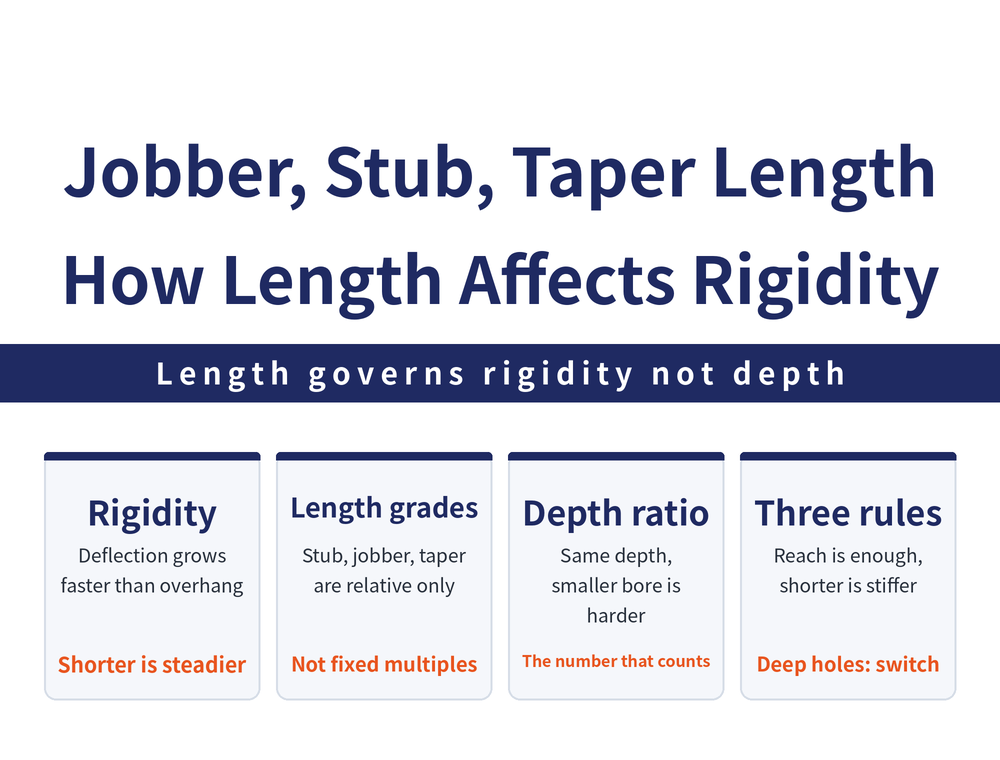
Drill length is often read as a "how deep can it go" specification. That is only half right. What length actually governs is rigidity — a drill is essentially a slender cantilever, and as overhang grows, deflection grows considerably faster than the length itself.
The consequences chain together: the drill wanders on entry, hole straightness degrades, vibration and noise rise, and the edge chips more readily. This is why the same hole often runs at higher parameters with a shorter drill. For the underlying principle see drill flute length and rigidity — that article covers the mechanics, this one adds the specification layer: what the length names in the catalogue actually mean.
2. The common length grades
Catalogues state overall length and flute length directly, but the named grades are what most people order by:
| Grade | Relative position |
|---|---|
| Stub | Shortest, stiffest |
| Screw machine | Between stub and jobber |
| Jobber | The general-purpose length, widest stock availability |
| Taper length / extra length | Longest, least rigid |
🔴 This table gives relative positions only, not fixed multiples. The actual flute and overall lengths for each grade are set by standards and individual manufacturer catalogues, and vary with diameter. The widely repeated "this grade equals so many times diameter" claims come from mixed sources — order to the actual dimensions in the catalogue you are buying from, rather than back-calculating from a multiple.
One further distinction: shank length is not flute length. What governs cutting rigidity is flute length and actual overhang, not overall length. For straight shank diameter and runout specifications see straight shank drill specification and runout.
3. Depth-to-diameter ratio: the number that actually matters
More than any length name, the depth-to-diameter ratio (L/D) maps directly onto difficulty. A 30 mm deep hole is 3D with a 10 mm drill and 10D with a 3 mm drill — entirely different propositions.
| Ratio | Usual approach |
|---|---|
| Shallow to moderate | Ordinary twist drill, choose the shortest that reaches |
| Deeper | Long-flute drill with pecking, or move to a coolant-fed long drill |
| Around 20D | Small-diameter coolant-fed drill solutions |
| 30D to 50D | Coolant-fed long drills |
| Deeper still | Dedicated systems: gundrilling, BTA and similar |
For each approach see small diameter deep hole drilling (20D), coolant-fed deep hole drilling (30D–50D) and deep hole drilling methods overview. For when to break the cut into steps see peck drilling.
4. Three rules for choosing length
One: long enough to reach, and no longer. The drill only needs to reach the bottom of the hole plus the necessary retract and clamping allowance. "Buy longer to be safe" is the most common and most expensive mistake — every extra millimetre converts directly into lost rigidity.
Two: shorter is stiffer. Given the reach requirement is met, always take the shortest available. This mirrors deep-hole practice, where even dedicated systems recommend a drill only slightly longer than the required hole depth.
Three: do not force deep holes with a longer drill. Past a certain depth ratio the problem stops being rigidity and becomes chip evacuation and coolant delivery — chips cannot get out and coolant cannot reach the edge, and no amount of drill stiffness solves either. At that point the system needs changing, not the length. For the overall route to hole accuracy see improving hole accuracy.
5. Frequently Asked Questions (FAQ)
Q: What length is a jobber drill bit?
Jobber is the general-purpose standard length grade and the one held in widest stock. Actual flute and overall lengths are set by the standard and by each manufacturer's catalogue, and should not be back-calculated from a diameter multiple.
Q: Is buying longer the safer choice?
No. Extra length converts directly into lost rigidity, bringing wander, poorer straightness and a higher risk of chipping. Choose the shortest drill that reaches.
Q: Should I go by length grade or depth ratio?
Depth ratio. Length grades describe only the tool; the depth-to-diameter ratio reflects the difficulty of the actual hole — for the same depth, a smaller diameter is significantly harder.
Q: Can deep holes be handled with an extra-length drill?
Only up to a point. Beyond a certain depth ratio the bottleneck shifts from rigidity to chip evacuation and coolant delivery, which a longer drill cannot fix. Move to a coolant-fed long drill or a dedicated gundrilling or BTA system.
This article is part of Drill Bits: The Complete Guide - Start From Depth-to-Diameter, Then Pick the Drill and Set the Conditions; that guide shows how the whole topic fits together.