Turning Troubleshooting Guide | Tool Wear, Accuracy and Surface Issues
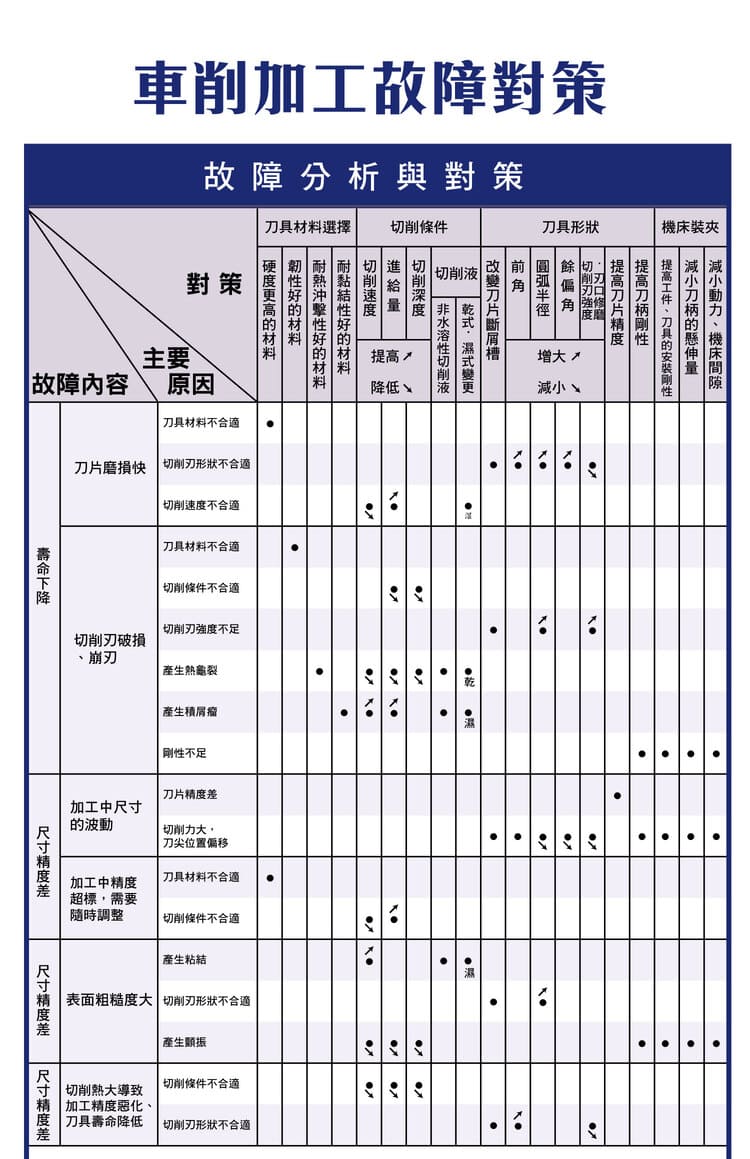
Common turning failures include insert wear, edge chipping, unstable dimensions, poor surface finish and inadequate chip control. Their root causes lie mostly in tool material selection, cutting-condition settings, tool geometry and machine rigidity. By adjusting cutting speed, feed rate, depth of cut and coolant supply, and by optimising tool angles and clamping stability, you can raise machining quality and tool life, cut the reject rate and improve productivity.
Turning Failure Categories
Main problem types: reduced tool life, dimensional accuracy errors, poor surface roughness, burr and edge chipping, and chip-handling problems.
Key influencing factors: tool material, cutting conditions, tool geometry, and machine rigidity.
Tool Life Problems
Rapid insert wear
| Cause | Countermeasure |
|---|---|
| Unsuitable tool material | Use a harder or more wear-resistant grade |
| Cutting speed too high | Lower the cutting speed |
| Unstable cutting conditions | Improve the coolant supply |
Tool breakage and edge chipping
| Cause | Countermeasure |
|---|---|
| Insufficient tool strength | Use a tougher grade |
| Excessive cutting load | Reduce the feed rate |
| Insufficient rigidity | Improve clamping stability |
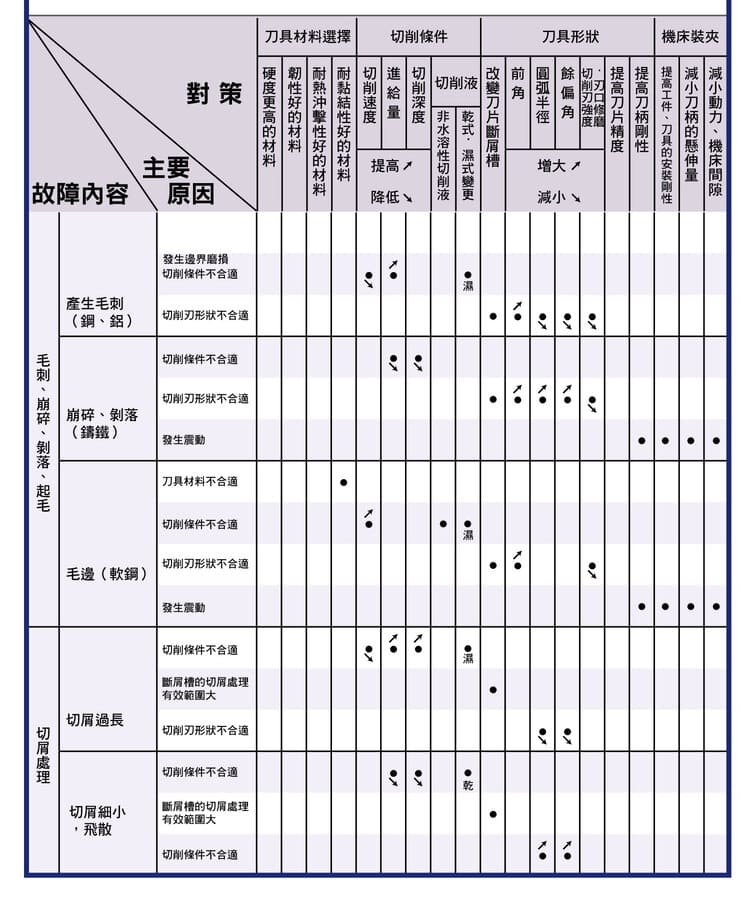
Dimensional Accuracy Problems
Dimensional variation during machining
| Cause | Countermeasure |
|---|---|
| Tool position offset | Improve tool-mounting accuracy |
| Varying cutting force | Stabilise the cutting conditions |
Insufficient machining accuracy
| Cause | Countermeasure |
|---|---|
| Unsuitable tool material or geometry | Select a suitable tool |
| Unstable cutting conditions | Optimise the cutting parameters |
Surface Quality Problems
High surface roughness
| Cause | Countermeasure |
|---|---|
| Poor cutting conditions | Reduce the feed rate |
| Tool wear | Replace the tool |
Built-up edge
| Cause | Countermeasure |
|---|---|
| Cutting speed too low | Raise the cutting speed |
| Cutting edge not sharp enough | Use a sharper tool |
Vibration and surface defects
| Cause | Countermeasure |
|---|---|
| Insufficient machine rigidity | Improve rigidity |
| Excessive tool overhang | Reduce the overhang |
Thermal Deformation and Dimensional Change
Thermal deformation degrades accuracy
| Cause | Countermeasure |
|---|---|
| Cutting temperature too high | Apply cutting fluid |
| — | Lower the cutting speed |
Shortened tool life
| Cause | Countermeasure |
|---|---|
| Heat build-up | Improve cooling |
| Increased friction | Optimise the cutting conditions |
Burr and Chipping Problems
Burr formation
| Cause | Countermeasure |
|---|---|
| Dull cutting edge | Use a sharper edge preparation |
| Poor cutting conditions | Adjust the feed rate |
Chipping and flaking
| Cause | Countermeasure |
|---|---|
| Uneven cutting load | Reduce the depth of cut |
| Insufficient tool strength | Use a tougher grade |
Chip Control Problems
Chips too long
| Cause | Countermeasure |
|---|---|
| Insufficient chip-breaking ability | Improve the chip-breaker design |
| — | Adjust feed rate and depth of cut |
Fine, scattered chips
| Cause | Countermeasure |
|---|---|
| Unstable cutting conditions | Stabilise the cutting parameters |
| — | Improve cooling |
Machining Optimisation Strategy
Tool selection: high-hardness and high-toughness grades, with suitable tool geometry.
Cutting conditions: control vc, f and ap.
Machine conditions: raise rigidity and suppress vibration.
Coolant strategy: use an appropriate cutting fluid.
Engineering Application Points
Key controls: tool material, cutting parameters, and clamping accuracy.
Machining results:
More stable dimensions
Better surface quality
Longer tool life
For measuring and cross-referencing surface roughness, see Surface Roughness Chart by Process.
FAQ
Why do turning inserts wear out so fast?
Usually unsuitable tool material, excessive cutting speed, or unstable cutting conditions; switch to a more wear-resistant grade, lower the speed, and improve cooling.
What causes unstable turning dimensions?
Often tool-mounting offset or varying cutting forces; improve mounting accuracy and stabilize the cutting parameters.
Why does built-up edge form on turned surfaces?
A cutting speed that is too low or a dull edge; raise the cutting speed and use a sharper tool to suppress it.
How do you control long or scattered chips in turning?
Long chips usually mean poor chip-breaking—improve chip-breaker geometry and adjust feed and depth; scattered fine chips mean unstable parameters—stabilize conditions and improve cooling.
For the full reading guide on this topic, see Surface Finish: A Complete Reading Guide.