
Machining Stainless Steel: The Complete Guide - Name the Family First, Then Set Tool, Data and Finish
Stainless does not cut hard because it is hard. The same tool behaves differently in 304 and in 420, and when it stops cutting, you have usually hardened the material yourself. This guide arranges everything on the site about stainless into the order a shop actually works in: name the family, understand why it resists, then pick the tool, set the data and finish the part. Jump to the section you need.
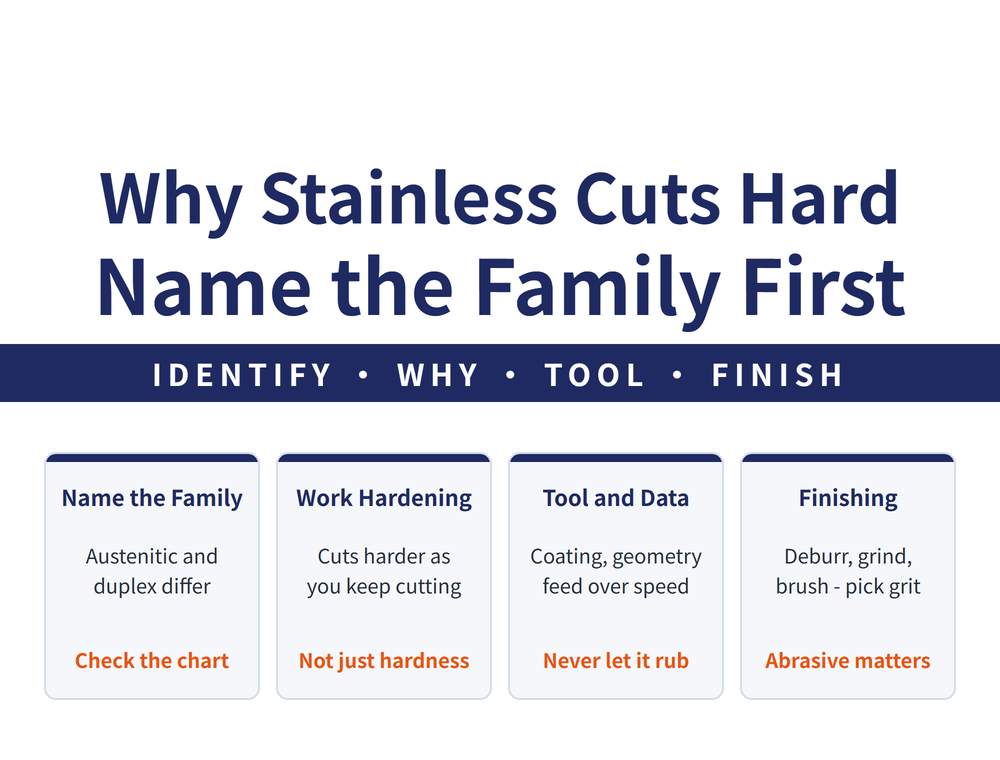
1. The Order of This Line: Family, Why, Tool and Data, Finish
These articles are not parallel - they run in sequence. Skip the first two steps and go straight to a cutting data table, and the numbers will not fit the bar in front of you:
| Step | What it answers | Section |
|---|---|---|
| 1 Name the family | 304, 316, 420, duplex - which group is this | Section 2 |
| 2 Know why | Why it resists even though it is not hard | Section 3 |
| 3 Tool and data | Grade, coating, cut direction and feed | Sections 4-5 |
| 4 Finish | Deburring, grinding, and whether to cut dry | Sections 6-7 |
Step one is where most people go wrong. Stainless is not one material, it is a family - austenitic grades work harden, martensitic grades can be hardened by heat treatment, duplex shows a bit of both. Treat them as one material and the settings will be well off.
2. Step One: Which Family Is This
Two articles cover this step. Confirm the code, then confirm the family - everything later only applies once the code matches.
| Article | When to read it |
|---|---|
| Stainless Steel Grade Cross-Reference | When you need to convert between SUS, AISI, DIN and EN, or find a substitute |
| ISO M Stainless Machining Guide | Once you know the code, to learn how that family behaves in the cut |
The split is simple: the cross-reference answers what it is called, the machining guide answers how it will behave. Looking up the code and going straight to cutting data skips the second question.
3. Why It Cuts Hard: Not Hardness, You Hardened It
"Hard to cut because it is hard" barely holds for stainless. 304 is softer than plenty of carbon steels and still gives more trouble.
| Article | When to read it |
|---|---|
| What Work Hardening Is | When it cuts harder as you go and the edge dulls quickly. The core mechanism here |
| ISO Workpiece Material Classification | When you want to know why stainless is its own M group, apart from P steels |
The point worth remembering about work hardening: it is the one mechanism your own method makes worse. Feed too light, a dull edge still in the cut, the wrong cut direction - all of them speed it up. So Section 5 is not only about efficiency, it is about not hardening the stock.
4. Tool and Coating: Grade First, Then Coating
Stainless pulls the tool choice in a different direction from carbon steel: sharp, free-cutting, able to take the heat, rather than simply harder.
| Article | When to read it |
|---|---|
| Tool Material Classes P M K N S H | When you are choosing the tool grade at the P M K N S H level |
| Tool Material and Coating by Workpiece | Once you know it is the M group, to match a specific grade and coating |
The two run in opposite directions but meet at the same decision: one starts from the tool, the other from the workpiece. Use the second to narrow the field to what suits the M group, then use the first to check the tool in your hand is one of them.
5. Process by Process: Turning, Milling, Drilling, Tapping
This is the longest section, but you do not need all of it - read the row for the operation you are about to run.
| Article | When to read it |
|---|---|
| Turning Cutting Conditions Guide | Turning stainless, when you need to set speed and feed |
| Peck Rhythm for Deep Holes on a Lathe | Drilling a deep hole on the lathe, when you need a peck interval |
| Climb Milling vs Conventional Milling | Milling stainless. Cut direction feeds straight into work hardening |
| Drilling Parameters Guide | Drilling stainless, when you need speed and feed |
| Tap Breakage Solved by Regrinding | When taps keep breaking and you want to look at the point geometry |
All four share one floor: never let the tool sit in the cut and rub. Dwelling, a feed that is too light, a hesitant retract - each costs more in stainless than in carbon steel, because those few seconds are exactly when the hard layer from Section 3 is being made.
6. Finishing: Deburring, Grinding and Brushes
Finishing stainless is not the steel method one size down. Pick the wrong abrasive and you will heat the surface until it discolours.
| Article | When to read it |
|---|---|
| Deburring and Finishing by Material | When deburring and surface work has to follow the material |
| Choosing the Abrasive Grain | When parts are heating or discolouring, or the grain choice is unclear |
| Grinding Parameters by Material | When you need grinding parameters for stainless |
| Choosing a Wire Brush | When a brush is doing the deburring or the surface work |
One detail gets missed here: abrasives and brushes that have touched carbon steel should not go near stainless. Embedded iron particles rust on the surface, and that is not the stainless failing.
7. Should You Cut It Dry
Stainless is the family most likely to go wrong dry, but it is not impossible - it depends what you put in place instead.
| Article | When to read it |
|---|---|
| How to Do Dry Milling | When dry milling stainless and you need the right set of measures |
| Choosing a Cutting Fluid | When choosing between soluble, neat oil and minimum quantity lubrication |
The rule is short: the heat and the sticking in stainless both have to be held down by lubrication. Take it away and the support has to come from somewhere else - grade, coating, geometry and chip evacuation. Drop one and you are back in the Section 3 loop.
8. Frequently Asked Questions (FAQ)
Q: Do 304 and 316 machine the same way?
Broadly yes. Both are austenitic, both work harden, and the tool and cut-direction principles carry across. The difference is that 316 contains molybdenum and is slightly tougher and gummier, so under the same conditions tool life is usually shorter and it sticks more readily. In practice, set up as for 304, revise the tool life expectation down, and make sure lubrication is generous. For codes and composition, see Stainless Steel Grade Cross-Reference in Section 2.
Q: Why does stainless, which is not very hard, cut worse than harder steels?
Because hardness is not the only reason a material resists. Austenitic grades work harden, so the layer the tool has passed through is harder than the original and the next pass is chewing on it. Conduction is poor, so heat stays at the edge instead of leaving with the chip. It is also tough and prone to sticking. None of those three is a hardness effect - see What Work Hardening Is in Section 3.
Q: Where should I start in this line?
It depends on what you have. Only a code and no idea of the family, start at Section 2. Family known and a tool to choose, jump to Section 4. Already cutting and it is going badly, read Section 3 then return to Section 5 for your operation. Only finishing left, go straight to Section 6. This line is deliberately not meant to be read end to end.
Q: How is this different from Workpiece Materials Complete Guide?
Different scope. That one runs across: how every material is classified and how the class points to a tool, with one entry per ISO group. This one runs down a single group, from naming the grade to finishing the part. If you are not yet sure which group your stock belongs to, read that one first. Once you know it is stainless, stay here.
Published: 2026-09-25 | Last updated: 2026-09-25









