
Machining Titanium and Superalloys: The Complete Guide - Heat Has Nowhere to Go, from Grade to Cooling
Titanium and heat-resistant alloys are hard to machine because the heat has nowhere to go. Conduction is poor, so cutting heat stays at the edge instead of leaving with the chip, and tools burn faster than in anything else. On top of that the material work hardens. This guide puts everything on the site about this group into working order: name the alloy, understand why it burns tools, then pick the tool, set the data, get the heat out and finish the part.
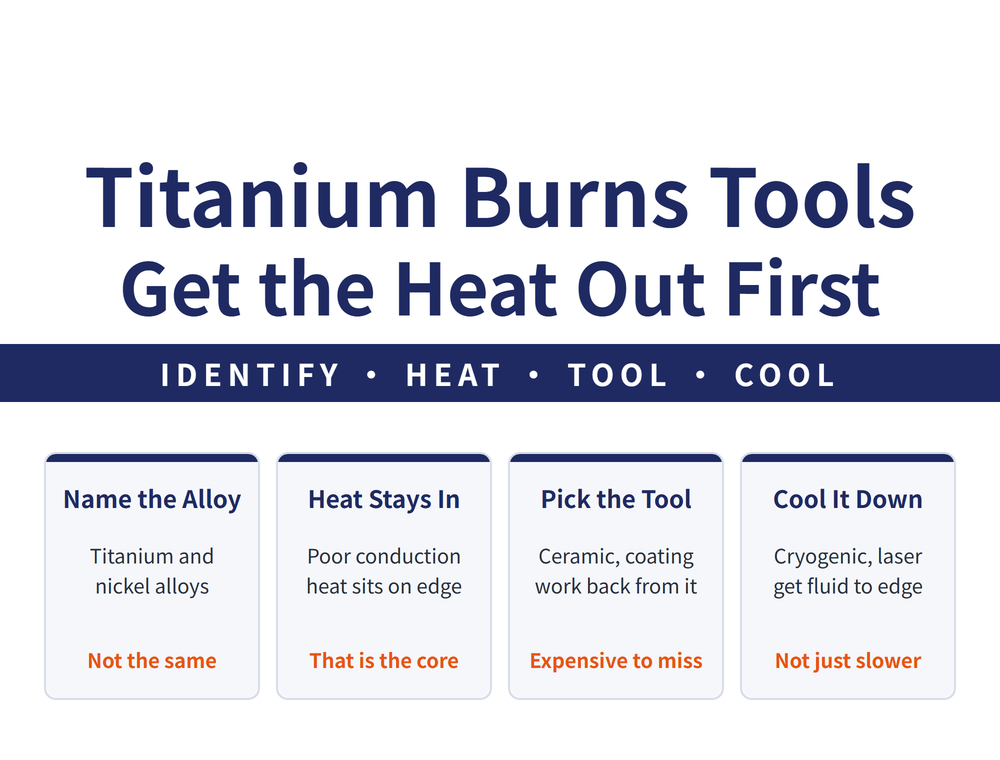
1. The Order of This Line: Alloy, Heat, Tool and Data, Cooling
This is the most expensive group on the site - tools cost more, cycles run longer, and getting it wrong costs more than a few minutes. The order is worth following more strictly here than anywhere else:
| Step | What it answers | Section |
|---|---|---|
| 1 Name the alloy | Titanium or nickel-base - the two differ | Section 2 |
| 2 Know why | Why the heat will not leave and tools burn | Section 3 |
| 3 Tool and data | Grades and coatings that hold up hot | Sections 4-5 |
| 4 Cool and finish | Getting heat out, and grinding afterwards | Sections 6-7 |
Many shops treat this group as "harder steel" and do one thing about it: drop the speed. Lower speed does make less heat, but it also keeps the tool in the cut longer, and dwelling is exactly what this group punishes. Section 6 covers the better route.
2. Step One: Titanium or Nickel-Base Superalloy
Both sit in the ISO S group, but they behave differently and one recipe will not cover both. Place your stock first.
| Article | When to read it |
|---|---|
| ISO S Titanium and Superalloy Guide | To learn how this group behaves in the cut. Read this one first |
| Reading Aluminium and Titanium Grades | When you see a code such as Ti-6Al-4V and want the grade rules |
The distinction pays off concretely: titanium leans towards chemical reactivity and elastic recovery, nickel-base alloys towards hot strength and severe work hardening. Both burn tools, but what you are holding down is different, and the tool choice in Section 4 forks accordingly.
3. Why Tools Burn: The Heat Stays, and It Work Hardens Too
The core problem is one sentence: the heat that should leave with the chip stays on the cutting edge instead.
| Article | When to read it |
|---|---|
| What Work Hardening Is | When it cuts harder as you go and the edge dulls fast. This group does it too |
| ISO Workpiece Material Classification | When you want to know why S is its own group, apart from P and M |
The two effects compound: heat softens the edge and speeds up wear, a dull edge makes work hardening worse, and that makes more heat. This is why tools in this group often do not dull gradually but fail suddenly - once one link in the chain goes, the rest follows quickly.
4. Tool and Coating: The Ones That Hold Up Hot
The test here is the opposite of steel: ask whether it keeps its hardness hot, before asking how hard it is cold.
| Article | When to read it |
|---|---|
| Ceramic Cutting Tool Guide | When cutting heat-resistant alloys with ceramics and choosing a type |
| Tool Coating Types at a Glance | When choosing between coatings from TiN through to AlCrN |
| Tool Material and Coating by Workpiece | Once you know it is the S group, to match a specific grade and coating |
One common misreading is worth clearing up first: titanium-based coatings do not exist for cutting titanium. A coating name says nothing about the workpiece it suits. What matters is its temperature limit and friction behaviour, and all three articles cover that.
5. Process by Process: Milling, Drilling, Threading, Tapping
You do not need all of this section - read the row for the operation in front of you. None of the four is titanium-only, but each has a section for this group.
| Article | When to read it |
|---|---|
| End Mill Cutting Conditions Guide | Milling titanium, when you need surface speed and feed per tooth |
| Drill Points by Material | When drills keep burning and you want to change the point geometry |
| External Thread Machining Parameters | Turning ISO, UNC or NPT external threads, setting depth and passes |
| Tap Breakage Solved by Regrinding | When taps keep breaking and you want to look at the regrind |
All four share one floor: once the tool is in, keep it cutting - no dwelling, no air passes, no rubbing over the same spot. There is no "go gently" option in this group, because a light cut is exactly what work hardening feeds on.
6. Cooling and Coolant Delivery: Better Than Just Slowing Down
If the problem is that the heat cannot leave, the answer is to carry it away actively, not to make slightly less of it.
| Article | When to read it |
|---|---|
| Cryogenic and Laser Assisted Cooling | When normal coolant is not holding it and you are weighing cryogenic or laser assist |
| Choosing a Cutting Fluid | When choosing between soluble, neat oil and minimum quantity lubrication |
Coolant here carries an extra requirement: the fluid has to actually reach the edge. Flood from outside barely enters a deep hole or a closed corner, and not reaching the edge is the same as not supplying it. Through-tool delivery, pressure and nozzle angle are not optional extras in this group.
7. Finishing: This Group Is Fussy About Abrasives
Grinding afterwards cannot follow the steel method either. This group is even fussier about abrasive choice than it is about cutting tools.
| Article | When to read it |
|---|---|
| Grinding Parameters by Material | When you need grinding parameters for titanium |
| Choosing the Abrasive Grain | When parts are heating and discolouring, or the grain choice is unclear |
What is at stake here is not only efficiency: titanium swarf is fine and reactive, and discolouration from over-grinding is a reject in many contexts. Read the grain selection and the parameter article together.
8. Frequently Asked Questions (FAQ)
Q: Can titanium and nickel-base superalloys use the same approach?
Broadly yes, in detail no. Both are ISO S, both conduct heat poorly and both work harden, so "keep the tool cutting, get coolant to the edge, choose grades that hold up hot" carries across. The difference is that titanium shows more chemical reactivity and elastic recovery, while nickel-base alloys are more stubborn hot and work harden harder. Place your stock with ISO S Titanium and Superalloy Guide in Section 2, then go to Section 4 for the tool.
Q: Why is slowing down not enough for titanium?
Because lower speed only addresses making less heat, not the heat being unable to leave. Slower means the tool stays in the cut longer, so more heat accumulates at the edge, and a light cut is exactly the condition work hardening prefers. The more effective direction is to carry the heat away while keeping a real feed per tooth - see Cryogenic and Laser Assisted Cooling in Section 6.
Q: Where should I start in this line?
It depends on what you have. Only a grade code and no idea whether it is titanium or nickel-base, start at Section 2. Alloy placed and a tool to choose, jump to Section 4. Already cutting and burning tools, read Section 3 then go straight to Section 6. Only grinding left, go to Section 7. This line is deliberately not meant to be read end to end.
Q: How is this different from Workpiece Materials Complete Guide?
Different scope. That one runs across: how every material is classified and how the class points to a tool, with one entry per ISO group. This one runs down a single group, from naming the alloy to grinding the finished part. If you are not yet sure which group your stock belongs to, read that one first. Once you know it is ISO S, stay here.
Published: 2026-09-25 | Last updated: 2026-09-25









