How to Choose a Carbide Drill Bit: Solid Carbide vs HSS, Types and Material Fit
The most common mistake in choosing a carbide drill bit is treating it as "a more expensive, longer-lasting HSS drill". The real difference is geometric — solid carbide drills all but eliminate the chisel edge, and that single change alters both self-centring ability and how the operation sequence is planned. This article covers the substrate difference, the positioning of the three drill types, an ISO material-group matrix, and the four questions to settle before choosing.
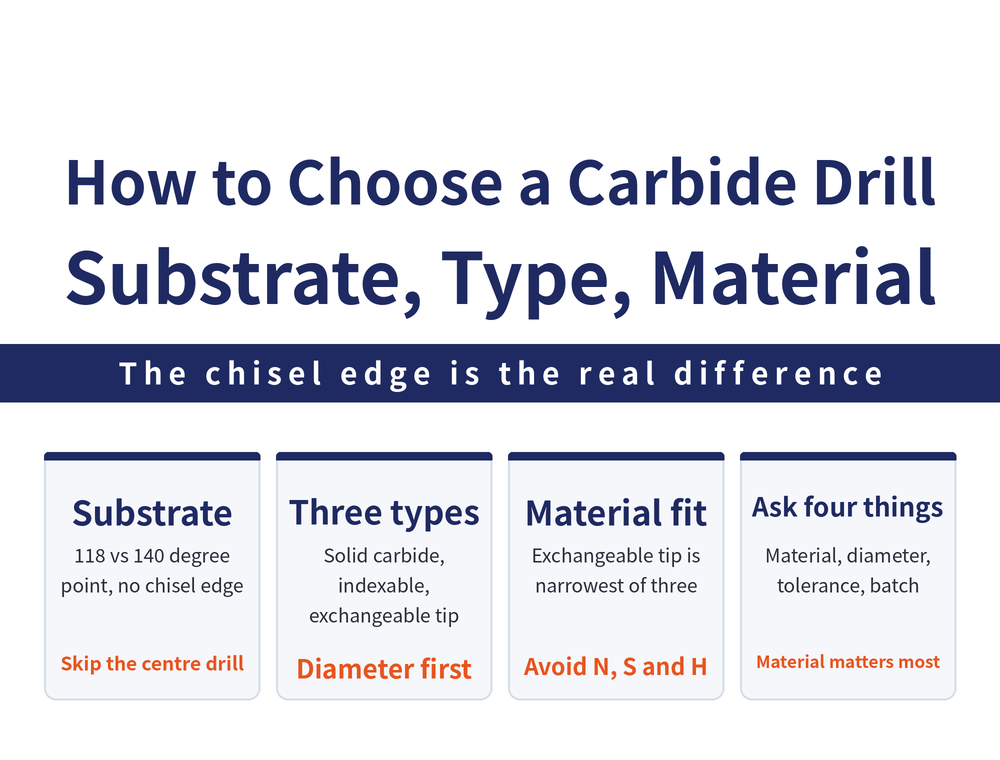
1. The difference between carbide and HSS is the chisel edge
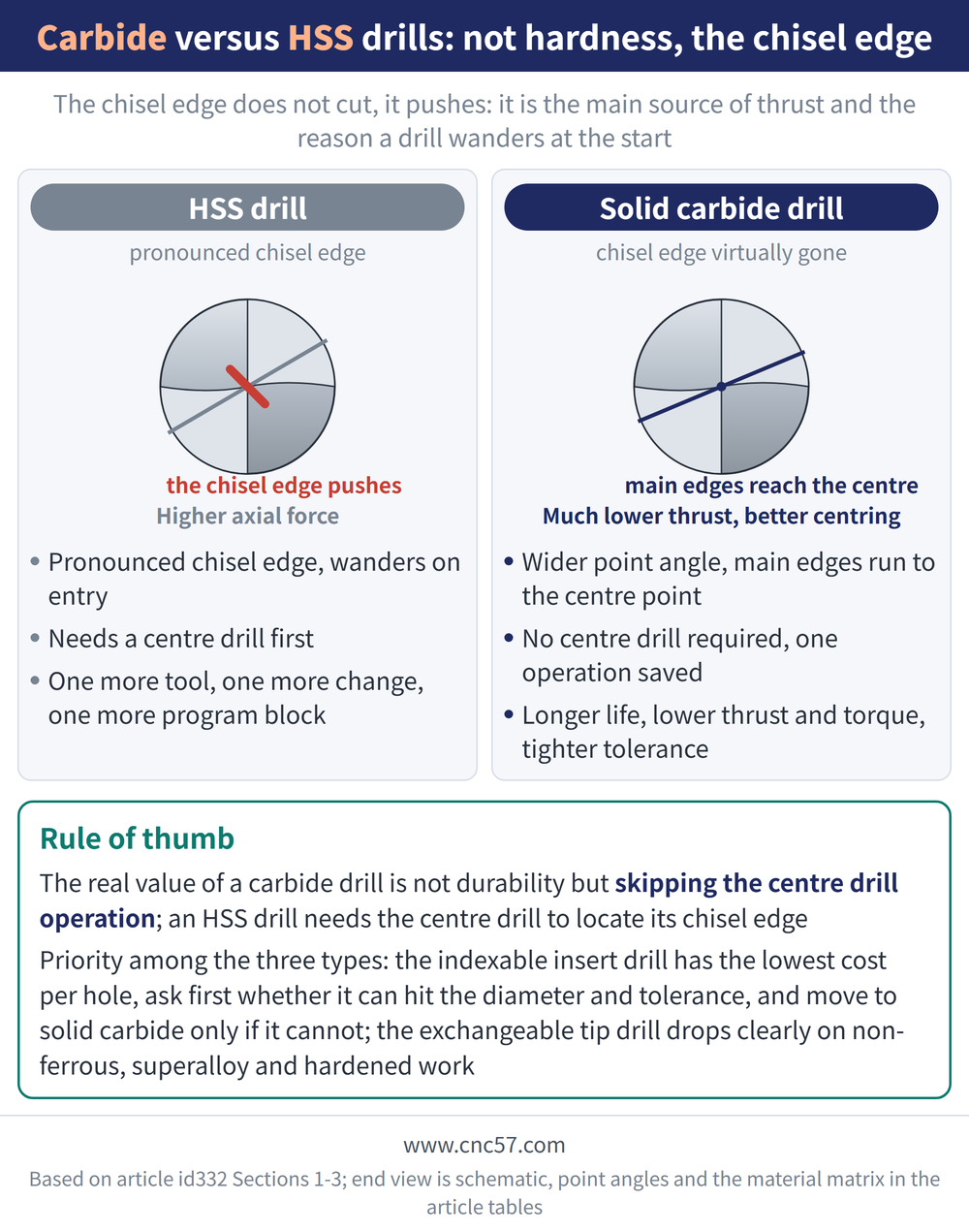
The substantive difference is not hardness but the chisel edge — the short edge where the two main cutting edges meet at the drill centre.
| Item | HSS drill | Solid carbide drill |
|---|---|---|
| Point angle | 118° | 140° |
| Chisel edge | Pronounced | Virtually eliminated |
| Axial cutting force | Higher | Markedly lower |
| Centring | Needs a centre drill first | No centre drill required |
The chisel edge does not cut so much as extrude. It is the main source of axial force and the reason a drill wanders on entry. A solid carbide drill lets the main cutting edges reach the centre point, so the chisel edge all but disappears, axial force falls and centring improves.
The cost implication matters more than the quality one: an operation disappears. No centre drilling means one fewer tool, one fewer tool change and one less block of program. For centre drill specifications see the centre drill guide, and for terminology see drill bit anatomy explained.
The remaining advantages of solid carbide follow from this: longer life, lower thrust and torque, tighter tolerances. For the HSS grade system see HSS grade decoding.
2. Three types: start with diameter and tolerance
| Type | Diameter | Tolerance | Characteristics |
|---|---|---|---|
| Solid carbide drill | Small, widest hole-depth range | Close or precision | First choice for small holes and tight tolerances |
| Indexable insert drill | Medium to large | Medium | Lowest cost per hole; flat-bottom blind holes, plunging or boring; highly versatile |
| Exchangeable tip drill | Medium | Close | Steel body for strength; an economical compromise |
The source states an explicit priority: the indexable insert drill has the lowest cost per hole and should always be considered first (compiled from the Sandvik technical handbook as a manufacturer recommendation; follow the catalogue and your own conditions in practice). In other words, the first question in selection is not "which is most accurate" but "can an indexable drill hit this diameter and tolerance" — if it can, use it; only if it cannot should you move to solid carbide. For detail see the indexable drill guide.
3. Six material groups: the exchangeable tip drill is the narrowest
| Drill type | P steel | M stainless | K cast iron | N non-ferrous | S superalloy | H hardened |
|---|---|---|---|---|---|---|
| Solid carbide drill | +++ | +++ | +++ | +++ | +++ | +++ |
| Indexable insert drill | +++ | +++ | +++ | +++ | +++ | +++ |
| Exchangeable tip drill | +++ | +++ | +++ | ++ | ++ | + |
Solid carbide and indexable insert drills hold the highest rating across all six groups, giving them the widest scope; the exchangeable tip drill drops clearly on the difficult groups (N, S, H). The practical rule: even when diameter and tolerance sit in the exchangeable tip drill's sweet spot, if the workpiece is non-ferrous, a superalloy or hardened steel, prefer one of the other two. For ISO group classification see how to read insert material codes.
4. Four questions to settle first
| Question | What it governs |
|---|---|
| What is the workpiece material | The most important item. Governs geometry and coating — austenitic stainless, for instance, wants a long-curl design, thinner web and point-flute geometry, while martensitic grades accept a general-purpose drill |
| How large is the hole | Small favours solid carbide; larger shifts to indexable or modular, where the cost gap is significant |
| Depth and tolerance | Decides whether a dedicated deep-hole method is needed, and whether a finishing operation must be reserved |
| Batch size and machine | Low volume across materials favours general-purpose; high volume on one material is where material-specific geometry repays its cost |
Two points that get skipped. First, solid carbide drills generally have through coolant, which raises productivity whatever the material — confirm the machine can supply the pressure. For coolant-fed drill types see the through-coolant drill guide. Second, match coating to the workpiece: AlTiN-family coatings are the usual direction for high-temperature conditions, and coating positioning is covered in common tool coating materials.
Cutting conditions are out of scope here; for conversion and setting see the drilling parameters guide, and for whether to regrind a dull drill see carbide drill regrinding.
5. Frequently Asked Questions (FAQ)
Q: Can a carbide drill really skip the centre drill?
A solid carbide drill virtually eliminates the chisel edge and its main cutting edges reach the centre point, so centring is clearly better than HSS and a centre drill is normally unnecessary. Angled or irregular entry faces still need separate assessment.
Q: Solid carbide or indexable insert drill?
Start with diameter and tolerance. The indexable insert drill has the lowest cost per hole and should be evaluated first at medium and large diameters; move to solid carbide when the hole is small or the tolerance tight.
Q: The exchangeable tip drill is cheaper — when should it be avoided?
On non-ferrous metals, superalloys and hardened steel. Its suitability rating on those three groups is clearly below the other two types, even where diameter and tolerance would fit.
Q: General-purpose or material-specific drill?
It depends on batch size. General-purpose pays off when volumes are low and materials vary; material-specific geometry only recovers its cost at high volume on a single material.
This article is part of Drill Bits: The Complete Guide - Start From Depth-to-Diameter, Then Pick the Drill and Set the Conditions; that guide shows how the whole topic fits together.